

Can Mediation Resolve Divorce And Child Custody Issues In Singapore?
| Mediation can settle most of what a divorce turns on: custody, care and control, access, maintenance and the division of assets. It cannot dissolve the marriage. Only the Family Justice Courts do that, in two stages at least three months apart. Couples who agree everything before filing use the simplified track. Those who do not face a normal track the courts say may run 12 to 18 months. Parents of children under 21 have to complete the Mandatory Co-Parenting Programme before filing at all. Short version: mediation decides how much of the divorce a judge has to decide. That is a bigger difference than it sounds. |
The short answer
Yes, for most of it. Mediation can resolve nearly every question a divorcing couple in Singapore has to answer, and in practice it resolves them faster and at lower cost than a contested hearing.
What it cannot do is end the marriage. That remains a judicial act. A couple can mediate every issue between them and still need the court to grant an interim judgment and, ordinarily no sooner than three months later, a final one. Mediation changes what the court is being asked to decide, not whether the court is involved.
Before deciding whether mediation is appropriate, separating spouses can consult Jacque Law’s guide to divorce in Singapore for an overview of the legal process and the issues that may need to be resolved.
What mediation is doing in a Singapore divorce
Singapore’s Family Justice Courts operate on a stated principle of therapeutic justice: the system treats a divorce as a family reorganizing itself rather than a dispute to be won. Mediation is the practical expression of that. A neutral third party helps two people reach terms they both accept, instead of two lawyers persuading a judge to impose terms neither chose.
Two features of the local process will look unfamiliar to anyone used to a US-style mediation.
First, mediation here is not purely elective. Where a case involves children, the courts may direct parties to the Family Dispute Resolution Division rather than leaving the choice to them.
Second, a separate requirement sits even earlier in the sequence. Under section 94A of the Women’s Charter, parents with children below 21 must complete the Mandatory Co-Parenting Programme before a divorce application can be filed. It runs as an e-learning module plus a consultation with a counsellor, and its purpose is to get parents thinking about the effect on the children before positions harden.
What actually gets settled
The negotiable content of a divorce falls into three groups, and mediation reaches all three.
| Issue | What is being agreed | Why it settles well in mediation |
|---|---|---|
| Custody | Who makes major decisions on schooling, healthcare and religion | Joint custody is the common outcome anyway, so the argument is usually about trust, not law |
| Care and control, and access | Which parent the child lives with, and the other parent’s time | Depends on school runs, work patterns and housing, which parents know better than a court can |
| Maintenance | Support for a spouse and for the children | Turns on real budgets that both sides can see |
| Division of assets | The matrimonial pool, including property and pensions | Trade-offs across several assets are easier to construct privately than to litigate |
The custody vocabulary is worth pausing on, because it is where foreign practitioners most often mistranslate. Singapore separates custody, meaning decision making authority over major matters, from care and control, meaning who the child lives with day to day, from access, meaning the other parent’s contact. A parent can hold joint custody and no care and control. That is a common order, and it means something quite different from the US shorthand of joint legal and physical custody.
Agreed and contested, described neutrally
Neither route is the virtuous one. They are different tools.
An agreed resolution produces terms the parties designed, arrives faster, costs less, and leaves two people who still have to raise children together with something other than a judgment to point at. It requires both of them to negotiate in reasonable faith and to disclose honestly.
A contested hearing produces a decision by a judge on evidence, with the court’s powers of disclosure and enforcement behind it. It is slower and more expensive. It is also the correct answer when one side will not disclose, when there is a genuine and unbridgeable dispute of fact, or when the imbalance between the parties is such that a negotiated deal would not be a real agreement.
The timing difference is visible in the tracks. Where the couple has agreed, the divorce and the ancillary matters in advance, the case runs on the simplified track. Where they have not, the Family Justice Courts indicate the normal track may take 12 to 18 months.
When mediation is the wrong instrument
Mediation depends on two conditions: both people can bargain freely, and both are telling the truth about what they have. Where either fails, mediating anyway produces a worse outcome than litigating, and it produces it slowly.
Circumstances that should prompt a hard look:
- Family violence, or a pattern of coercive control. The imbalance does not stay outside the room, and a mediator is not positioned to correct it.
- Suspected non-disclosure. A settlement built on a picture of the assets that one side knows is incomplete is not a settlement. Court process exists precisely to compel disclosure.
- Cross-border assets or an overseas parent. Not automatically unsuitable, but agreements here need to be enforceable in another jurisdiction, which is a drafting question before it is a negotiating one.
- Deadlock on a matter of principle. Relocating a child to another country is rarely a matter that splits down the middle.
Partial mediation is often the right answer in these cases. Settle the finances, put the children’s arrangements to the judge, and stop treating the choice as all or nothing.
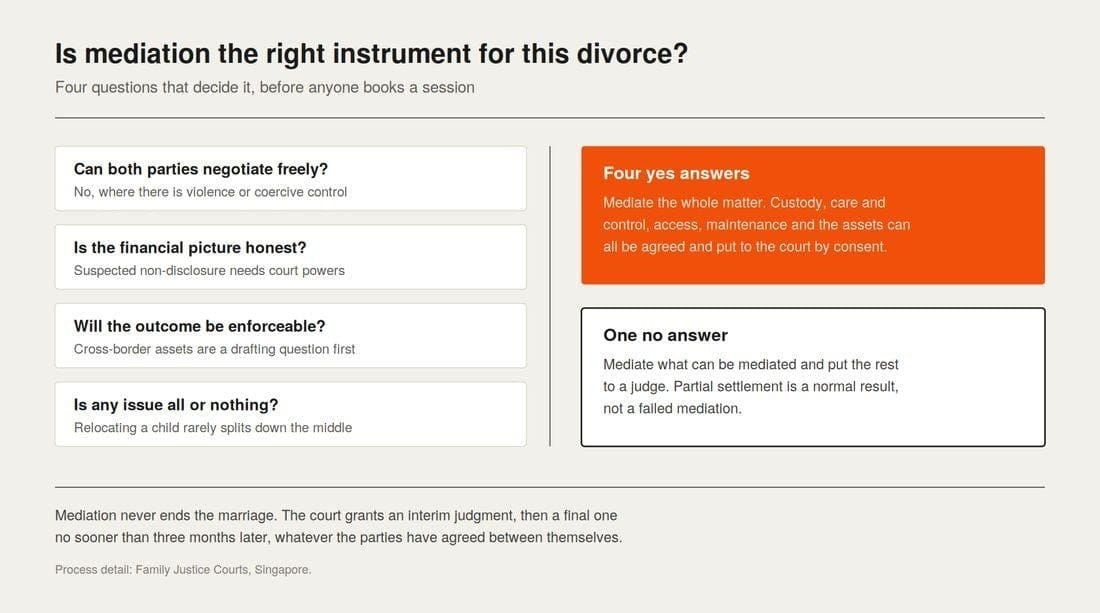
A no on any one of these is a reason to mediate less, not to abandon mediation.
Why advice comes before signature, not after
The most expensive mistake in a mediated divorce is signing something both parties understood differently.
Terms reached in mediation are typically recorded in a draft consent order and placed before the court. Once that order is made it binds. Reopening it is possible in limited circumstances, but the threshold is high and the attempt is not cheap.
So each spouse needs to know, before agreeing: what a court would be likely to order on these facts, what the agreement gives up against that baseline, whether the deal is enforceable where the assets sit, and how it will actually work in eighteen months when someone changes job or country. Someone accepting a smaller share of an asset pool in exchange for the family home should know what that trade is worth. A mediator, being neutral, is not the person who can tell them.
The same preparation discipline applies wherever a divorce is filed. Our own checklist of what to know before filing covers the ground for US jurisdictions, and the Family Justice Courts set out the Singapore position on mediation and counselling directly. The pre-filing requirement for parents is explained by MSF on its Mandatory Co-Parenting Programme page.
Mediation is not a softer version of a divorce. It is the same divorce, with the parties deciding more of it themselves. Whether that is the right call depends on whether both of them can.














