How to File a Bicycle Accident Claim After a Dooring Crash in Chicago: Who’s Liable?
[In Chicago, you generally have 2 years to file a bicycle dooring injury lawsuit under Illinois law. Dooring crashes are common on busy corridors with curbside parking and bike lanes, and liability can fall on drivers, passengers, employers, or even government entities. This article explains who’s liable, what evidence proves a dooring claim, and how to file and protect your case.]
What Counts as a “Dooring” Crash in Chicago?
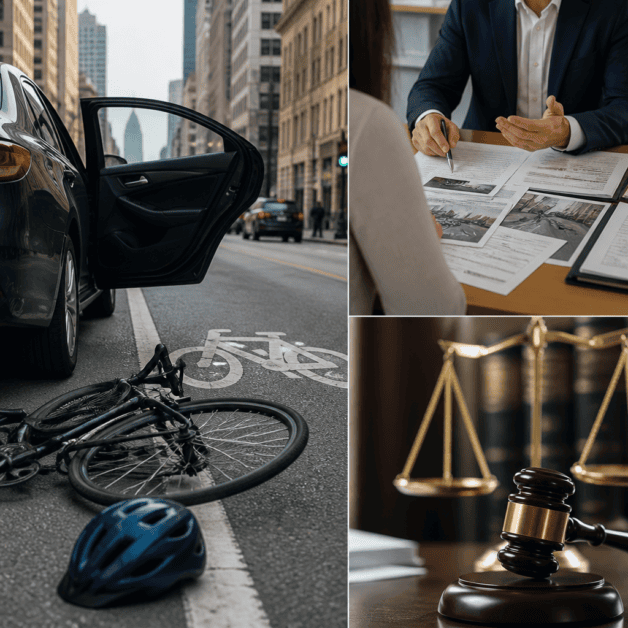
A “dooring” crash happens when a driver or passenger opens a vehicle door into the path of a bicyclist, forcing the rider to strike the door, swerve into traffic, or crash. In Chicago, dooring is especially dangerous on streets with curbside parking alongside bike lanes or shared lanes—where a door can swing into the “door zone” with little warning.
Common injuries include clavicle and wrist fractures, facial trauma, concussions, back and neck injuries, and road rash severe enough to require grafting. Many cyclists are also injured when they’re forced into moving traffic after impact, turning a dooring into a multi-vehicle collision.
Who’s Liable After a Dooring Crash in Chicago?
Liability depends on who opened the door, why it was opened, and what else contributed to the collision. In many dooring cases, more than one person or entity may be legally responsible.
1) The person who opened the door (driver or passenger)
Most dooring claims are brought against the occupant who opened the door into the cyclist’s path. Illinois traffic safety rules generally require a person to ensure it is safe before opening a door and to avoid interfering with traffic, including bicyclists. When a door is opened without checking mirrors or looking over a shoulder, that conduct often supports a strong negligence claim.
Practical example: A passenger in a rideshare steps out on Milwaukee Avenue and swings the rear door into a protected bike lane. The cyclist hits the door and breaks a wrist. The passenger’s failure to check for an oncoming cyclist is typically the core act of negligence.
2) The vehicle owner (vicarious and permissive-use issues)
Depending on the facts and insurance policy, the vehicle owner may be involved through permissive-use coverage or ownership-related liability theories. Even if the owner wasn’t present, insurance coverage may extend to certain acts connected to the use of the vehicle, including entering or exiting.
3) An employer (if the dooring occurred during work duties)
If the door was opened by an employee acting within the scope of employment—such as a delivery driver, courier, parking attendant, security staff, or a worker using a company vehicle—an employer may be liable under respondeat superior.
Practical example: A technician parks a branded van for a service call and opens the driver-side door into a cyclist. If the technician was working at the time, the company may be a defendant, and a commercial policy may apply.
4) A rideshare company or livery operator (fact-specific)
Dooring involving Uber/Lyft trips is common in congested pickup/drop-off areas. Whether the rideshare company is directly liable varies, but the rideshare driver’s insurance status (app on/off, en route, passenger onboard) can impact available coverage. In many cases, the immediate negligence is the passenger’s or driver’s act of opening the door, but coverage analysis is critical.
5) A government entity (rare, but possible)
Some crashes involve roadway design, missing markings, obstructed visibility, or defective signage near bike lanes. Claims involving the City of Chicago or another public entity are complex, time-sensitive, and require careful investigation of immunities and notice rules. Government defendants are not common in straightforward dooring cases, but they may be relevant where infrastructure defects materially contributed.
What Laws and Rules Matter in a Chicago Dooring Claim?
Dooring cases usually turn on negligence: a duty to use reasonable care, breach of that duty, causation, and damages. Several legal concepts often shape the outcome:
- Traffic-safety rules about opening doors: Illinois and local rules generally prohibit opening a vehicle door unless it’s reasonably safe and can be done without interfering with traffic. A violation can be powerful evidence of fault.
- Negligence per se (in the right case): If a specific safety statute was violated and it was designed to protect people like bicyclists from this type of harm, the violation may help establish breach of duty.
- Illinois modified comparative fault: If the cyclist is found more than 50% at fault, they cannot recover. If 50% or less, damages are reduced by the percentage of fault.
- Lane positioning and “door zone” arguments: Insurers often argue that cyclists “should have” ridden farther left to avoid doors. The counterargument frequently involves safe passing clearances, debris, parked-car spacing, and whether a bike lane’s placement reasonably guided the rider.
Common Defenses Insurance Companies Use—and How Lawyers Counter Them
Dooring claims can look “obvious,” but insurers still dispute liability and damages. Expect some of these tactics:
“The cyclist was riding too close to parked cars”
Adjusters often argue the rider assumed the risk of doors by riding in the door zone. A strong response uses scene evidence: bike lane markings, available roadway width, traffic conditions, and whether moving left would have forced the cyclist into unsafe passing conflicts. Photos showing the door’s reach into the bike lane are especially important.
“The cyclist was speeding or not paying attention”
Drivers and passengers may claim they “barely opened the door” and the rider “came out of nowhere.” This can be tested with time-stamped video, witness statements, and damage patterns (hinge impact points, paint transfer, and the angle of collision).
“No contact—so no claim”
Some cyclists crash while swerving to avoid a door and never make contact. A lack of contact does not automatically defeat a claim. If the unsafe door opening caused the evasive maneuver, causation may still be proven with credible evidence.
“Pre-existing injury”
Insurers frequently minimize damages by attributing symptoms to prior conditions. Medical records, treating-physician opinions, diagnostic imaging, and a clear timeline of symptom onset help distinguish a new injury or an aggravation that is legally compensable.
Evidence That Wins Dooring Cases in Chicago
Because dooring happens quickly, early evidence collection can make or break the claim.
Police report and 911/EMS records
Call 911 when possible. A crash report can capture admissions (e.g., “I didn’t see the bicyclist”), diagram the scene, and list witnesses. EMS documentation also supports injury timing and severity.
Photos and video (immediately if possible)
Key images include:
- Vehicle position and the open door relative to the bike lane
- License plate, make/model, rideshare decals, company logos
- Roadway markings, signage, lighting, and any obstructions
- Damage to the bike, helmet, and the vehicle door
Look for nearby cameras: CTA buses, storefronts, residential doorbells, parking garages, and city traffic cameras. Video is often overwritten quickly, so preservation requests matter.
Witness statements
Neutral witnesses—other cyclists, pedestrians, drivers—often decide contested liability. Get names, phone numbers, and short descriptions of what they saw.
Medical documentation and injury journal
Dooring injuries can evolve over days. Prompt evaluation (urgent care/ER) helps document concussion symptoms, fractures, and soft-tissue injuries. Maintain an injury journal noting pain levels, missed work, sleep disruption, and limitations.
Bike repair estimates and property damage proof
Keep receipts and repair quotes for the bicycle, helmet replacement, lights, clothing, and accessories. Property damage helps corroborate the force and mechanics of the crash.
How to File a Bicycle Accident Claim After a Dooring Crash in Chicago
Most dooring cases begin as insurance claims and may later become lawsuits if liability or value is disputed.
Step 1: Identify all potential insurance policies
Potential sources include:
- The driver’s auto liability insurance
- A passenger’s auto policy (sometimes applicable)
- Commercial policies (delivery, fleet, employer vehicles)
- Rideshare coverage (depending on trip status)
- Your own auto policy’s uninsured/underinsured motorist (UM/UIM) coverage (in certain scenarios)
Insurance coverage is often the limiting factor for recovery, so finding all policies early is crucial.
Step 2: Send a preservation letter and gather records
An attorney typically sends letters demanding preservation of video, trip data (for rideshares), vehicle inspection access, and phone records if distraction is suspected. Your lawyer will also obtain medical records and billing statements to document damages.
Step 3: Document damages thoroughly
In Illinois, recoverable damages may include:
- Medical expenses: ER, imaging, surgery, PT/OT, follow-up care
- Lost income: missed work, reduced earning capacity
- Pain and suffering: physical pain, disability, scarring
- Emotional distress: anxiety riding in traffic, sleep issues
- Property damage: bike replacement/repair and gear
Step 4: Make a demand and negotiate
Once treatment stabilizes (or future care needs can be reliably projected), your attorney may submit a demand package summarizing liability, injuries, and financial losses. Many dooring claims resolve through settlement; others require filing suit to secure fair value.