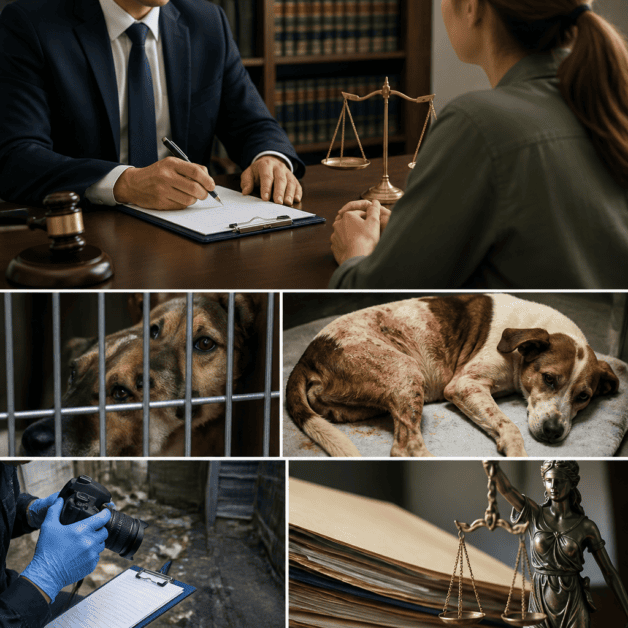
How to File an Animal Cruelty Complaint in California Under Penal Code § 597 and What Evidence Humane Officers Need
California animal cruelty complaints can be filed through local law enforcement, county animal control, or a humane officer under Penal Code § 597. The right agency depends on whether the conduct is active abuse, neglect, or an urgent life-threatening situation. This article explains where to report, what evidence humane officers need, how investigations work, and what charges and court orders may follow.
Understanding Penal Code § 597: What Counts as “Animal Cruelty” in California
California Penal Code § 597 is the state’s primary animal cruelty law. It generally prohibits a person from maliciously and intentionally maiming, mutilating, torturing, or wounding a living animal, and from cruelly beating or killing an animal. It also reaches certain forms of severe neglect—particularly when a person subjects an animal to needless suffering or fails to provide necessary care.
In practice, animal cruelty allegations often involve one of three fact patterns:
1) Active abuse: striking, burning, stabbing, choking, poisoning, or otherwise inflicting injury; setting animals to fight; using extreme force “as punishment.”
2) Severe neglect: withholding food/water, leaving an animal in extreme heat without ventilation, failing to obtain care for obvious injuries, or hoarding-like conditions where animals suffer due to crowding and filth.
3) Cruel transportation/confinement: confinement or transport in conditions likely to cause suffering (often litigated alongside other statutes depending on the facts).
Related statutes that may be charged with (or instead of) PC § 597
Investigations frequently involve overlapping laws, such as:
Penal Code § 597f (failure to provide food, water, shelter); Penal Code § 597.1 (authority to seize animals in certain neglect situations); Penal Code § 597.5 (dogfighting); and local ordinances regulating care standards, licensing, or number of animals.
Why this matters: when a complainant reports “cruelty,” humane officers and law enforcement must classify the conduct. The classification determines urgency, the evidence needed, and whether the case is most likely to be handled administratively (citations/abatement) or criminally (misdemeanor or felony filing).
Where to File an Animal Cruelty Complaint in California
California does not have a single statewide intake portal for every cruelty report. The fastest route depends on risk level and which agency has jurisdiction.
1) Call 911 for emergencies
If an animal is in immediate danger—active violence, an animal locked in a hot car with signs of distress, a situation involving weapons, or a dangerous person—call 911. Emergency calls generate a documented incident response and allow officers to act quickly when life or safety is at stake.
2) Contact local law enforcement (police/sheriff)
Police and sheriff’s departments have broad authority to investigate crimes. They can take reports, detain suspects, seek search warrants, and work with prosecutors. This is often the best choice where the cruelty is part of a broader criminal situation (domestic violence, child endangerment, threats, firearms, burglary, drug activity, etc.).
3) Report to county/city animal control
Animal control is commonly the front door for neglect complaints: thin animals, chronic lack of water, feces accumulation, untreated medical problems, excessive animals on a property, or barking/quality-of-life issues that may mask neglect. Animal control can inspect (with consent or proper legal authority), issue corrective notices, and refer egregious cases for criminal prosecution.
4) Contact a humane officer (where available)
Some jurisdictions operate with humane officers through humane societies or SPCAs with enforcement authority. Humane officers are typically specialized in animal-cruelty investigations and evidence development. They may coordinate with law enforcement and prosecutors and can be central to building a case under PC § 597.
What information to include in the complaint
To make your report actionable, include:
Who: name/description of the suspect (if known), address, vehicles, and any relevant relationship to the animal.
What: specific acts observed (dates, times, frequency). Avoid conclusions (“he’s abusive”) and report facts (“kicked dog twice; dog yelped and limped”).
Where: exact location, unit number, cross-streets, gate codes if lawful to provide, and where animals are kept on the property.
When: ongoing timeline, last observed date, and whether pattern exists.
Risk: immediate danger, weapons, aggressive animals, children present, threats made.
What Evidence Humane Officers Need (and Why It Matters)
Animal cruelty cases rise or fall on proof: proof the animal suffered, proof the defendant caused or allowed it, and proof the required mental state (often “maliciously” or with criminal negligence, depending on charge theory and related statutes). Humane officers generally look for evidence in five categories.
1) Firsthand observations and witness statements
Strong cases start with credible, timely accounts:
Direct witness statements: what the witness saw/heard, distance, lighting, duration, prior incidents.
Reporting party history: how they know the animals, whether they have ongoing access, and whether there is bias (neighbor disputes are common and must be vetted).
Corroboration: multiple witnesses, consistent timelines, or independent supporting evidence.
Practical tip: if you are reporting, write down details immediately and keep notes consistent. Officers often compare initial statements to later interviews for reliability.
2) Photos and videos (with lawful collection)
Visual evidence can document:
Body condition: protruding ribs/hips, hair loss, sores, swelling, limping, labored breathing.
Living conditions: feces/urine saturation, lack of water, hazardous debris, confinement size, temperature risks, lack of shelter.
Injuries or blood: wounds, bruising, broken nails, facial swelling, scars, or fresh bleeding.
Time sequence: repeating photos over days/weeks can show progressive weight loss or persistent deprivation.
Legal caution: humane officers must respect privacy rights and property boundaries. Evidence gathered through trespass or improper access can create suppression issues. Complainants should avoid entering private property without permission and instead document from public vantage points when possible.
3) Veterinary records and expert opinions
Medical evidence is often the difference between suspicion and a provable PC § 597 case. Humane officers may seek:
Vet exams documenting injury severity and pain: fractures, internal injuries, dehydration, emaciation, infections, parasite loads.
Cause-and-timing opinions: whether injuries are consistent with blunt force trauma, chronic neglect, or accidental causes; whether wounds are fresh vs. healing.
Toxicology: suspected poisoning cases may require lab testing and chain-of-custody for samples.
Necropsy (animal autopsy): in death cases, necropsy can establish cause of death and help connect it to conduct.
Because criminal cases require proof beyond a reasonable doubt, veterinarians often provide crucial “bridge” testimony linking conditions to suffering and explaining why the suffering was avoidable.
4) Chain of custody and evidence integrity
Humane officers must be able to prove that evidence is what they claim it is and was not altered. This includes:
Logged collection: who collected items, when, where, and how they were stored.
Original files: preserving original photo/video files with metadata when possible.
Secure storage: preventing contamination of physical evidence (e.g., food/water samples, bedding, suspected toxins).
Animal identification: microchip scans, tags, distinctive markings, and intake records if animals are seized.
5) Proof of ownership, custody, and responsibility
Many defenses hinge on “not my animal” or “I wasn’t responsible for care.” Humane officers therefore gather:
Licensing and microchip registrations
Adoption paperwork, vet bills, receipts
Lease terms and property control (who lives there, who controls the area where animals are kept)
Statements by the suspect (admissions about feeding schedules, confinement, discipline methods)
How Humane Officers Investigate: From Intake to Possible Seizure
While procedures vary by county, a typical cruelty investigation follows a recognizable path.
Step 1: Intake, triage, and jurisdiction check
The agency determines whether the report alleges a crime, whether the location is within its jurisdiction, and whether the situation is emergent. Cases involving immediate suffering may be prioritized for same-day response.
Step 2: Attempted contact and initial welfare check
Officers may attempt to contact the owner/custodian, observe animals from lawful vantage points, and request consent to inspect. In neglect cases, owners may be given an opportunity to correct conditions—unless the suffering is severe or immediate.
Step 3: Documentation of conditions
Humane officers document environmental conditions (temperature, water availability, sanitation), animal condition (body score, gait, wounds), and any tools or hazards (chains, confined crates, makeshift enclosures). They may also identify all animals present to assess scale and resources.
Step 4: Legal authority—consent, warrant, or exigency
To enter areas protected by privacy rights, officers generally need consent or a search warrant. In rare urgent circumstances, exigent conditions may justify immediate action, but those