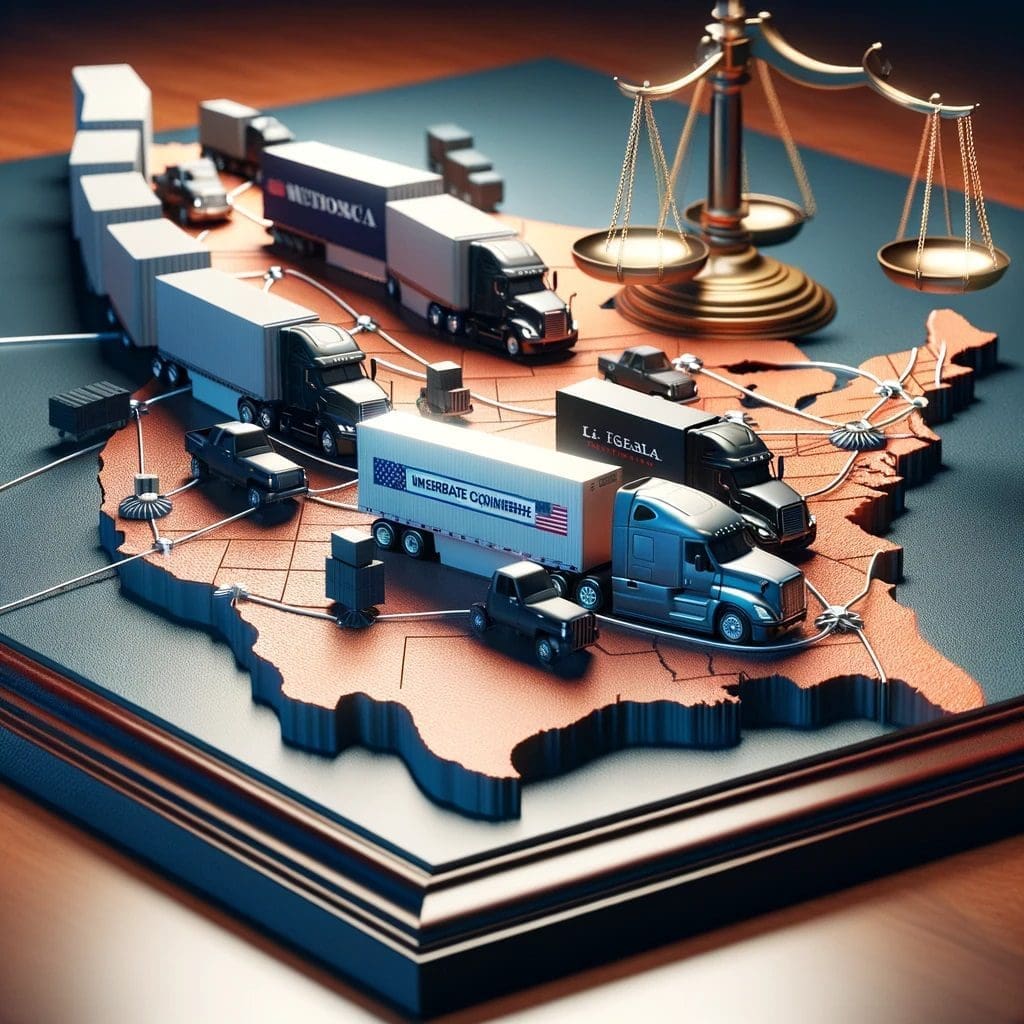
regulatory challenges

Explore insights into navigating complex regulatory environments and understand the hurdles that businesses and individuals face in compliance. This section features expert interviews, articles, and resources focused on regulatory law, providing a comprehensive look at the evolving legal landscape. Gain valuable knowledge on how legal frameworks impact various industries and the strategic approaches to overcoming these legal challenges.

Interstate Commerce: A Key Determinant in Federal Legal Authority

How Will Technology Shape the Future of Interstate Commerce?

Technology is projected to drive U.S. e-commerce sales to about $1.8 trillion in 2024, expanding interstate transactions. AI, digital payments, real-time logistics, and stricter data-privacy and cybersecurity rules will reshape how firms sell, ship, and comply across state lines. This article covers the history, legal doctrines, and emerging regulations shaping interstate commerce. Over the course […]

How Will Technology Shape the Future of Interstate Commerce? Read More »

Climate Law Issues and Legal Strategies Unveiled

What are the emerging issues in environmental law and climate litigation?

Climate litigation is accelerating, with more than 2,600 cases filed globally as courts test climate-risk duties and net-zero commitments. Key flashpoints include ESG disclosure enforcement, greenwashing suits, supply-chain emissions (Scope 3), environmental justice, and liability for climate damages. This article surveys the leading emerging issues shaping environmental law for governments, companies, and individuals. The field

What are the emerging issues in environmental law and climate litigation? Read More »

Challenging Oil Standing Requirements

Environmental Law: Green Groups Challenge Oil Drilling Standing Requirements

Environmental groups can challenge oil and gas drilling approvals only if they prove Article III standing—typically a concrete, particularized injury that is traceable to the decision and likely to be redressed by the court. Recent cases have tightened how courts evaluate causation and redressability in climate and environmental suits. This article explains the standing requirements,

Environmental Law: Green Groups Challenge Oil Drilling Standing Requirements Read More »

Strategies Against Capricious Rules

How to challenge agency rulemaking as arbitrary and capricious

Under the APA, courts will set aside an agency rule as “arbitrary and capricious” if the agency failed to give a reasoned explanation or ignored key evidence in the record. A successful challenge typically shows the rule conflicts with the statute, relies on improper factors, or fails to address important comments. This article explains the

How to challenge agency rulemaking as arbitrary and capricious Read More »

Navigating Agency Decisions - Fair or Capricious?

Can unpopular agency decisions be classified as arbitrary and capricious?

Unpopular agency decisions are not arbitrary and capricious on that basis alone—courts apply the APA’s “arbitrary and capricious” test by reviewing the administrative record for reasoned decision-making. A decision is more likely to be set aside if the agency ignored key evidence, failed to explain its change in policy, or relied on improper factors. This

Can unpopular agency decisions be classified as arbitrary and capricious? Read More »

Evidence Required to Challenge Agency Rulings

What evidence is necessary to prove an agency’s decision is arbitrary and capricious?

To prove an agency decision is arbitrary and capricious, you generally need record-based evidence showing the agency ignored key facts, failed to consider important aspects of the problem, offered an explanation contrary to the evidence, or departed from policy without a reasoned basis. This showing is typically made from the administrative record under the APA’s

What evidence is necessary to prove an agency’s decision is arbitrary and capricious? Read More »

Understanding Regulatory Law: Essential Guide to Legal Compliance

Regulatory Law – Navigating Legal Compliance

Regulatory law is the body of rules that governs how businesses must comply with government requirements across industries. It shapes licensing, reporting, safety standards, consumer protection, and enforcement—often at federal, state, and local levels. This article explains core compliance duties, common regulatory risks, how agencies investigate and penalize violations, and practical steps to build an

Regulatory Law – Navigating Legal Compliance Read More »

Scroll to Top