
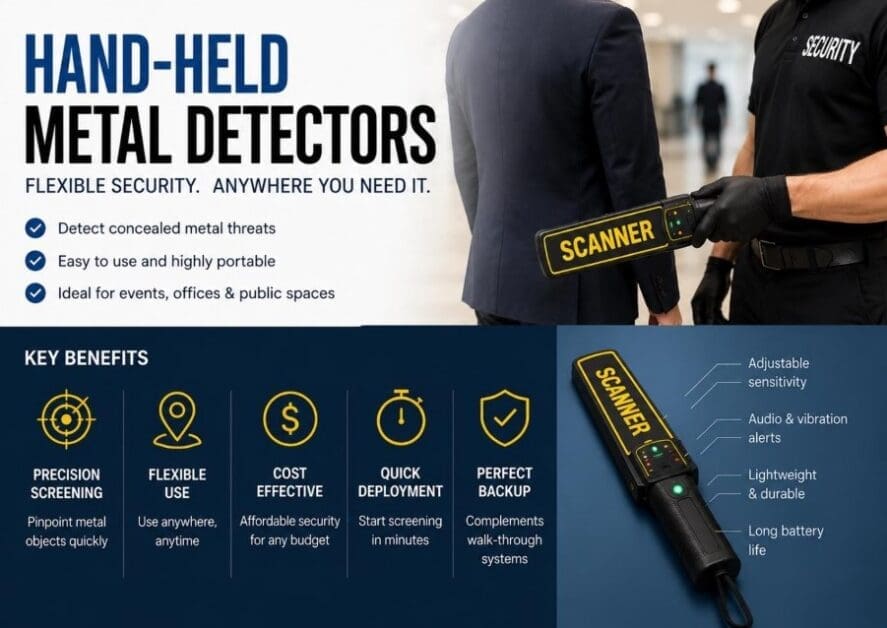
How Hand-Held Metal Detectors Improve Security at Events, Offices & Public Spaces
Hand-held metal detectors can scan a person in about 2–5 seconds to detect concealed metallic weapons and prohibited items. They’re compact, affordable, and easy to deploy for bag checks, entry lines, and secondary screening without installing large systems. This article explains where they work best, how to use them effectively, and key limitations to know.
Security threats today aren’t limited to airports or government buildings. Offices, schools, concerts, malls, and public gatherings all face the same basic risk — someone carrying a weapon or prohibited item undetected. That’s where hand-held metal detectors come in.
Compact, affordable, and easy to operate, hand-held metal detectors have become one of the most practical tools for security teams looking to add an extra layer of protection without the cost or footprint of larger systems. Here’s a closer look at how they work, where they’re used, and why they remain essential even in facilities that already use a walk-through system.
What Is a Hand-Held Metal Detector?
A hand-held metal detector is a battery-powered wand used by security personnel to scan individuals for concealed metallic objects — weapons, blades, tools, or other prohibited items. Unlike walk-through systems, which screen people as they pass through a fixed frame, hand-held detectors are used for close, targeted scanning of a specific person or area of the body.
They’re lightweight, portable, and require little to no training to operate, making them a go-to solution for venues that need flexible, on-the-spot screening.
Why Hand-Held Metal Detectors Matter for Modern Security
1. Precision Screening
When an alarm is triggered on a walk-through detector, a hand-held unit is used to pinpoint the exact location of the metal object on a person. This targeted scanning reduces unnecessary pat-downs and speeds up the resolution process.
2. Flexibility Across Locations
Hand-held detectors don’t need a fixed setup. Security staff can use them anywhere — entry points, hallways, parking areas, or during random spot checks — making them ideal for offices, schools, retail stores, and temporary event venues.
3. Cost-Effective Security
For smaller businesses, offices, or events with limited budgets, a hand-held metal detector offers an affordable way to screen visitors without investing in permanent infrastructure.
4. Quick Deployment
There’s no installation required. Staff can start screening within minutes, which is especially useful for one-off events, conferences, or temporary security needs.
5. Backup for Larger Systems
Even facilities with a fully installed walk-through metal detector benefit from having hand-held units on hand for secondary checks, alarm verification, or backup during equipment maintenance.
Where Hand-Held Metal Detectors Are Used
- Corporate offices – screening visitors and staff at reception or entry points
- Public events and concerts – quick, mobile screening for large crowds
- Educational institutions – random checks to maintain campus safety
- Retail stores and malls – theft and weapon deterrence
- Government and judicial buildings – secondary screening alongside fixed systems
- Hotels and hospitality venues – discreet, on-demand security checks
Hand-Held vs Walk-Through Metal Detectors: Do You Need Both?
This is a common question for businesses setting up a security plan. The short answer: they serve different purposes and work best together.
Hand-held detectors are ideal for flexible, low-traffic, or temporary screening needs. But for locations with high foot traffic — such as corporate headquarters, stadiums, or large public venues — a walk-through metal detector is better suited to screen large volumes of people efficiently and consistently, without slowing down entry. Security equipment providers such as PTI World offer walk-through systems built specifically for these high-traffic environments.
Many organizations use both: a walk-through system as the primary screening method, with hand-held detectors used by staff to resolve alarms and perform targeted checks. This layered approach gives security teams both speed and precision.
Choosing the Right Hand-Held Metal Detector
When selecting a hand-held detector, consider:
- Sensitivity settings – adjustable sensitivity helps detect smaller items without excessive false alarms
- Battery life – important for events or long shifts
- Build quality – durable, lightweight designs are easier for staff to use over extended periods
- Audio/vibration alerts – useful for discreet screening in sensitive environments
- Certifications – ensure the device meets relevant safety and security standards
Final Thoughts
Hand-held metal detectors remain one of the simplest, most reliable tools for improving security across offices, events, and public spaces. They offer flexibility that larger systems can’t match, and when paired with a properly installed walk-through metal detector, they create a comprehensive, layered security setup suited to almost any environment.
Whether securing a small office or a large public venue, investing in the right combination of screening equipment is one of the most effective steps any organization can take toward a safer environment.
Frequently Asked Questions (FAQs)
1. What is a hand-held metal detector?
A hand-held metal detector is a portable security wand used to detect concealed metal objects on a person’s body or within bags and personal belongings. Security personnel commonly use these devices to locate weapons, knives, tools, and other prohibited metal items during screening.
2. How does a hand-held metal detector work?
Hand-held metal detectors generate an electromagnetic field that reacts when it comes close to a metallic object. When metal is detected, the device alerts the operator through an audible alarm, vibration, visual indicator, or a combination of these notifications.
3. Can a hand-held metal detector detect all types of weapons?
Hand-held metal detectors are designed to identify metallic weapons such as firearms, knives, and other metal objects. However, they cannot detect non-metallic weapons or prohibited items made entirely from plastic, ceramic, or other non-metal materials.
4. Are hand-held metal detectors better than walk-through metal detectors?
Neither is inherently better—they serve different purposes. Hand-held metal detectors are ideal for targeted screening, secondary inspections, and mobile security operations. Walk-through metal detectors are better suited for screening large numbers of people quickly. Many organizations use both for a more effective layered security strategy.














