How to Prove Fault in a Florida Rear-End Collision When the Lead Driver Braked Suddenly
[In Florida, the rear driver is usually presumed at fault in a rear-end crash—but that presumption can be rebutted with evidence the lead driver stopped abruptly and unreasonably. Sudden braking can shift or share liability when it’s not tied to traffic conditions, hazards, or lawful driving. This article explains the Florida law, proof strategies, key evidence, and common defenses when the lead driver braked suddenly.]
Rear-end collisions in Florida are often treated as “open-and-shut,” but they are not always. The reality is that Florida applies a strong presumption that the rear driver was negligent—yet that presumption is rebuttable. When the lead driver braked suddenly, without a legitimate reason tied to safety or traffic conditions, the lead driver’s conduct can become the primary cause of the crash or a substantial contributing cause that reduces (or, in some cases, eliminates) the rear driver’s liability.
This matters because fault determines who pays for medical bills, vehicle damage, wage loss, and pain and suffering—and how much. It also affects insurance negotiations, litigation strategy, and whether the case is worth taking to trial.
Florida’s rear-end collision presumption (and why it’s not automatic liability)
Florida courts generally apply a presumption of negligence against the rear driver in a rear-end crash. The reasoning is straightforward: drivers must follow at a safe distance, keep a proper lookout, and be prepared for ordinary traffic changes.
But the presumption is not the same as strict liability. It can be rebutted with evidence showing that the rear driver’s conduct was not the legal cause of the collision, or that the lead driver (or a third party) created a sudden, unforeseeable hazard. In practice, the most common rebuttal theory is: the lead driver stopped abruptly and unreasonably—sometimes described in everyday terms as “brake checking” or “slamming on the brakes for no reason.”
Key takeaway
A sudden stop alone does not prove the lead driver was negligent. Your job is to show the stop was unnecessary, unsafe, and not reasonably foreseeable under the circumstances.
What “sudden braking” means in legal terms
Drivers brake suddenly for many legitimate reasons: traffic compression, a turning vehicle, a pedestrian, an animal, debris in the roadway, a red light changing, or an emergency vehicle. Florida law does not require a driver to “ease into” the brakes if an actual hazard exists.
The sudden-braking argument becomes powerful when the evidence supports one or more of the following:
- No hazard existed (no stopped traffic, no red light, no pedestrian, no obstruction).
- The lead driver’s stop was disproportionate (hard braking to near-zero for a minor condition).
- The lead driver created the hazard (cutting in closely, then braking immediately).
- The lead driver acted intentionally or aggressively (classic “brake check”).
- Brake lights were inoperative or visibility was impaired by the lead driver’s vehicle condition.
In short: to shift or share fault, you must show the lead driver’s braking was not a normal, expected response to roadway conditions.
Core elements to prove fault when the lead driver braked suddenly
Whether you represent the rear driver trying to rebut the presumption or the lead driver defending a claim of “unreasonable braking,” the analysis usually turns on the same negligence elements: duty, breach, causation, and damages.
1) Establish what a reasonable driver would have done
The “reasonable driver” standard is fact-specific. A sudden stop can be reasonable in dense traffic and unreasonable on an open roadway with no hazard. Proof often centers on:
- Speed and traffic flow
- Weather and lighting
- Visibility and line of sight
- Road design (curves, hills, merges)
- Whether the lead vehicle signaled or had functioning brake lights
2) Show the stop was unnecessary or unsafe
To rebut the rear-driver presumption, you are typically trying to prove the lead driver breached the duty to operate safely by stopping in a way that a reasonable driver would not. Strong arguments include:
- “No reason to stop” evidence: video, witness accounts, or traffic camera footage showing open roadway
- “Overreaction” evidence: hard braking for a distant, non-threatening condition
- “Aggression/retaliation” evidence: prior lane dispute, gestures, horn usage, or erratic maneuvers leading up to impact
3) Prove causation: the sudden stop caused the crash
Even if the lead driver’s stop was questionable, the rear driver must connect it to the collision. The defense will argue the rear driver was following too closely or distracted and would have hit the lead car regardless.
Causation is commonly proven (or disproven) by:
- Event data recorder (EDR) evidence showing timing and intensity of braking
- Dashcam footage showing the interval between lane change and braking
- Skid marks and impact analysis
- Phone records and distraction evidence
Evidence that wins (or loses) sudden-braking rear-end cases
Because the rear driver starts behind the presumption, objective evidence is often the difference between a reduced settlement and a full-value recovery (or between liability and no liability).
Dashcam and nearby surveillance video
Video is often the most persuasive evidence of whether there was a legitimate hazard. It can show:
- Traffic conditions ahead of the lead vehicle
- Whether the lead driver cut in closely before braking
- Whether brake lights illuminated
- Whether the rear driver had a reasonable stopping distance
If you don’t have a dashcam, look for nearby businesses, traffic cameras, or residential doorbell cameras that capture the roadway. Preservation letters should go out immediately; many systems overwrite footage within days.
EDR (“black box”) and vehicle telematics
Many newer vehicles store pre-crash data: speed, throttle, brake application, steering angle, and sometimes collision parameters. EDR downloads can help establish:
- How hard and how suddenly the lead driver braked
- Whether the rear driver braked promptly
- Closing speed and time-to-collision metrics
App-based telematics, fleet GPS systems, and insurer tracking programs may also store useful timestamps.
Accident reconstruction and physics-based timing
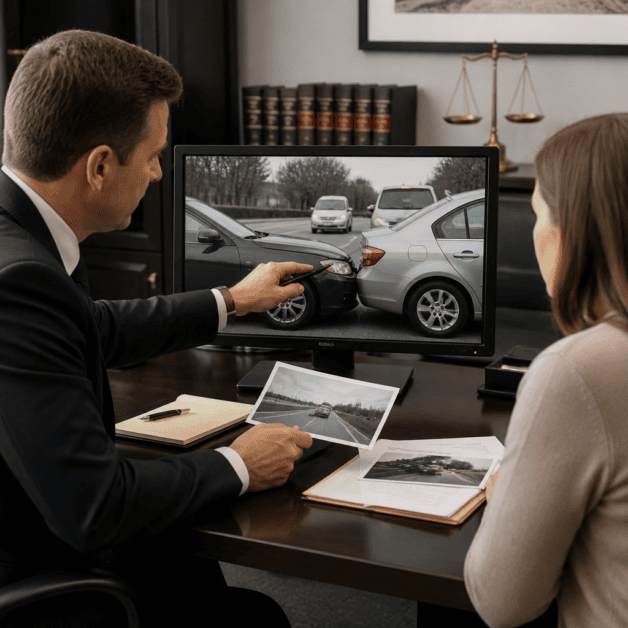
When liability is contested, a qualified reconstruction expert can translate scene evidence into defensible conclusions about perception-reaction time and stopping distance. For example, if the lead driver cut into the lane one car-length ahead at highway speed and immediately braked hard, the rear driver may not have had a reasonable opportunity to avoid impact—even with attentive driving.
Witness testimony (the right kind)
Independent witnesses matter more than involved drivers. Useful witness statements describe:
- The presence or absence of a hazard
- The lead driver’s lane changes, speed fluctuations, and aggressive behavior
- Whether brake lights appeared to function
Statements like “they stopped for no reason” are less helpful unless tied to concrete observations (e.g., “no cars were in front of them for at least 100 yards”).
Vehicle condition: brake lights, tires, and maintenance
If the lead driver’s brake lights were out, cracked, tinted too dark, or intermittently working, sudden braking becomes harder to anticipate. Photos, repair records, and post-crash inspections can support (or undermine) this theory.
Florida comparative negligence: how fault can be shared
Florida uses a comparative fault system in which each party can be assigned a percentage of responsibility. In a sudden-braking rear-end case, that often means:
- The lead driver may bear fault for an unreasonable stop or unsafe lane change
- The rear driver may still bear fault for following too closely, speeding, or inattention
The practical impact is financial: a party’s recovery can be reduced by their percentage of fault. That’s why insurers aggressively argue “following too closely” even when the lead driver’s braking looks suspicious—and why your evidence must address both the stop and the rear driver’s response time.
Common defenses you must anticipate
Whether you’re pursuing a claim or defending one, the same themes appear repeatedly in Florida rear-end litigation.
“The rear driver wasn’t paying attention”
Insurers look for distraction indicators: phone use, delayed braking, no skid marks, or inconsistent statements. Countermeasures include phone record analysis (when appropriate), EDR data showing prompt braking, and testimony about traffic conditions and line of sight.
“There was a hazard—traffic stopped”
This is the most common rebuttal to the sudden-braking claim. If traffic did stop, the lead driver’s braking is typically considered reasonable, and the rear driver’s presumption becomes harder to overcome. Video and third-party witnesses are crucial here.
“Even if the stop was sudden, it was foreseeable”
On congested I-95 corridors or urban arterials, abrupt braking may be foreseeable. Your argument improves if the stop occurred in an area where abrupt stops are unusual (e.g., open roadway) or the lead driver’s actions created a new hazard (e.g., unsafe cut-in).
Examples: when sudden braking can change the fault outcome
Example 1: Cut-in and immediate brake (lead driver shares or bears majority fault)
A lead