court rulings

Explore comprehensive insights into significant judicial decisions shaping the legal landscape across various jurisdictions. Visitors will find detailed analyses, expert interviews, and up-to-date coverage on precedential judgments, helping to understand their implications in both state and federal courts. This authoritative resource is essential for anyone seeking to stay informed on the evolving interpretations of law and their potential impact on future legal proceedings.

Judge's gavel with law books and scales of justice

Judicial Decisions: Types, Process, and Legal Impact

Judicial decisions are formal court rulings that resolve legal disputes and interpret laws. From judicial review agency decisions to judicial foreclosure process and child welfare decisions, these determinations shape our legal system, creating precedents that guide future cases and protect individual rights.

Judicial Decisions: Types, Process, and Legal Impact Read More »

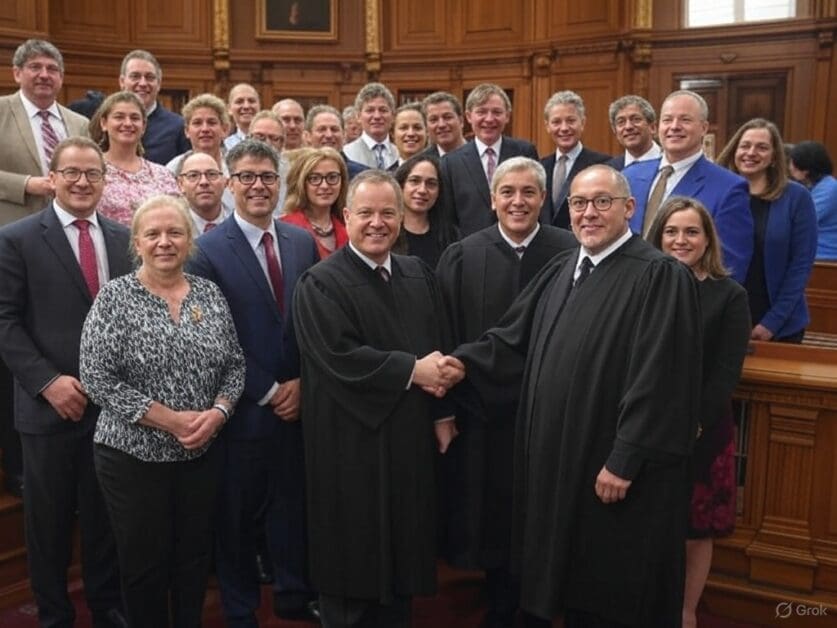
Recent Supreme Court Decisions Enhance Rights in Grand Court with Cheerful Handshakes

How Do Recent Supreme Court Decisions Impact Legal Rights?

Recent Supreme Court decisions impact legal rights by changing binding precedent in 100% of U.S. jurisdictions—federal and state. These rulings can expand or restrict rights and reshape how lower courts apply the Constitution to issues like abortion, firearms, agency authority, and free speech. This article summarizes the key decisions, practical effects, and what they mean

How Do Recent Supreme Court Decisions Impact Legal Rights? Read More »

How Trump’s Federal Funding Freeze Faces Legal Results

What’s the Legal Outcome of Trump’s Attempt to Freeze Federal Funding?

Federal courts blocked Trump’s federal funding freeze, including a preliminary injunction issued March 6, 2025, by U.S. District Judge John McConnell. The rulings held the executive branch cannot unilaterally withhold congressionally appropriated funds, reinforcing separation of powers. This article summarizes key court decisions, legal reasoning, and implications for federal agencies and states. The recent attempt

What’s the Legal Outcome of Trump’s Attempt to Freeze Federal Funding? Read More »

Precedent Drives Legal Decisions in Court

Stare Decisis in Criminal Cases: Precedent in Legal Decisions

Stare decisis in criminal cases means courts follow binding precedent from higher courts, with federal courts bound by the U.S. Supreme Court and circuit precedent. It promotes consistent rulings while still allowing change when prior decisions are clearly wrong or unworkable. This article explains how precedent operates in criminal decisions and when courts may depart

Stare Decisis in Criminal Cases: Precedent in Legal Decisions Read More »

Can Controversy Overturn Court Rulings

Can a decision be overturned simply because it is unpopular or controversial?

No—0 U.S. court decisions can be overturned solely because they are unpopular or controversial. Reversal generally requires legal error, constitutional conflict, new controlling precedent, or proper appellate or legislative action. This article explains how appeals, precedent, and public opinion interact in overturning rulings. The question of whether a judicial decision can be overturned solely based

Can a decision be overturned simply because it is unpopular or controversial? Read More »

Comparing Judicial Review Standards

How does the arbitrary and capricious standard differ from other standards of review?

The arbitrary and capricious standard is a deferential review that upholds an agency decision unless it lacks a rational basis in the record or ignores key facts. Unlike de novo or substantial evidence review, courts do not reweigh evidence and instead look for reasoned decision-making. This article compares it to other standards and explains when

How does the arbitrary and capricious standard differ from other standards of review? Read More »

Defining Arbitrary Actions Through Legal Precedents

What are the legal precedents that define arbitrary and capricious actions?

“Arbitrary and capricious” action is a core Administrative Procedure Act standard courts use to invalidate agency decisions that lack a rational explanation or ignore important evidence. Key U.S. Supreme Court precedents—including *Motor Vehicle Manufacturers Ass’n v. State Farm* and *FCC v. Fox Television Stations*—require reasoned decisionmaking and a record-based justification. This article summarizes the leading

What are the legal precedents that define arbitrary and capricious actions? Read More »

Lawyers Leveraging PR to Navigate Online Crises

Key examples of arbitrary and capricious agency actions in recent cases

Courts can set aside agency decisions as “arbitrary and capricious” under the Administrative Procedure Act when the agency fails to give a reasoned explanation, ignores important evidence, or departs from prior policy without justification. Recent rulings show judges closely scrutinizing rulemakings, enforcement actions, and benefits determinations for logical consistency and record support. This article highlights

Key examples of arbitrary and capricious agency actions in recent cases Read More »

Scroll to Top