
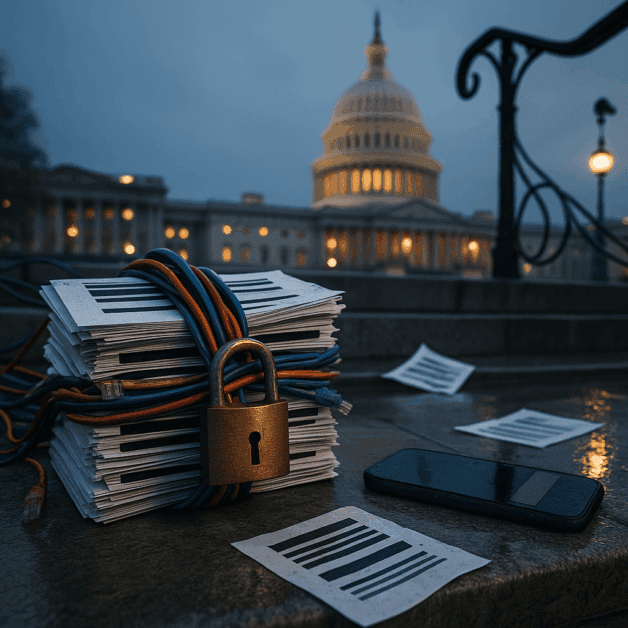
The Federal Privacy Bill Everyone Expects (and Why It Keeps Dying)
A comprehensive federal privacy law still hasn’t passed Congress, despite years of bipartisan proposals and repeated momentum. The main sticking points are preemption of state laws, whether consumers can sue (private right of action), and how enforcement would work across sectors. This article explains the bill everyone expects, why prior efforts keep stalling, and what businesses and consumers should watch next.
America’s Privacy Problem: Why No Federal Law Exists Yet
Most Americans assume the government has their back when it comes to protecting their personal data. They imagine some kind of federal privacy law sitting on the books, shielding their information from being collected, sold, or misused without their knowledge. The truth? No comprehensive federal privacy law exists in the United States. And despite years of trying, passing one has proven to be surprisingly difficult.
This isn’t for lack of awareness. Politicians on both sides of the aisle have acknowledged the problem. Tech companies have faced Senate hearings. High-profile data breaches have made national headlines. And yet, the federal privacy bill that everyone seems to expect — the one that would give Americans real control over their personal information — keeps stalling before it ever becomes law.
So what’s going on? Why is federal privacy legislation so hard to get right? And what does that mean for everyday people trying to protect their consumer rights online?
A Quick Look at Where Things Stand
The United States has a patchwork approach to privacy protection right now. There are sector-specific laws covering things like health records (HIPAA), children’s online data (COPPA), and financial information (GLBA). But there’s no single, overarching federal privacy law that covers how companies collect and use your personal data in a general sense.
Some states have stepped in to fill that gap. California passed the California Consumer Privacy Act (CCPA) in 2018, giving residents certain rights over their data. Virginia, Colorado, Connecticut, and several other states have followed with their own versions of privacy legislation. But a state-by-state approach creates a messy situation for both consumers and businesses.
At the federal level, the most recent serious attempt was the American Data Privacy and Protection Act (ADPPA), which gained bipartisan support in 2022. It passed out of committee with a strong vote — something rare in today’s political climate. Then it stalled. It never reached a floor vote in the full House or Senate.
Why the Bill Keeps Failing to Cross the Finish Line
There’s no single villain in this story. The federal privacy bill keeps dying for a mix of political, business, and legal reasons. Here’s a breakdown of the main obstacles:
1. The Preemption Fight
One of the biggest sticking points is whether a federal law should override, or “preempt,” state privacy laws. Businesses generally prefer one national standard. Dealing with 50 different state laws is complicated and expensive. So they push for a federal law that replaces everything at the state level.
But states — especially California — strongly resist this idea. California’s CCPA is considered one of the strongest privacy protection laws in the country. California lawmakers and advocates argue that a federal law could actually weaken protections if it sets a lower standard and wipes out stronger state rules. That tension has been a major roadblock every time federal privacy legislation gets close to passing.
2. Business Lobbying Power
The tech industry spends enormous amounts of money lobbying Congress. While some companies say they support federal privacy law in principle, they often push hard behind the scenes to water down the specifics. Things like limiting how consumers can sue companies, narrowing the definition of sensitive data, or weakening enforcement mechanisms are all common pressure points.
This lobbying effort doesn’t come from just one side of the tech world either. Small businesses worry about compliance costs. Advertisers worry about losing access to data that powers their business model. Data brokers have a lot to lose if consumers gain the right to opt out of data collection entirely.
3. Enforcement Disagreements
Who should enforce a federal privacy law? The Federal Trade Commission (FTC) is the most obvious candidate, but it currently lacks the direct rulemaking authority needed to fully enforce a new privacy law without additional powers from Congress. Some lawmakers want to create a new, dedicated privacy agency. Others think that’s too much government. This debate slows things down considerably.
There’s also the question of private right of action — meaning, whether individual consumers should be allowed to sue companies directly for privacy violations. Consumer rights advocates say this is essential for holding companies accountable. Many businesses and some lawmakers argue it would open the floodgates to frivolous lawsuits and cost companies billions.
4. Political Timing and Priorities
Congress has a crowded agenda at any given time. Even when a federal privacy bill has bipartisan support, it often gets pushed aside for other legislative priorities. Elections shift the makeup of committees. New crises demand attention. Bills that don’t have a powerful, organized constituency pushing them over the finish line tend to fall through the cracks.
Privacy legislation also doesn’t have the same kind of passionate voter base as issues like healthcare or immigration. That makes it easier for lawmakers to delay without facing serious political consequences.
What a Federal Privacy Law Could Actually Do
It’s worth stepping back and thinking about what comprehensive federal privacy legislation could mean for regular people. The benefits are real and significant:
- Transparency: Companies would be required to tell you clearly what data they collect, why they collect it, and who they share it with.
- Control: You would have the right to access your own data, correct errors, and in many cases, request that it be deleted.
- Opt-out rights: You could say no to having your data sold to third parties, including data brokers who trade in personal information.
- Stronger protections for sensitive data: Things like your health information, location, financial records, and browsing history could receive extra layers of protection.
- Accountability: Companies that violate privacy rules would face real penalties, not just a slap on the wrist.
For consumers, these protections would represent a major shift in power. Right now, most people have very little meaningful control over what happens to their data once it enters the digital ecosystem. A strong federal privacy law would change that.
How the US Compares to Other Countries
The United States is something of an outlier among wealthy democracies when it comes to privacy protection. The European Union passed the General Data Protection Regulation (GDPR) in 2018, setting a high global standard for how companies must handle personal data. Canada, Brazil, Japan, South Korea, and many other countries have passed their own national privacy laws in recent years.
The absence of a comprehensive federal privacy law in the US has real consequences. American consumers have fewer protections than their counterparts in many other countries. It also creates complications for international data transfers and puts US companies at a disadvantage when operating in markets with strict privacy requirements.
The irony is that the US was once a leader in thinking about privacy as a fundamental right. Today, it lags behind much of the world in turning that principle into enforceable law.
Could It Actually Happen?
There are reasons for cautious optimism. The ADPPA showed that bipartisan agreement is possible — which is no small thing in today’s political environment. Public awareness of data privacy issues has grown significantly, fueled by news stories about social media companies, data breaches, and AI tools that use personal information in ways people never expected.
Some industry players have shifted their position too. Facing a growing maze of state laws, some large tech companies now say they’d prefer one clear federal standard. That makes the political math slightly easier, at least in theory.
Still, the path forward is uncertain. The preemption issue hasn’t gone away. Lobbying pressure remains intense. And Congress has a well-documented habit of letting privacy bills die quiet deaths in committee.
What You Can Do in the Meantime
While waiting for federal privacy legislation to become a reality, there are practical steps you can take to protect yourself:
- Review the privacy settings on your devices, apps, and social media accounts regularly.
- Use strong, unique passwords and enable two-factor authentication wherever possible.
- Be cautious about what personal information you share online, especially on platforms you don’t fully trust.
- If you live in a state with a privacy law, learn what rights it gives you and how to exercise them.
- Consider using privacy-focused tools like encrypted messaging apps, private browsers, or virtual private networks (VPNs).
These steps won’t give you the full protection that a strong federal privacy law would, but they can meaningfully reduce your exposure in the meantime.
The Bottom Line
The demand for federal privacy law is real, and so is the problem it’s meant to solve. Americans share enormous amounts of personal data every day, often without fully understanding how it’s being used or who it’s being sold to. The tools to address this exist. The political will has flickered — but never quite caught fire.
Every year without a federal privacy law is another year that consumer rights in the digital space go underprotected. The stakes are high enough that this conversation isn’t going away. Whether Congress finally acts on it — and how strong the result would be — remains one of the more important open questions in American tech policy.














