
The New AI Surveillance Tools Police Are Using — And What You Can Refuse
Police now use at least 5 major AI surveillance tools—facial recognition, ALPR/license-plate readers, predictive policing, social media monitoring, and cell-site simulators—to identify and track people. Many uses require a warrant or your consent, and you can refuse searches, questioning, and phone unlocks in most situations. This article explains the tech, your constitutional rights, and practical refusal steps.
How Police Are Using AI to Watch You
Technology is changing fast, and law enforcement agencies across the country are keeping up. Police departments are now using powerful artificial intelligence tools to track, identify, and monitor people in ways that were impossible just a few years ago. Some of these tools are helpful for solving crimes. Others raise serious questions about privacy rights and the limits of government power.
Understanding what these tools are, how they work, and what your legal rights are can make a real difference in your life. This article breaks it all down in plain language.
What AI Surveillance Tools Are Police Currently Using?
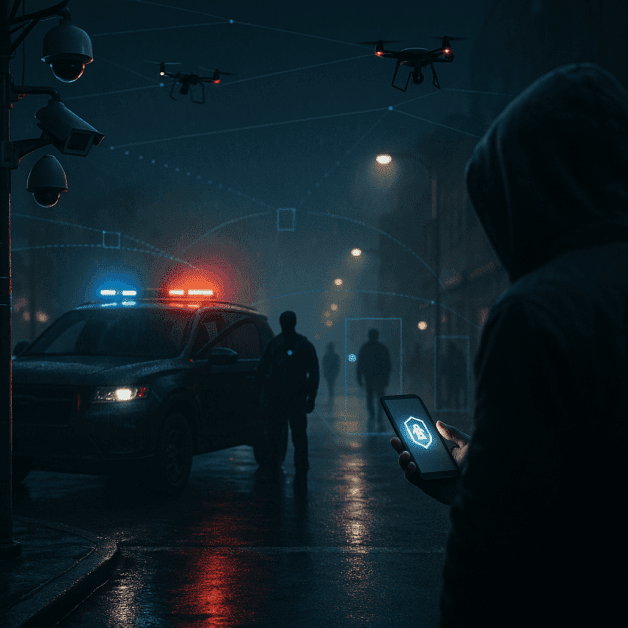
Law enforcement agencies at the local, state, and federal level are using a growing list of AI-powered surveillance technologies. Here are some of the most common ones in use today:
Facial Recognition Software
Facial recognition is probably the most well-known AI surveillance tool. It works by scanning images or video footage and comparing faces against large databases of photos. Police use it to identify suspects, find missing persons, and track individuals through public spaces.
Programs like Clearview AI have given police access to billions of photos scraped from social media platforms and public websites. A single photo taken from a security camera can potentially be matched to a real person within seconds.
The problem? These systems make mistakes. Studies have shown that facial recognition tools are significantly less accurate when identifying women, older people, and people with darker skin tones. This has already led to wrongful arrests in several documented cases.
Predictive Policing Algorithms
Predictive policing software uses data and algorithms to forecast where crimes might happen or who might commit them. Cities like Los Angeles and Chicago have used programs like PredPol and ShotSpotter to decide where to send officers and who to watch more closely.
Critics argue that these systems often reflect existing biases in policing data. Because certain communities have historically been over-policed, the data fed into these algorithms tends to direct more police attention right back to those same areas and people — creating a self-reinforcing cycle.
License Plate Readers
Automated License Plate Readers, or ALPRs, are cameras mounted on police cars, bridges, and street poles that automatically scan and record every license plate they see. This data is stored in large databases and can be used to track where a vehicle has been over time.
Companies like Flock Safety and Motorola Solutions supply these systems to thousands of police departments. Your car’s movement can be logged without any suspicion of wrongdoing on your part.
Cell-Site Simulators (Stingrays)
A cell-site simulator, often called a Stingray, is a device that mimics a cell tower. When your phone connects to it, the device can capture your location and, in some cases, the content of your communications. Police can use Stingrays without your knowledge, and they typically don’t need a warrant in every jurisdiction.
Social Media Monitoring Tools
Law enforcement agencies use specialized software to scan and analyze public social media activity. These tools can flag certain keywords, track accounts, and build profiles of individuals based on their online behavior. During protests and public events, this type of monitoring has become increasingly common.
Drone Surveillance
Police departments are deploying drones more frequently for crowd monitoring, crime scene investigation, and suspect tracking. Some agencies now use AI-powered drones that can follow a person or vehicle automatically without a human directly controlling the camera.
What Does the Law Say? Understanding the Fourth Amendment
The Fourth Amendment to the U.S. Constitution protects people from unreasonable searches and seizures. For a long time, this was mostly applied to physical spaces — your home, your car, your belongings. But the rise of AI surveillance technology is forcing courts to rethink what “unreasonable search” means in a digital world.
Here are some key legal principles that apply to police surveillance today:
- The Third-Party Doctrine: Under this older legal principle, information you share with a third party — like your phone company or a social media platform — is not protected by the Fourth Amendment. This means police can often access it without a warrant. However, courts are starting to challenge this doctrine as it applies to modern technology.
- The Carpenter Decision (2018): In Carpenter v. United States, the Supreme Court ruled that police need a warrant to access several weeks of cell phone location data from a phone carrier. This was a landmark ruling that started to push back on mass digital surveillance under Fourth Amendment protections.
- Public Spaces vs. Private Spaces: Courts have generally held that you have no reasonable expectation of privacy in public spaces. What you do in a park, on a sidewalk, or in front of a store can legally be observed and recorded by police. However, the question of whether AI tools that track your movements across an entire city over a long period of time cross a constitutional line is still being debated in courts.
- State Laws Matter: Federal law sets a baseline, but individual states can pass stronger privacy protections. Illinois, Texas, Washington, and California have laws that regulate facial recognition technology, for example. Your rights may be stronger depending on where you live.
What You Can Legally Refuse
Knowing what you can say no to is one of the most practical things you can take away from this article. Here’s a clear breakdown:
You Can Refuse to Unlock Your Phone
In most cases, you have the right to refuse to give police your phone password or PIN. The Fifth Amendment, which protects you from self-incrimination, has been interpreted by many courts to protect passcodes. However, if a court issues a valid warrant, you may be compelled to provide biometric access like a fingerprint or face scan, depending on your state. The law here is still evolving.
You Can Refuse Consent to Search Your Home or Car
If police ask for your permission to search your vehicle or home, you have the right to say no. Police still need a warrant or a recognized legal exception to conduct a search without your consent. Simply saying “I do not consent to this search” clearly and calmly is your legal right.
You Cannot Physically Block Surveillance in Public
Unfortunately, you generally cannot legally stop police from using cameras, drones, or facial recognition on you in a public space. Since courts have ruled that people have a reduced expectation of privacy in public, physically interfering with surveillance equipment could lead to charges.
You Can Refuse to Give a DNA Sample (Usually)
Police cannot typically force you to give a DNA sample without a warrant or a court order. However, if you are arrested for certain crimes, some states do require DNA collection. Always ask to speak with an attorney before agreeing to any biological sample collection.
You Can Refuse to Answer Questions
The Fifth Amendment gives you the right to remain silent. You are required to identify yourself in most states if police have a reasonable suspicion that you were involved in a crime, but you are not required to answer questions beyond that. Politely and clearly stating “I am exercising my right to remain silent” protects you legally.
Cities and States Pushing Back on AI Surveillance
Not everyone is accepting this new surveillance landscape without a fight. A growing number of cities and states are passing laws to limit how and when police can use AI tools.
- San Francisco, California was the first major U.S. city to ban police use of facial recognition technology in 2019.
- Boston, Massachusetts followed with its own ban in 2020.
- Illinois has the Biometric Information Privacy Act (BIPA), one of the strongest biometric data protection laws in the country.
- Virginia passed a law requiring law enforcement agencies to get approval before using facial recognition and to maintain public transparency about its use.
These local actions show that surveillance law is not fixed. It is actively being shaped by public pressure, legal challenges, and changing political priorities. Staying informed about what your city or state is doing matters.
How to Protect Your Privacy in an AI Surveillance World
While you cannot opt out of all surveillance, there are practical steps you can take to protect yourself:
- Know your local laws. Research what surveillance technologies your local police department uses and what legal protections exist in your state.
- Use strong passcodes, not biometrics. A PIN or password offers stronger legal protection than a fingerprint or face unlock in many court rulings.
- Be thoughtful about what you share online. Public social media posts can be monitored by law enforcement without a warrant.
- Support organizations advocating for privacy rights. Groups like the American Civil Liberties Union (ACLU) and the Electronic Frontier Foundation (EFF) actively challenge unlawful surveillance in courts and legislatures.
- Speak up in your community. Attend local government meetings, contact elected officials, and support policies that require transparency and accountability from law enforcement agencies using AI tools.
The Bottom Line
AI surveillance tools are real, they are expanding quickly, and they are already affecting everyday people. Police technology has moved far ahead of many privacy laws, leaving courts, legislatures, and citizens scrambling to catch up. The Fourth Amendment remains a critical protection, but its boundaries in the age of artificial intelligence are still being defined.
You have rights. Knowing what they are — and how to use them calmly and clearly — is one of the most important things you can do to protect yourself. Stay informed, stay engaged, and do not be afraid to ask questions or seek legal help when you need it.














