
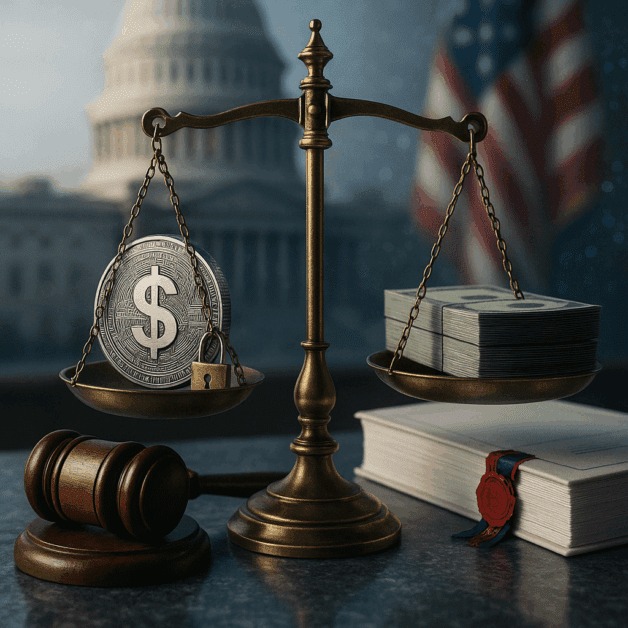
The Stablecoin Legislation That Just Became Federal Law
Federal stablecoin legislation has been signed into law, creating the first nationwide regulatory framework for U.S. stablecoins. It outlines baseline requirements for issuers such as reserve backing, disclosures, and compliance obligations. This article explains what the new law changes, who it applies to, and what holders and businesses should do next.
A New Era for Stablecoins in the United States
For years, the world of stablecoins operated in a legal gray area. There were guidelines, warnings, and plenty of debate in Washington — but no clear federal law telling companies exactly what they needed to do. That changed recently when stablecoin legislation was signed into federal law, marking one of the most significant moments in the history of cryptocurrency regulation in the United States.
If you hold, use, or simply follow digital currencies, this law affects the landscape you operate in. Here is a straightforward breakdown of what happened, what the law actually says, and why it matters to everyday people.
What Is a Stablecoin and Why Does It Need Regulation?
Before getting into the details of the legislation, it helps to understand what stablecoins are and why lawmakers felt the need to act.
A stablecoin is a type of cryptocurrency designed to hold a steady value. Most are pegged to the U.S. dollar, meaning one stablecoin is meant to always be worth one dollar. Popular examples include USDT (Tether), USDC (USD Coin), and others that millions of people use daily for payments, transfers, and trading.
The problem is that some stablecoins in the past have not been as “stable” as advertised. In 2022, the collapse of TerraUSD wiped out billions of dollars in value almost overnight. That event, along with the broader crash in crypto markets, pushed lawmakers to take the issue seriously. Without proper rules, consumers had no protection, and the financial system carried hidden risks.
The Key Points of the New Federal Stablecoin Law
The legislation puts a formal legal structure around who can issue stablecoins and under what conditions. Here are the most important things the law establishes:
- Only approved issuers can offer stablecoins: Companies that want to issue stablecoins in the U.S. must receive approval from a federal or state regulator. Operating without this approval is now illegal.
- Full reserve backing is required: Every stablecoin in circulation must be backed one-to-one by high-quality, liquid assets. These include U.S. dollars, short-term Treasury bills, and other low-risk holdings. Issuers cannot use customer funds for risky investments.
- Regular audits and disclosures: Approved issuers are required to publish monthly reports about their reserves and undergo regular audits. This gives the public a way to verify that the backing assets actually exist.
- The Federal Reserve plays a role: The law gives the Federal Reserve oversight authority over certain stablecoin issuers, particularly those connected to larger financial institutions. This brings stablecoins closer to the banking system than ever before.
- State-chartered issuers remain an option: Smaller issuers can choose to operate under state-level regulations, provided those rules meet federal minimum standards. This gives flexibility to the market while still maintaining baseline protections.
- Algorithmic stablecoins face strict limits: The law takes a cautious approach to algorithmic stablecoins — those that use software and market mechanics rather than real assets to maintain their value. These face tighter restrictions or outright prohibition until further review.
How This Law Compares to Previous Attempts
This is not the first time Congress tried to pass stablecoin regulation. Several bills were introduced over the past few years, but they stalled due to disagreements between Republicans and Democrats, disputes over the role of the Federal Reserve, and pushback from the crypto industry itself.
What made this legislation different was the political environment. With growing bipartisan concern about financial stability and a more crypto-friendly atmosphere in Washington following recent elections, negotiators found enough common ground to move the bill forward. Both sides had to give a little — the final law reflects compromises on state versus federal oversight and on how tightly to restrict newer types of stablecoins.
What This Means for Consumers and Everyday Users
If you use stablecoins for any reason — sending money, buying crypto, or holding digital dollars — this law is actually good news in several key ways:
- Better protection: You now have a legal guarantee that regulated stablecoins are backed by real assets. If a company claims its coin is worth one dollar, it has to prove it.
- More transparency: Monthly reserve reports mean you can check the financial health of any approved issuer before trusting them with your money.
- Clearer rules for businesses: Companies building products on top of stablecoins — like payment apps and financial services — now have a defined legal framework. This could actually speed up innovation because the uncertainty is gone.
- Reduced risk of collapse: The reserve requirements are specifically designed to prevent another TerraUSD-style situation where a stablecoin loses its value suddenly.
Of course, the law does not eliminate all risk. Unregulated coins from foreign issuers still exist, and enforcement across global markets remains a challenge. But within the United States, the rules are now much clearer.
What the Crypto Industry Thinks
Reactions from the cryptocurrency industry have been mixed but generally leaning positive. Larger, established players — especially those already operating regulated stablecoins like Circle, which issues USDC — welcomed the clarity. Having a legal framework removes the threat of sudden regulatory crackdowns and makes it easier to partner with traditional banks and financial institutions.
Smaller or newer crypto companies had more concerns. Some worry that the compliance costs — hiring legal teams, undergoing audits, maintaining reserve accounts — will be too high for startups to manage. Critics also argue that certain provisions give too much power to big banks at the expense of newer competitors.
Decentralized finance (DeFi) communities expressed concerns about how the law applies to projects that do not have a traditional corporate structure. Regulators have indicated that guidance on decentralized stablecoin projects will follow in the months ahead.
How This Fits Into the Bigger Picture of Cryptocurrency Law
The stablecoin law is one piece of a larger puzzle. U.S. lawmakers are still working on broader cryptocurrency legislation that would define which digital assets are securities, how crypto exchanges should be regulated, and what consumer protections should look like across the board.
The passage of this stablecoin law is widely seen as the opening move. It was viewed as the most achievable piece of crypto regulation because stablecoins are closely tied to the existing dollar-based financial system. Establishing rules here was less politically complicated than tackling Bitcoin, Ethereum, or the entire DeFi ecosystem all at once.
Expect to see more cryptocurrency law proposals in the coming months, with this legislation serving as a foundation and a model for what bipartisan compromise might look like.
What Happens Next
The law does not take effect all at once. Regulators have a set period — typically 12 to 18 months — to write the specific rules that companies must follow. During this time, federal agencies like the Office of the Comptroller of the Currency (OCC) and the Federal Reserve will publish detailed guidance, accept public comments, and finalize requirements.
Existing stablecoin issuers will need to apply for proper licenses or adjust their operations to comply. Companies that cannot meet the standards will need to either restructure or exit the U.S. market.
For consumers, the real-world impact will likely be felt gradually. You may notice that certain stablecoins become more prominent while others quietly disappear. Payment apps and crypto platforms will update their terms and disclosures to reflect the new legal reality.
The Bottom Line
The passage of federal stablecoin legislation is a genuine milestone. It brings one of the most widely used tools in the cryptocurrency world under a clear legal framework for the first time. While no law is perfect, and there will be debates about specific rules for years to come, the basic structure is now in place.
For anyone who cares about the future of digital money — whether as a user, an investor, or just a curious observer — this is a development worth understanding. The rules of the game have officially changed, and the era of stablecoin regulation in the United States has truly begun.














