
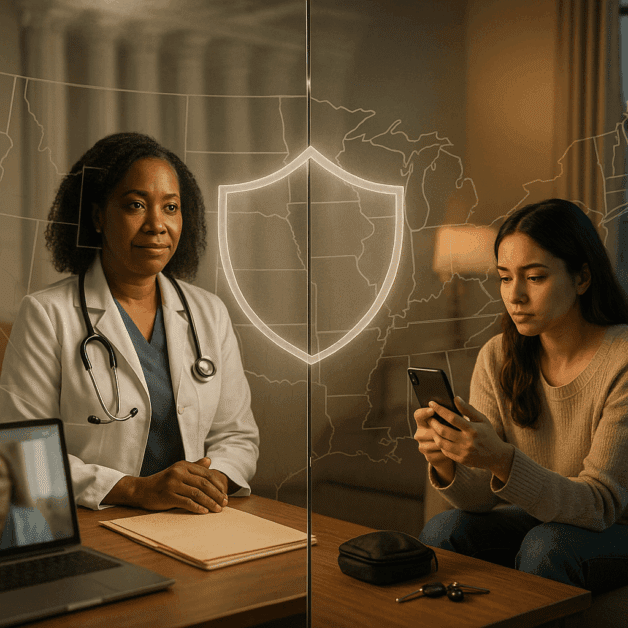
The ‘Shield Laws’ Protecting Out-of-State Doctors and Patients
Shield laws in more than a dozen states and Washington, D.C., are designed to protect doctors and patients involved in abortion and other legally provided care from out-of-state investigations and penalties. These measures can block extradition requests, limit cooperation with foreign subpoenas, and restrict the use of local courts or agencies to enforce another state’s laws. This article explains how shield laws work, who they cover, where they apply, and their legal limits and challenges.
What Are Shield Laws and Why Do They Matter?
In the years following the Supreme Court’s decision to overturn Roe v. Wade, a new legal battle has been quietly unfolding across state lines. A growing number of states have passed what are commonly known as “shield laws” — legal protections designed to defend doctors, patients, and other healthcare providers from being prosecuted or sued for abortion-related activities that are legal in their home state but restricted elsewhere.
These laws have become a critical part of the abortion law landscape in America, creating a kind of legal buffer between states with strict restrictions and those where abortion remains fully accessible. For many people, understanding how these laws work could be the difference between getting care and going without it.
How Shield Laws Actually Work
At their core, shield laws are about liability protection. They prevent state officials, courts, and law enforcement from cooperating with out-of-state investigations or legal actions targeting individuals for abortion services that were provided legally within the shield state’s borders.
Here’s what that typically looks like in practice:
- Doctors are protected: A physician in California, for example, who consults with or prescribes medication to a patient in Texas cannot be extradited, have their medical license revoked, or face civil lawsuits based on Texas law — as long as they acted within California’s legal framework.
- Patients are shielded too: Residents of restrictive states who travel to or remotely consult with providers in shield states are generally protected from being prosecuted under their home state’s laws for seeking that care.
- Interstate cooperation is blocked: Shield states instruct their officials not to honor subpoenas, extradition requests, or other legal demands from states trying to pursue abortion-related cases across state lines.
Which States Have Passed These Laws?
Since 2022, more than a dozen states have enacted some form of shield legislation. States including California, New York, Massachusetts, Colorado, Washington, and Illinois have been among the most active in passing these protections. While the specific language of each law varies, they share a common purpose: ensuring that healthcare providers and patients operating within their borders are not subject to the legal reach of states with abortion bans.
Some states have gone further than others. California, for instance, updated its shield law multiple times to close loopholes and strengthen protections, especially around the mailing of abortion medications like mifepristone and misoprostol.
The Role of Telemedicine in This Debate
One of the biggest factors driving the urgency of shield laws is the rise of telemedicine. A doctor sitting in Massachusetts can now legally consult with a patient in a state where abortion is banned — and prescribe medication through the mail. This has created a legal gray zone that restrictive states are trying to shut down and shield states are working to protect.
Healthcare provider rights are directly challenged in these cases. Without shield laws, a doctor could face losing their medical license or even criminal charges in another state simply for doing their job legally. These laws act as a wall between two conflicting sets of state regulations, allowing care to flow where it is needed most.
What Shield Laws Cannot Do
It’s important to be honest about the limits of these protections. Shield laws are powerful tools, but they are not perfect solutions.
- They do not stop all legal threats: A person physically located in a restrictive state can still face legal consequences under that state’s laws, especially if they seek care locally rather than traveling or using telemedicine from a shield state.
- Federal law could override them: If Congress were to pass a national abortion law — whether a ban or a protection — it would supersede individual state shield laws. The current patchwork of protections depends heavily on the political climate at the federal level.
- Legal uncertainty remains: No major court has fully ruled on the constitutionality of shield laws in the context of interstate abortion conflicts. The legal foundation, while solid in many respects, has not been fully tested at the highest levels.
- Enforcement can be unpredictable: The practical ability of a restrictive state to pursue someone across state lines is often limited, but it is not zero. Civil lawsuits funded by private individuals — as seen in Texas — create a different kind of legal pressure that shield laws may not completely block.
Why State Regulation Is at the Heart of the Issue
The United States has always operated under a system of federalism, where both state and federal governments share power. But the abortion debate has pushed that system to its limits. State regulation of healthcare is not unusual — states routinely set their own rules for medical licensing, insurance, and procedures. What is unusual is when two states have directly opposing laws that both claim to govern the same medical act.
Shield laws are essentially one state saying, “Our rules apply within our borders, and we will not help another state punish someone for following them.” This is a legally defensible position, but it creates enormous complexity for patients, doctors, insurers, and courts alike.
What This Means for Everyday People
For someone living in a state with strict abortion restrictions, shield laws represent a potential lifeline — but only if they can access care in a state that offers those protections. That often means having the financial means to travel, the ability to take time off work, or reliable internet access for telemedicine consultations. Not everyone has those resources.
For healthcare providers, these laws offer reassurance but also demand careful attention to the specific rules of their state. A doctor must understand exactly what their shield law covers before consulting with out-of-state patients, prescribing medications, or sharing medical records.
The Ongoing Legal Battle
The tension between restrictive states and shield states is not going away. Several restrictive states have already taken legal steps to challenge the scope of shield protections, arguing that another state cannot simply refuse to cooperate with legitimate legal processes. These conflicts will almost certainly make their way to federal courts in the coming years.
At the same time, advocacy groups on both sides of the abortion law debate are watching closely. Those who support abortion access view shield laws as essential tools for protecting healthcare provider rights and ensuring patients can make their own medical decisions. Those who oppose abortion argue that shield laws allow states to interfere with the enforcement of democratically passed laws in other states.
Looking Ahead
Shield laws represent one of the most creative and contested responses to the post-Roe legal landscape. They reflect a country deeply divided on abortion policy, where states are essentially building walls — some to keep abortion services out, and others to protect those who provide and seek them.
What is clear is that the legal framework around abortion is still evolving rapidly. For patients, doctors, and policymakers, staying informed about how these laws work — and where they fall short — is more important than ever. The rules are being written in real time, and the stakes could not be higher.














