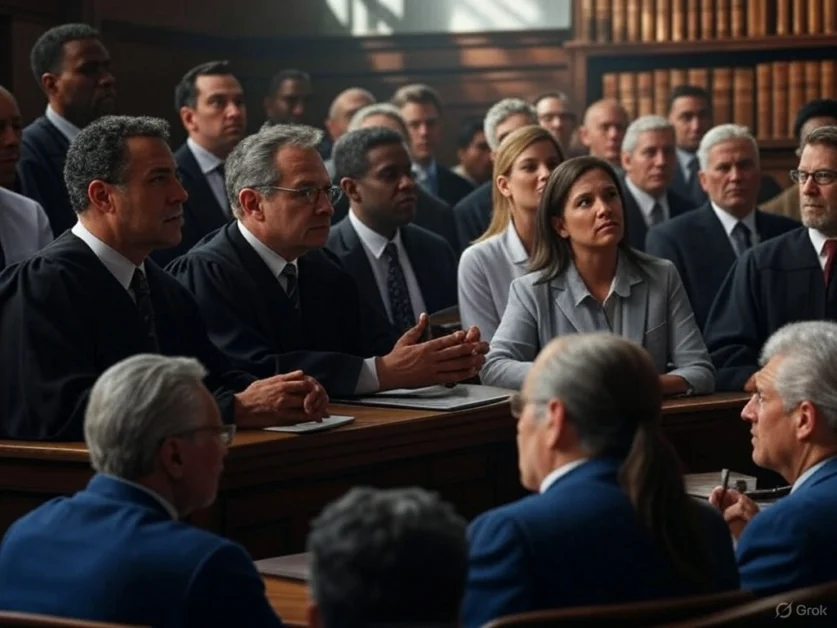
Explore a comprehensive collection of resources dedicated to understanding the intricacies of constitutional law. Visitors will find informative articles, in-depth video interviews with legal experts, and clear definitions of key terms, all designed to deepen your knowledge of individual rights, governmental powers, and landmark Supreme Court cases. Whether you're a legal professional or someone seeking clarity on constitutional issues, this category provides authoritative insights and guidance.
The Fifth and Fourteenth Amendments stand as twin pillars in our constitutional architecture, establishing crucial protections against governmental overreach through their respective due process clauses. These constitutional guarantees ensure that no person shall be “deprived of life, liberty, or property, without due process of law.” Though separated by nearly eight decades and born of different […]
The recent term of the Supreme Court has produced a series of landmark legal precedents that will reshape American jurisprudence for generations. These decisions reflect the Court’s evolving interpretation of constitutional principles and statutory frameworks, establishing new legal standards that will guide lower courts, legislators, and executive agencies. The significance of these rulings cannot be […]
The American constitutional framework establishes due process as a cornerstone of our legal system, providing essential protections against arbitrary government action. The concept of due process encompasses two distinct but related doctrines: procedural due process and substantive due process. Understanding the differences between these two types of due process is crucial for comprehending how our […]
In the American legal system, due process rights in criminal proceedings form the bedrock of procedural justice, ensuring that every defendant receives fair treatment under the law. These constitutional protections stand as a bulwark against arbitrary governmental action, safeguarding individual liberty even when one stands accused of wrongdoing. Understanding these rights is not merely academic—it […]
The concept of due process stands as one of the most fundamental pillars of American jurisprudence, serving as a bulwark against arbitrary governmental action and ensuring that legal proceedings adhere to principles of fairness and justice. This cornerstone of American legal thought did not emerge fully formed but rather evolved through centuries of legal development, […]
The proliferation of digital platforms in modern society has created unprecedented legal challenges for lawmakers, courts, and regulatory bodies. These platforms—from social media giants to e-commerce marketplaces—have fundamentally altered how individuals communicate, conduct business, and consume information. The legal challenges in regulating digital platforms stem from their novel business models, global reach, and the rapid […]
The American criminal justice system is built on the premise that prosecutors serve not merely as advocates for conviction, but as ministers of justice. When prosecutors overstep this role, the consequences can be profound, undermining the integrity of the courts and threatening the rights of the accused. Prosecutorial misconduct examples: grounds for appeal or dismissal […]
The principle of double jeopardy stands as one of the most fundamental protections in our constitutional order. Enshrined in the Fifth Amendment, this doctrine prohibits the government from subjecting any person “for the same offence to be twice put in jeopardy of life or limb.” This protection against repeated prosecutions for identical offenses represents a […]
The concept of entrapment defense stands as a critical safeguard in our criminal justice system, protecting citizens from overzealous law enforcement tactics that might otherwise induce law-abiding individuals to commit crimes. When police officers or government agents go beyond merely providing an opportunity to commit a crime and instead actively persuade, threaten, or coerce individuals […]
The regulation of artificial intelligence in legal decision-making processes represents one of the most significant challenges facing our legal system today. As courts, administrative agencies, and legal practitioners increasingly rely on algorithmic tools to assist with or even make consequential decisions, the question of how the law regulates these technologies has taken on paramount importance. […]
The rapid integration of technology into government systems has created a complex web of legal challenges that demand careful consideration. As digital tools increasingly shape how governments operate, collect data, and interact with citizens, the legal frameworks governing these activities struggle to keep pace with innovation. The influence of technology on government operations raises fundamental […]
The Fourth Amendment of the United States Constitution stands as a bulwark against unreasonable searches and seizures, safeguarding the privacy and property rights of American citizens against governmental overreach. This fundamental protection, however, is not absolute, and the complexities surrounding illegal search and seizure and the process of getting evidence thrown out of court continue […]