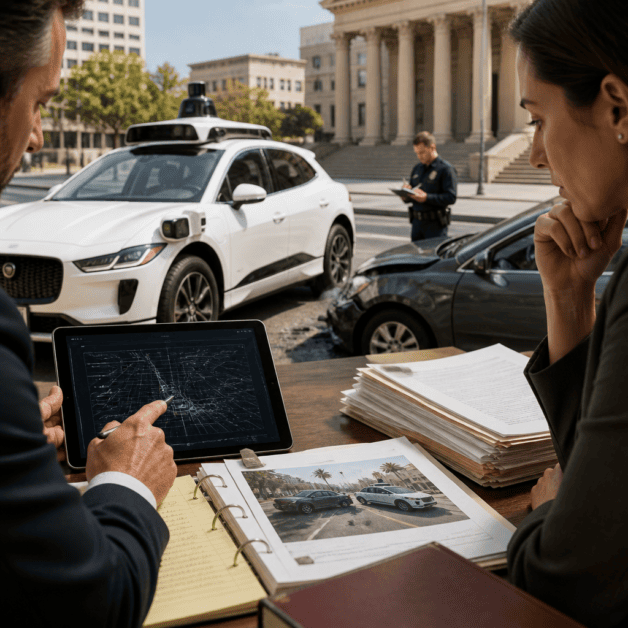
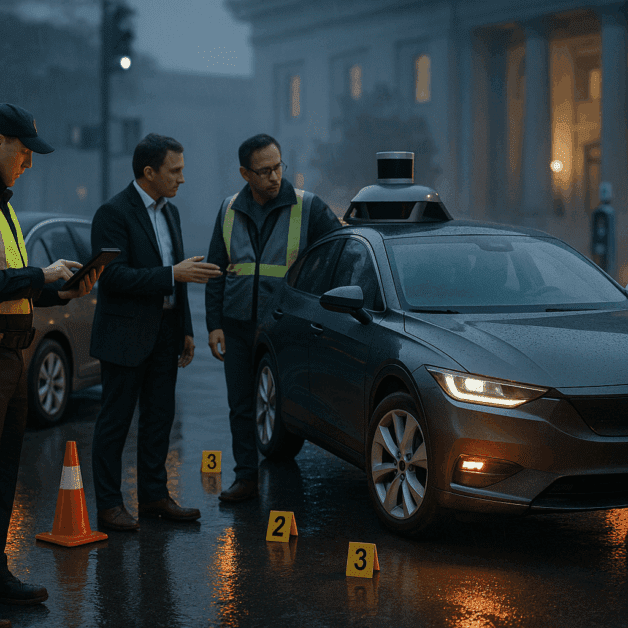
Legal issues involving the testing, deployment, and operation of self-driving and driver-assist vehicles. Covers regulatory compliance and permitting, liability and insurance after crashes, product defect and cybersecurity risks, data privacy, and questions of responsibility among drivers, manufacturers, and software providers.
A Phoenix autonomous vehicle left-turn crash can involve multiple liable parties—not just the human driver—because Arizona law recognizes fault apportionment among everyone who contributed to the collision. When Tesla Full Self-Driving (FSD) is engaged, liability analysis expands to include driver conduct, system limitations, and potential product defects. This article explains how to prove liability in […]
In most Phoenix Waymo robotaxi crashes, liability is determined by one core question: who had the legal duty to drive safely at the moment of impact—human or automated system. Arizona’s autonomous-vehicle framework allows fully driverless operation, which shifts many cases toward product liability, fleet maintenance, and company negligence theories rather than “driver error.” This article […]
Arizona generally allows injured Phoenix crash victims 2 years to file a negligence lawsuit, including claims involving autonomous vehicles. Waymo robotaxis operate in metro Phoenix, and collisions raise unique questions about driverlessness, corporate responsibility, and high-tech evidence. This article explains how to prove liability using insurance layers, vehicle data logs, and Arizona negligence rules. Proving […]
[In Phoenix, proving liability in an autonomous-vehicle pedestrian crash often requires establishing negligence and preserving electronic evidence within days—before key logs are overwritten. Phoenix streets now see increased testing and deployment of self-driving systems, raising unique questions about who is legally responsible when a pedestrian is hit. This article explains how to prove fault in […]
California rear-end collisions create a rebuttable presumption of fault against the trailing driver—even when a Level 3 automated driving system (ADS) is engaged. In 2026, proving fault usually turns on who had “control” at the moment of impact, what the ADS did, and whether warnings were timely and followed. This article explains the evidence, statutes, […]
In California, proving liability in a Tesla Autopilot crash with a human override usually requires showing (1) who had “control” at the critical moment and (2) which duty was breached under comparative fault rules. Because Autopilot is driver-assist—not a fully autonomous system—Tesla, the human driver, and sometimes third parties may share responsibility. This article explains […]
Under emerging 2026 rules, liability in an autonomous vehicle crash can shift among 3 parties: the human driver/operator, the automaker, and the autonomous software provider. Investigators use event data recorders, ODD limits, and system-status logs to determine whether it was driver misuse, a product defect, or a software failure. This article explains how fault, insurance […]