How to Prove Liability in a Phoenix, Arizona Autonomous Vehicle Pedestrian Accident Involving Waymo or Cruise
[In Phoenix, proving liability in an autonomous-vehicle pedestrian crash often requires establishing negligence and preserving electronic evidence within days—before key logs are overwritten. Phoenix streets now see increased testing and deployment of self-driving systems, raising unique questions about who is legally responsible when a pedestrian is hit. This article explains how to prove fault in Arizona cases involving Waymo or Cruise, including evidence, defendants, and litigation strategy.]
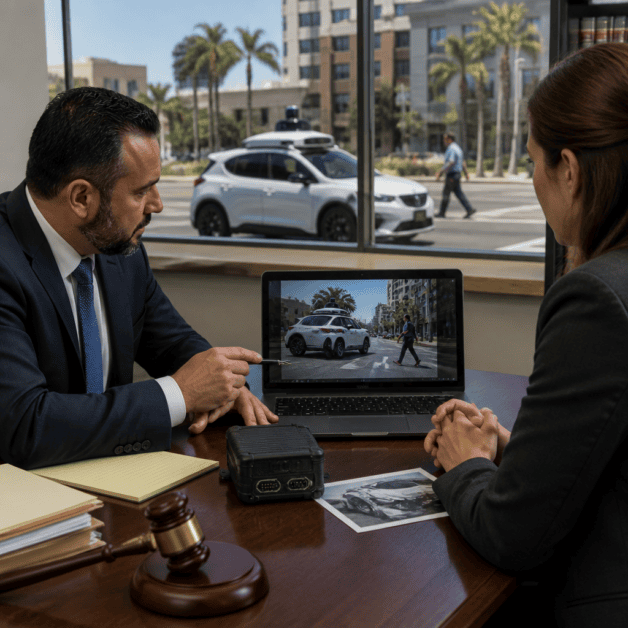
Autonomous vehicles (AVs) change the “who is at fault” analysis in a pedestrian collision. In Phoenix, a crash involving a Waymo or Cruise vehicle can still be a traditional negligence case—but it may also involve product liability, negligent supervision, or corporate policies that affect how the vehicle drives and responds to pedestrians. The key difference is evidence: AVs generate extensive electronic data (camera video, LiDAR/radar returns, system logs, remote-operator records, and mapping information) that can prove exactly what the vehicle “saw,” decided, and did.
Below is a practical, litigation-focused guide to proving liability in a Phoenix autonomous vehicle pedestrian accident—what you must prove under Arizona law, who can be responsible, and the evidence that most often wins these cases.
1) What You Must Prove in an Arizona Pedestrian Injury Claim
Most Phoenix pedestrian injury lawsuits start with negligence. To prove negligence in Arizona, an injured pedestrian generally must establish:
Duty of care
Drivers and vehicle operators must use reasonable care to avoid harming others. Autonomous-vehicle operators and companies are not exempt from this duty simply because software is driving. If the vehicle is operating on Phoenix roads, someone—often a corporate entity—has a duty to deploy and operate it safely.
Breach
You must show the defendant failed to use reasonable care. In AV cases, breach can look like:
- Failing to yield at a marked crosswalk or to a pedestrian lawfully in the roadway
- Unsafe speed for conditions (night, glare, rain, construction cones, crowding)
- Improper right turn on red near pedestrians
- Failure to detect or classify a pedestrian (including a child, wheelchair user, or person walking a bike)
- Unsafe “behavior planning,” such as creeping forward or proceeding with an obstructed view
Causation
You must connect the breach to the injury. Autonomous data is often the best way to prove causation because it can show the vehicle’s speed profile, braking, steering, and perception timeline in the seconds before impact.
Damages
Damages include medical bills, future care, lost earnings, pain and suffering, and, in severe cases, life-care costs and loss of consortium. AV cases frequently involve high medical damages due to the vulnerability of pedestrians.
2) Arizona Comparative Fault: Expect the Defense to Blame the Pedestrian
Arizona uses a pure comparative fault system. That means a pedestrian can still recover damages even if they are partially at fault, but the recovery is reduced by their percentage of fault. In practice, Waymo/Cruise-style defenses may argue:
- The pedestrian crossed outside a crosswalk
- The pedestrian entered the road suddenly
- Dark clothing/low visibility prevented detection
- The pedestrian was distracted (phone, earbuds)
To counter this, your proof must be time-stamped and physics-based: precise speed, distance, perception, and braking data, backed by scene measurements and video.
3) Identify All Potential Defendants (It’s Rarely Just “the Car”)
Autonomous vehicle pedestrian cases often have multiple liable parties. Early identification matters because each party controls different evidence and insurance.
Waymo or Cruise (the AV operator and deploying entity)
If the AV is part of a robotaxi or testing fleet, the company operating the service is usually the primary defendant for negligent operation, negligent training/supervision, and policies governing the automated driving system.
Safety driver or remote operator (if applicable)
Some deployments involve safety operators or remote assistance. If a human had the ability or duty to intervene, issues include reaction time, attentiveness, and compliance with internal protocols.
Manufacturers and component suppliers
If the crash implicates defective sensors, braking systems, or steering components, product liability may apply. Defendants can include the vehicle manufacturer, the AV system integrator, and specific component manufacturers.
Maintenance providers
Poor calibration, sensor cleaning, tire/brake maintenance, or firmware update failures may open the door to negligence claims against contractors.
Government entities (limited, but possible)
If roadway design, signal timing, or construction-zone control contributed, a city or state entity might be involved. Government claims in Arizona are time-sensitive and procedurally strict, so attorneys must evaluate this immediately.
4) The Most Important Evidence in a Phoenix AV Pedestrian Crash
Standard pedestrian crash evidence (photos, witness statements, police report) still matters. But autonomous cases can hinge on electronic data that can disappear quickly due to retention policies or routine overwriting.
1) AV sensor and video data
Look for multi-angle camera footage, LiDAR point clouds, radar tracks, and sensor fusion outputs. This can help answer:
- When did the system first detect the pedestrian?
- How did it classify the pedestrian (adult, child, cyclist, unknown object)?
- Did the system predict the pedestrian’s path correctly?
- What was the “time-to-collision” and when did braking begin?
2) Event data recorder (EDR) / “black box” information
Even autonomous vehicles may store EDR-style data such as speed, throttle, brake application, steering angle, stability control, and crash pulse information. This helps lock down the physics of the impact.
3) Autonomy system logs and disengagement reports
AV systems record state changes—autonomous mode, manual takeover, alerts, emergency braking, and fault codes. A critical question is whether there was a disengagement, a system fault, or a delayed response.
4) Mapping and geofencing records
AVs rely on high-definition mapping and operational design domains (ODDs). If the vehicle operated outside intended conditions—poor lighting, heavy rain, unprotected left turns, or an unexpected construction detour—those facts can support negligence and punitive themes.
5) Remote assistance records and internal communications
If remote guidance occurred, you may need call logs, text/dispatch records, and remote operator screens. These can establish whether the company’s remote support was timely and competent.
6) Scene evidence: visibility, signage, and timing
In Phoenix, glare, wide arterial roads, and high-speed corridors can be central issues. Preserve:
- Signal timing and pedestrian phase data
- Lighting conditions and streetlight outages
- Skid marks, gouge marks, debris fields, and impact points
- Surveillance video from nearby businesses or residences
5) Preserving Evidence: Spoliation Letters and Rapid Investigation
In AV litigation, evidence preservation is a case-within-a-case. A strong early preservation plan often determines whether you can prove liability.
Send a targeted preservation/spoliation letter immediately
Your notice should identify categories of data to preserve, including raw sensor data, processed perception outputs, system logs, remote assistance records, mapping data, incident reports, and any internal reconstructions. It should also request preservation of the vehicle in its post-crash condition and prevent software updates or repairs that could alter data.
Seek a temporary restraining order (TRO) if necessary
If you have credible concern that critical vehicle data will be overwritten, counsel may consider emergency court relief to prevent alteration or destruction—especially where the vehicle is back in service quickly.
Coordinate with accident reconstruction and AV experts
Traditional reconstruction experts help with speed, impact geometry, and human factors. Autonomous-specific experts help interpret perception stacks, braking logic, object classification, and system limitations.
6) Theories of Liability That Commonly Apply to Waymo or Cruise Pedestrian Cases
Negligent operation (corporate driver theory)
Even without a human behind the wheel, the company deploying the vehicle can be liable for operating an unsafe system on public roads. The argument is straightforward: a reasonable operator would not deploy a system that fails to detect pedestrians reliably, yields improperly, or behaves unpredictably at crosswalks.
Negligent supervision, training, and monitoring
If human safety operators or remote personnel are part of the deployment, the plaintiff may allege the company failed to train, supervise, or staff them appropriately—especially if response time or escalation protocols were inadequate.
Product liability (design defect, manufacturing defect, failure to warn)
When the crash stems from how the AV system is designed—e.g., it systematically misclassifies pedestrians at night or in certain lighting—design defect claims can apply. Failure-to-warn theories may arise if the company knew of recurring issues (for example, problems in construction zones or with certain pedestrian behaviors) and did not adequately mitigate or disclose them.
Negligence per se (where a traffic law violation is shown)
If evidence shows a clear violation of Arizona traffic rules (such as failing to yield where required), that violation can be powerful proof of breach. In practice, AV logs and camera footage are often the cleanest way to establish the violation beyond dispute.
7) Proving the “Why”: Using AV Data to Tell a Jury What Happened
Jurors understand yielding at a crosswalk; they do not automatically understand “perception stack latency” or “planner indecision.” A winning case translates technical facts into common-sense safety failures.
Example: Crosswalk failure to yield
A pedestrian enters a marked crosswalk at dusk near a busy Phoenix arterial. The AV’s forward camera sees