How to Document a Car Accident in Arizona After a Hit-and-Run When the Other Driver Isn’t Found
Arizona law requires you to report many crash injuries or significant damage to law enforcement “immediately,” and insurers often expect prompt notice—ideally within 24 hours. In a hit-and-run where the other driver isn’t found, your documentation is what proves fault, damages, and coverage eligibility. This guide explains exactly what to collect, how to preserve it, and how Arizona claims typically work when the at-fault driver disappears.
When the at-fault driver flees and is never identified, the case turns on one question: can you prove what happened and what it cost you? In Arizona hit-and-run claims, documentation replaces the missing driver. The strongest cases are built in the first hours and days—through a disciplined record of the scene, the vehicle, your injuries, your expenses, and every communication with police and insurers.
This article provides a practical, Arizona-focused documentation playbook for attorneys, accident victims, and claims professionals—especially when the police cannot locate the other driver.
1) Immediate Arizona priorities: safety, reporting, and preservation
Get safe, then document before the scene changes
If you are able, move to a safe location and call 911. Then begin capturing information that will disappear quickly: vehicle positions, debris fields, skid marks, traffic signal timing, and witness presence. In hit-and-runs, the other car is gone—so the condition of your vehicle and the scene become the “other driver’s statement.”
Arizona reporting rules that matter for documentation
Arizona requires drivers involved in a crash that results in injury or death—or property damage that appears to meet the statutory threshold—to immediately notify law enforcement. If the collision involves a hit-and-run, calling police promptly is also essential to trigger a formal report, initiate any search, and document contemporaneous observations (odor of alcohol, witness statements, roadway hazards).
Documentation tip: Write down the time you called 911, the dispatcher’s name/ID if available, the responding agency (city police, DPS, sheriff), and the incident or call number provided.
Do not “fix” evidence prematurely
It is natural to want repairs quickly. But in unidentified-driver claims—especially uninsured motorist (UM) or collision disputes—the insurer may question whether the damage matches your description. Preserve the vehicle in its post-crash condition until you’ve completed comprehensive photographs and, if possible, an inspection. If towing is required, obtain tow records and ask the yard to keep the vehicle available for inspection.
2) Scene documentation checklist (the first 30 minutes)
Photographs and video: what to capture
Use your phone camera, but be systematic. Take wide shots, medium shots, then close-ups. A useful set often includes:
- Wide: intersection or roadway context; lanes; traffic lights/signs; nearby businesses/cameras.
- Vehicle position: your car relative to lane markers, curb, median, or shoulder.
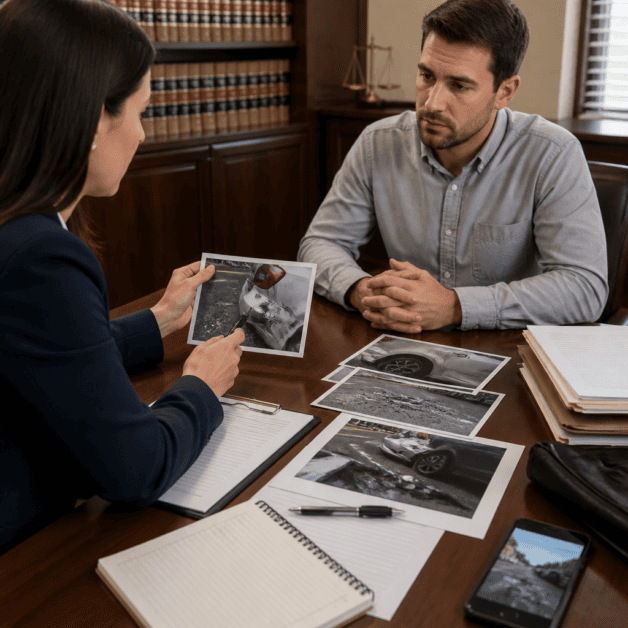
- Damage patterns: multiple angles of each damaged panel; close-ups of paint transfer, scrapes, dent edges.
- Debris and marks: broken plastic, glass, skid marks, gouges, fluid trails.
- Injury evidence: visible bruising, abrasions (not graphic); torn clothing; deployed airbags.
- Lighting and weather: sun glare, darkness, rain; wet pavement.
Example: If your left rear quarter panel is crushed, capture the direction of impact and any paint transfer. Blue paint transfer can later align with a witness description (“dark blue sedan”) or a suspected vehicle found with matching damage.
Write a “scene memo” while it’s fresh
In hit-and-runs, memory drift is a major problem. Open a notes app and record:
- Exact location (cross-streets, direction of travel, lane)
- Time of crash and approximate speed
- What you saw of the fleeing vehicle (make/model guesses, color, decals, damage, sound)
- Partial plate, state, plate frame, or distinguishing characters
- Number of occupants and any descriptions
- What the other driver did (ran red light, merged into you, reversed, etc.)
Documentation tip: If you can safely do so, dictate a short voice memo. Audio often captures nuance faster than typing.
Witnesses: your most valuable substitute for the missing driver
Witnesses disappear fast. Politely ask for:
- Name and phone/email
- Where they were positioned when they saw the crash
- Whether they saw a plate, direction of travel, or vehicle description
If a witness is willing, record a short video statement on your phone: “My name is…, I saw…, from…, the car that fled was….” This can be powerful if they later become unreachable.
3) Video evidence in Arizona: how to secure it before it’s overwritten
Identify all possible cameras near the crash
In metro areas like Phoenix, Tucson, Mesa, and Scottsdale, evidence often exists even when drivers aren’t located. Common sources include:
- Business surveillance (gas stations, convenience stores, restaurants)
- HOA and residential doorbell cameras facing the street
- Parking lots and garages
- City or DOT traffic cameras (availability and retention vary)
- Your dash cam or a rideshare driver’s dash cam
Act fast: retention windows can be days, not weeks
Many systems overwrite footage in 3–14 days. If you can, return to nearby businesses quickly and request they preserve footage for the relevant date/time window. When represented, attorneys typically send preservation letters immediately. Even if a business won’t provide a copy to you, asking them to preserve it can prevent destruction while a subpoena or formal request is pursued.
Documentation tip: Photograph the camera location and the business address. Write down the manager’s name and the time you spoke.
4) Police report strategy: what to provide and what to request
Give responding officers concrete, usable details
A vague report (“car sped away”) can weaken a UM claim or later investigation. Provide your scene memo, witness info, and any video leads. Ask the officer to include:
- Witness names and contact information
- Direction of flight and vehicle description
- Debris/paint transfer notes
- Any nearby camera locations you identified
Obtain the report number and follow up
Before leaving, request the report number (or incident number). After the report is available, review it for accuracy. If key details are missing (e.g., witness phone number, vehicle color), follow the agency’s procedure to supplement the record. Keep a printed copy and a digital copy in your claim folder.
5) Medical documentation: prove injury and causation without delay
Get evaluated promptly—even if symptoms are mild
Soft-tissue injuries, concussions, and back/neck injuries often present hours later. Delayed treatment creates an insurer argument that the injury was unrelated. Go to urgent care, your primary care provider, or the ER based on symptom severity. Explain it was a motor vehicle collision and describe all symptoms, however minor.
Create an “injury timeline”
Maintain a simple daily log for the first 30 days, then weekly. Include:
- Pain level and locations
- Sleep disruption
- Activity limitations (driving, lifting, work tasks)
- Medication side effects
- Missed work and modified duties
Example: “Day 3: neck stiffness and headaches; couldn’t complete shift; took prescribed muscle relaxer; drowsy.” This ties symptoms to functional impact—critical in settlement valuation.
6) Vehicle and property damage documentation: make the impact undeniable
Photograph and inventory everything
Take photos of:
- All exterior damage and undercarriage if possible
- Interior impact points (steering wheel, seat belt marks, headrest position)
- Child car seats (these may require replacement after a crash)
- Personal property damaged inside the car (phone, glasses, laptop)
Keep repair estimates, supplements, and parts photos
Insurers often issue an initial estimate that later “supplements” after teardown. Save:
- Initial estimate
- Supplemental estimates
- Final invoice
- Photos from the body shop during teardown
Documentation tip: Ask the shop to note paint transfer, collision direction indicators, and structural damage. These details can corroborate your version when the other driver is unknown.
7) Insurance documentation in Arizona: UM/UIM, collision, and notice
Notify your insurer quickly and in writing
Even when the other driver isn’t found, you may have coverage through:
- Uninsured motorist (UM): often applies when the at-fault driver is unidentified or uninsured, depending on policy terms and facts
- Collision coverage: pays for vehicle repairs subject to deductible
- MedPay: may pay medical bills regardless of fault (if purchased)
Provide basic facts without speculation. Ask for the claim number, adjuster name, and a written list of what they need.