
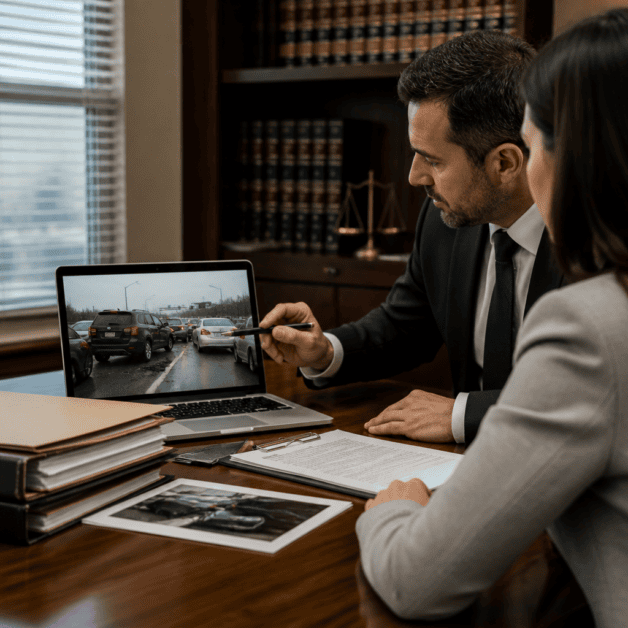
How to Prove Negligence in a Multi-Car Pileup on I-95 in Florida Using Dashcam and Police Report Evidence
Proving negligence in a Florida I-95 multi-car pileup typically requires 4 elements—duty, breach, causation, and damages—supported by objective evidence like dashcam video and the Florida Traffic Crash Report. I-95 pileups often involve chain-reaction impacts, conflicting accounts, and multiple insurance carriers. This article explains how Florida attorneys use dashcam footage and police-report evidence to establish liability, preserve proof, and handle comparative fault in complex crashes.
Why I-95 multi-car pileups are uniquely hard to prove
Multi-car collisions on I-95 in Florida routinely produce competing narratives: one driver insists they were “stopped safely,” another says they were “cut off,” and several motorists may not know what happened behind them. In chain-reaction crashes, the legal question is rarely “Who hit whom?”—it’s “Who caused the sequence that made the impacts unavoidable?”
Florida negligence claims require proof of four elements: (1) the defendant owed a duty of reasonable care, (2) the defendant breached that duty, (3) the breach caused the crash and injuries (causation), and (4) the plaintiff suffered damages. In a pileup, the dispute is usually about breach and causation—especially when multiple impacts occur within seconds.
Florida’s legal framework: duty, breach, causation, damages—and comparative fault
Duty and breach on an interstate
Every driver on I-95 owes a general duty to operate their vehicle reasonably under the circumstances, including maintaining a safe following distance, keeping a proper lookout, obeying speed limits, and adjusting to traffic, weather, and visibility. In pileups, common alleged breaches include:
– Following too closely (tailgating) and rear-ending a slowing vehicle
– Excessive speed for conditions (heavy rain, fog, construction, debris)
– Unsafe lane changes or sudden braking without necessity
– Distracted driving (phone use) and delayed reaction times
– Impairment or fatigue
– Failure to move disabled vehicles to safety or use hazard lights when possible
Causation: the “but for” and “legal cause” problem in a chain reaction
In a multi-impact crash, a defendant may admit they struck a vehicle but argue their impact was minor or occurred after the plaintiff’s primary injury. That makes causation evidence critical. Attorneys often break causation into two timelines:
(1) Crash causation: who triggered the hazardous event (sudden stop, lane intrusion, loss of control).
(2) Injury causation: which impact(s) caused which injuries and property damage.
Comparative negligence in Florida and why it changes strategy
Florida applies comparative fault rules, meaning a plaintiff’s recovery can be reduced based on their percentage of fault. In pileups, insurers frequently argue the injured driver contributed by driving too fast for congestion, following too closely, or failing to brake earlier. That is why objective evidence—dashcam footage, event data, measurements, and timestamps—often determines whether fault is fairly allocated.
Dashcam footage: the most persuasive “neutral witness” in an I-95 pileup
What dashcam video can prove
Dashcam footage can establish critical facts that human witnesses often misperceive during fast-moving freeway collisions:
– Traffic flow and spacing seconds before impact
– Brake lights and the timing of sudden stops
– Lane positions and unsafe merges
– Speed relative to surrounding traffic (even without exact mph)
– Weather, visibility, and road conditions (standing water, glare, debris)
– Whether a vehicle was stopped in a travel lane without hazards
– The number and sequence of impacts (especially with audio)
Front, rear, and cabin cameras: why each matters
A front-facing camera can capture the precipitating event (for example, a driver cutting across lanes near an exit). A rear camera is often even more important in a rear-end sequence because it shows whether the trailing driver had time and distance to stop. A cabin camera may capture the driver’s reactions, hands, and whether they were distracted—though it also raises privacy considerations and should be handled carefully in litigation.
Authenticating dashcam evidence in a claim or lawsuit
To use dashcam footage effectively, an attorney should be prepared to show it is authentic and unaltered. Practical steps include:
– Preserve the original memory card and create forensic copies
– Maintain a clear chain of custody (who handled it, when, and why)
– Document device details (make/model), date/time settings, and GPS overlays
– Export in native format when possible, not only a compressed clip
– Save “pre-impact” buffers (many cameras overwrite in loops)
Even where the video is not perfectly timestamped, attorneys can correlate events using 911 call logs, crash report times, toll transponder records, or nearby surveillance footage to establish a reliable timeline.
Police reports in Florida: valuable leads, but know the limits
What the Florida Traffic Crash Report typically contains
The Florida Traffic Crash Report is a roadmap to the investigation. Depending on the agency and severity, it may include:
– Driver and witness identification and contact data
– Vehicle diagrams and point of impact indications
– Roadway, lighting, and weather observations
– Citations or contributing circumstances (speeding, following too closely)
– Statements summarized by the officer
– Injury coding and EMS involvement
– Measurements, skid marks, debris fields, and lane blockages
Crash report privilege: why the report may not be fully admissible
Florida law limits the admissibility of certain crash report contents in civil trials, particularly statements made for purposes of completing the report. Practically, that means the crash report is often most powerful as an investigative tool: it identifies witnesses, points attorneys to additional evidence, and suggests theories of fault. An attorney can still use admissible components and independent evidence—like photos, video, and testimony—to prove the same facts without relying on privileged statements.
How attorneys use the report strategically
In I-95 pileups, the report helps counsel quickly spot key issues:
– Whether the investigating officer identified a “first harmful event”
– Whether a driver received a citation (useful for settlement posture even if not determinative)
– Whether road conditions or construction were noted, prompting third-party inquiries
– Whether commercial vehicles were involved, raising FMCSA compliance questions
Building the negligence case: a step-by-step proof model
Step 1: Lock down the timeline and sequence of impacts
Because chain-reaction collisions can involve 5–20 vehicles, proving sequence is foundational. Attorneys often combine:
– Dashcam video time markers and audio impact cues
– Vehicle damage profiles (rear crush vs. front-end intrusion)
– Police diagrams and measurements
– 911/dispatch timestamps
– Photos taken at the scene and vehicle rest positions
Example: A dashcam shows traffic slowing near a merge, Vehicle A swerves into the plaintiff’s lane and brakes, the plaintiff brakes hard, and Vehicle B rear-ends the plaintiff seconds later. The timeline supports negligence against Vehicle A (unsafe lane change/braking) and Vehicle B (following too closely), with comparative fault arguments evaluated against the plaintiff’s speed and spacing.
Step 2: Prove breach with objective indicators
Dashcam footage can show a breach directly (texting posture, drifting lanes, late braking). If the dashcam does not capture the at-fault vehicle clearly, breach can still be proven through reconstruction and physical evidence:
– Skid marks and yaw marks (braking vs. loss of control)
– Debris patterns and gouge marks
– Crush depth consistent with high-speed impact
– ECM/EDR downloads (where available) showing braking and throttle
Step 3: Prove causation—link the breach to the pileup and the injury
Florida pileups often produce the defense argument: “My client hit them, but the injury happened earlier (or later).” Attorneys counter with:
– Dashcam audio and frame-by-frame impact sequencing
– Medical records tied to onset and mechanism of injury
– Biomechanical and reconstruction experts where warranted
– Repair estimates and total loss analysis matching impact severity
Example: The plaintiff is struck twice—first a moderate rear-end, then a high-energy secondary impact when another vehicle is pushed into them. Video plus damage analysis can separate the forces and support apportionment across negligent drivers, while still establishing that each negligent act was a legal cause of some portion of harm.
Step 4: Document damages early and continuously
Negligence claims rise or fall on damages proof. Attorneys should gather:
– ER/urgent care records, imaging, and specialist referrals
– Physical therapy and future care estimates
– Wage loss verification and work restrictions
– Pain journals and functional limitation documentation
– Property damage photos, rental records, and diminished value where applicable
In a pileup, insurers sometimes minimize injuries as “low impact” by pointing to the wrong collision in the sequence. Matching injuries to the correct impact using video, photos, and medical opinion can prevent under-valuation.
Preserving crucial evidence on I-95: dashcams, traffic cameras, and commercial data
Send spoliation/preservation letters immediately
Some of the best evidence in an I-95 crash is ephemeral. Video systems overwrite in days; commercial telematics can be purged; tow yards may dispose of vehicles. Preservation letters should target:
– At-fault drivers and their insurers (preserve phones, vehicles, EDR/ECM data)
– Commercial carriers (driver logs, GPS, dashcam, Qualcomm/ELD data)
– Businesses and agencies with nearby surveillance (gas stations, hotels, DOT assets)
– Towing/storage facilities (no destructive inspections without notice)
Look for third-party video sources beyond the dashcam
Even if the client lacks a dashcam, attorneys














