Government Accountability

Explore content that delves into the mechanisms ensuring that public officials and institutions adhere to the law, featuring expert interviews and insightful articles. Gain a deeper understanding of legal terms like oversight, transparency, and regulatory compliance, crafted by legal professionals. Stay informed about the processes that uphold integrity and prevent misconduct within government structures.

Legal scales with gavel and constitution document

What is due process?

Due process is a constitutional guarantee in the Fifth and Fourteenth Amendments that requires fair procedures before the government can deprive a person of life, liberty, or property. It protects against arbitrary government action through notice, a meaningful hearing, and an impartial decision-maker. This article explains procedural vs. substantive due process and common examples in

What is due process? Read More »

Illustrative Insight into Deliberate Indifference and Prisoner Rights

Why Inmates Are Vulnerable to Deliberate Indifference

Inmates are vulnerable because prisons control 100% of their access to medical care and safety, so ignored known risks can quickly become severe harm. When officials know of a serious risk and fail to act, courts may treat it as deliberate indifference under the Eighth Amendment. This article explains the legal standard, common fact patterns,

Why Inmates Are Vulnerable to Deliberate Indifference Read More »

DOGE FOIA Ruling Brings Clarity as Judge and Rep Shake Hands in Modern Courtroom Win

Federal Judge Orders DOGE to Comply with FOIA Requests Amid Transparency Concerns

On March 10, 2025, U.S. District Judge Christopher Cooper ordered the Department of Government Efficiency (DOGE) to comply with FOIA requests in a 37-page ruling. The decision rejects DOGE’s long-running operational secrecy and reinforces public access to federal records. This article explains the ruling, its transparency implications, and what it means for FOIA requesters. The

Federal Judge Orders DOGE to Comply with FOIA Requests Amid Transparency Concerns Read More »

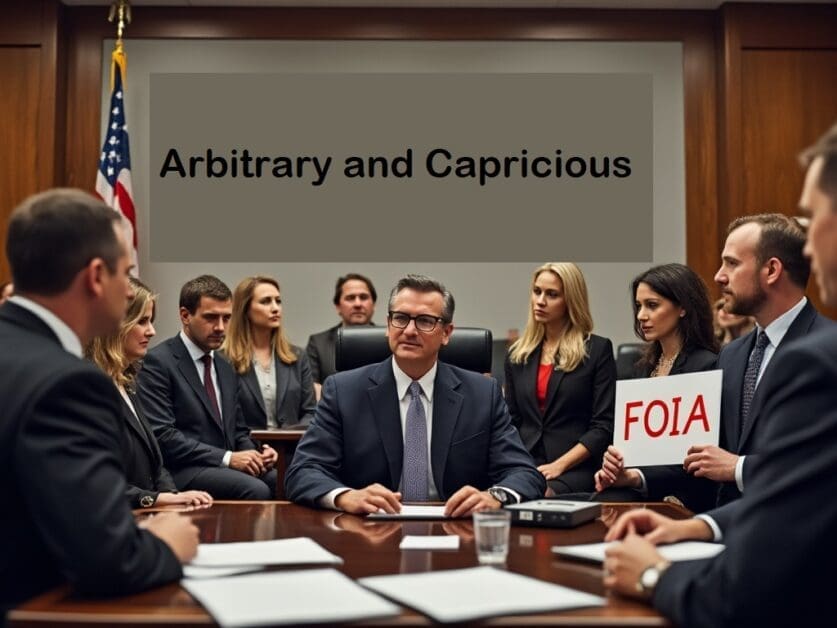
Navigating Agency Decisions - Fair or Capricious?

Can unpopular agency decisions be classified as arbitrary and capricious?

Unpopular agency decisions are not arbitrary and capricious on that basis alone—courts apply the APA’s “arbitrary and capricious” test by reviewing the administrative record for reasoned decision-making. A decision is more likely to be set aside if the agency ignored key evidence, failed to explain its change in policy, or relied on improper factors. This

Can unpopular agency decisions be classified as arbitrary and capricious? Read More »

Legal Standards Examined - Arbitrary and Capricious Review

Exploring the Arbitrary and Capricious Test in Judicial Review Processes

Courts applying the “arbitrary and capricious” test generally uphold an agency decision if it is reasonable and supported by the administrative record, and will set it aside only when the agency failed to consider important factors, relied on improper considerations, or offered an irrational explanation. Rooted in the Administrative Procedure Act, this deferential standard focuses

Exploring the Arbitrary and Capricious Test in Judicial Review Processes Read More »

The 'Arbitrary & Capricious' Standard in Law

Arbitrary and Capricious: Legal Standard Explained | Administrative Law Guide

“Arbitrary and capricious” is the deferential administrative-law standard courts use to invalidate agency actions that lack a rational explanation, ignore important evidence, or conflict with the record. Under the Administrative Procedure Act, judges generally uphold agency decisions if the agency considered relevant factors and reasonably explained its choice. This article defines the standard, compares it

Arbitrary and Capricious: Legal Standard Explained | Administrative Law Guide Read More »

Scroll to Top