
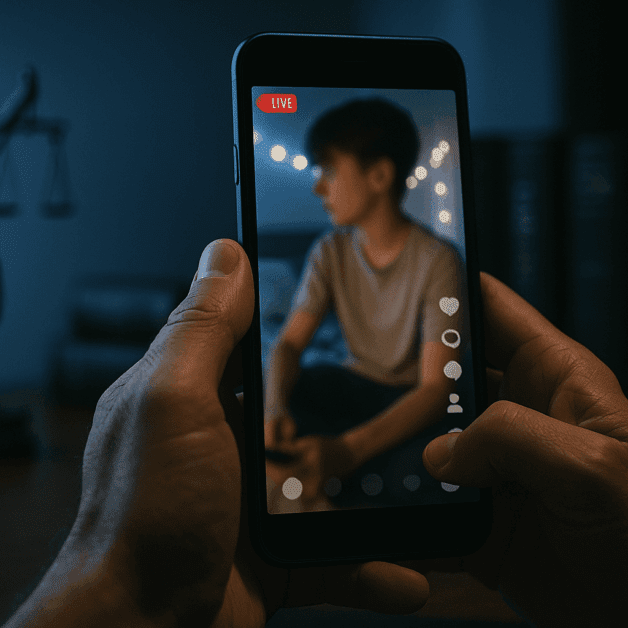
The One State Where It’s Still Legal to Screen-Record a Minor on Social Media
At least 1 U.S. state still permits screen-recording a minor on social media without consent under its current consent-to-recording rules. However, other laws (harassment, stalking, child exploitation, school policies, and platform terms) can still make the conduct illegal or actionable. This article explains the state-by-state consent framework and the key legal risks for recording minors online.
What You Need to Know About Screen-Recording Minors on Social Media
Most parents, teachers, and everyday internet users assume that recording someone — especially a child — without permission is always illegal. That assumption makes sense. Over the past decade, privacy laws have tightened across the country, and most states have put strong protections in place for minors online. But the legal landscape is not as uniform as many people think. In fact, there is still at least one state where screen-recording a minor on social media falls into a legal gray area — or remains technically permitted under current law.
Understanding where the law stands, why these gaps exist, and what they mean for everyday people is more important now than ever. Social media use among children and teenagers has exploded, and with it, the risks of their images, videos, and personal moments being captured and shared without their knowledge.
How Screen-Recording Laws Work in the United States
Before diving into the specific state in question, it helps to understand how recording laws work in general. In the United States, recording laws typically fall into two categories:
- One-party consent states: Only one person involved in the interaction needs to agree to the recording. In practice, this often means the person doing the recording can legally record without telling anyone else.
- Two-party (or all-party) consent states: Everyone involved must agree to be recorded. These states offer much stronger privacy protections.
However, these consent laws were originally written with audio and video recordings in mind — think phone calls and in-person conversations. Screen-recording is a newer action, and many state laws have not caught up with the technology. This gap is exactly where the problem lives.
Screen-recording someone’s public social media content — a TikTok video, an Instagram story, or a live stream — is treated differently than recording a private conversation. Because social media posts are often considered “public,” many existing laws do not directly prohibit capturing them, even when the person being recorded is a child.
The State Where It Remains Legal: A Closer Look
Montana stands out as a state where current privacy and consent laws create a notable gap when it comes to screen-recording minors on social media. Unlike states such as California, Illinois, or New York — which have enacted broader digital privacy protections and stronger laws covering minors specifically — Montana’s legal framework has not yet addressed this specific issue in a comprehensive way.
Montana operates under a one-party consent rule for recorded communications. More importantly, the state has not passed legislation that explicitly prohibits screen-recording publicly visible content posted by minors on social media platforms. This means that, under current state law, capturing and keeping a screen recording of a child’s public social media content does not clearly violate any Montana statute.
It is worth being clear: this does not mean such behavior is morally acceptable or without consequence in every situation. Federal laws, platform terms of service, and specific circumstances — such as intent to harass or distribute — can still result in legal trouble. But from a straightforward state law perspective, Montana has not closed this door.
Why This Legal Gap Exists
The gap is not unique to Montana — it just happens to be one of the clearest examples of a state that has not yet updated its laws to address modern digital behavior. Here is why these gaps tend to exist:
- Legislation moves slowly: Lawmakers often take years to respond to new technology. Screen-recording as a widespread activity only became common with smartphones, and laws simply have not kept pace.
- Public vs. private content confusion: Many existing laws were designed to protect people in private settings. When content is posted publicly online, the legal definition of “privacy” becomes complicated.
- Lack of lobbying pressure: In some states, there has not been enough public or political pressure to prioritize updating consent laws for digital content.
- Jurisdictional complexity: Social media is a national and global platform. States sometimes defer action, assuming federal law will eventually step in to set a uniform standard.
What Federal Law Says About Recording Minors Online
At the federal level, the most relevant law protecting children online is the Children’s Online Privacy Protection Act (COPPA). However, COPPA primarily focuses on how companies collect and use data from children under 13. It was not designed to regulate what individual users do when they screen-record content posted by minors.
The federal government has not passed a law that specifically prohibits screen-recording a minor’s publicly visible social media content. This means protection — or the lack of it — largely falls back on individual states. And as we have seen, not all states have taken action.
There are ongoing efforts in Congress to strengthen children’s digital privacy protections, including bills like the Kids Online Safety Act (KOSA), but as of now, no federal law directly fills this gap.
How Other States Have Approached This Issue
Several states have taken meaningful steps to protect minors from being recorded or having their content captured without consent. Here are some examples of how states have approached the issue:
- California: Has some of the strongest digital privacy laws in the country, including protections for minors under the California Consumer Privacy Act (CCPA) and additional regulations targeting minors’ online data and content.
- Illinois: Known for the Biometric Information Privacy Act (BIPA), Illinois also has strong protections around the collection of personal data from minors.
- New York: Has introduced and passed legislation aimed at protecting children’s digital privacy, including restrictions on how their content can be used or recorded.
- Florida: Recently passed laws specifically targeting social media use by minors, including stronger consent requirements.
These states serve as examples of what proactive legislation looks like. The contrast with states like Montana highlights just how uneven the legal landscape remains across the country.
What Parents and Guardians Should Know Right Now
If you are a parent or guardian, the most important thing to understand is that the law alone may not protect your child online. Regardless of what state you live in, taking proactive steps to safeguard your child’s digital presence is essential. Here is what experts generally recommend:
- Set accounts to private: Most social media platforms allow users to restrict who can see their content. Switching a child’s account to private significantly reduces the risk of screen-recording by strangers.
- Talk to your children about what they post: Anything posted publicly can be captured by anyone with a screen-recording tool. Teaching kids to think before they post is one of the most effective defenses.
- Report suspicious behavior: Most social media platforms have reporting tools. If you notice someone misusing your child’s content, report it immediately to the platform.
- Stay informed about your state’s laws: Laws change. Keeping up with what your state does or does not protect is an important part of digital parenting.
- Consider legal advice if something goes wrong: If you believe your child’s image or content has been misused, a family law or digital privacy attorney can help you understand your options.
The Bigger Picture: Why These Laws Need to Catch Up
The fact that even one state still lacks clear laws against screen-recording minors on social media should be a wake-up call. Children are not small adults. They are more vulnerable online, less equipped to understand the long-term consequences of having their image captured and potentially shared, and less able to advocate for their own privacy rights.
Privacy laws across the country were written for a different era. The internet has fundamentally changed how personal information — including images and videos of children — can be captured, stored, and distributed. State regulation needs to reflect that reality.
Advocacy groups, child safety organizations, and digital rights advocates continue to push for stronger and more consistent laws. But until those laws are in place, the responsibility falls on individuals, platforms, and communities to fill the gap.
Final Thoughts
It may be surprising that in today’s digital world, any state still allows screen-recording of a minor’s social media content without legal consequences. But the truth is, the law has not caught up with technology in many places — and Montana is one of the clearest examples of that gap.
Understanding consent laws, recording rights, and the specific privacy laws in your state is no longer just for lawyers. It is essential knowledge for every parent, educator, and person who cares about keeping children safe online. The law may not always protect our kids. But being informed, being proactive, and speaking up for stronger state and federal regulation can help close the gap — one step at a time.














