
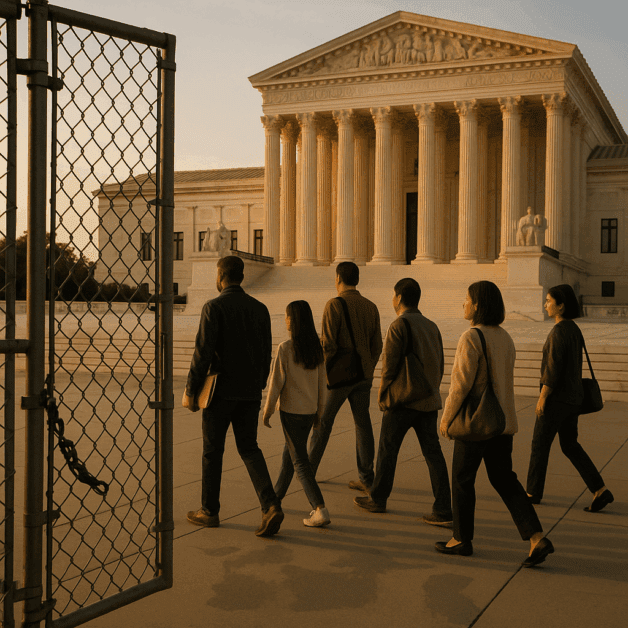
The Supreme Court Just Limited State Power Over Immigrants — Here’s the Ruling
The Supreme Court has narrowed how far states can go in enforcing immigration-related laws, reinforcing that immigration regulation is primarily a federal power. The ruling curbs state measures that intrude on federal authority and affects how state and local agencies may detain, prosecute, or otherwise target noncitizens. This article explains what the Court decided, why it matters, who is impacted, and the practical legal takeaways going forward.
A Major Decision From the Nation’s Highest Court
The United States Supreme Court has issued a ruling that significantly pulls back the power that individual states have over immigrants living within their borders. The decision, which has drawn widespread attention from legal experts, immigration advocates, and state lawmakers alike, reinforces a long-standing principle in American law — that the federal government holds the primary authority when it comes to immigration policy.
For many people, the details of a Supreme Court ruling can feel overwhelming or hard to follow. This article breaks down what happened, what it means, and why it matters to everyday Americans — whether you are an immigrant, a citizen, or simply someone who cares about how the law works in this country.
What Was the Case About?
At the heart of the ruling was a question that courts have wrestled with for decades: How much power can a state government exercise over people who are not citizens of the United States? Some states have passed their own laws targeting immigrants — ranging from restrictions on employment and housing to outright penalties for being in the country without legal status.
The case before the Supreme Court challenged one such state law. Supporters of the law argued that states have the right to protect their residents and manage local resources. Opponents argued that immigration is a federal matter, and states simply do not have the legal authority to create their own immigration enforcement systems.
The Court sided with the opponents, making it clear that when state law conflicts with federal immigration law, federal law wins — every time.
Understanding Federal Preemption
The legal concept at the center of this ruling is called federal preemption. This is not a new idea. It comes directly from the Supremacy Clause of the U.S. Constitution, which states that federal law is “the supreme law of the land.” In simple terms, when Congress passes a law on a particular subject, states cannot pass their own laws that contradict or undermine it.
Immigration law is one of the clearest examples of an area where federal authority dominates. The federal government decides:
- Who can enter the country
- Who can stay and under what conditions
- Who can become a permanent resident or citizen
- Who must leave and how that process works
When a state tries to add its own rules on top of federal immigration law — especially rules that are stricter or that create new penalties — it often crosses a line that the Constitution does not allow. That is exactly what the Supreme Court addressed in this ruling.
What Did the Court Actually Decide?
The justices ruled that the state law in question went too far. The majority opinion explained that allowing individual states to enforce their own immigration rules would create a patchwork system across the country. An immigrant could follow all federal rules and still face criminal penalties simply for crossing into a particular state. The Court found that this outcome conflicts directly with the intent of federal immigration law.
The ruling also noted that immigration decisions often involve complex diplomatic and foreign policy considerations. These are areas where only the federal government — not individual states — has the authority and the tools to act responsibly.
In short, the Court drew a firm line: states can cooperate with federal immigration enforcement, but they cannot create their own parallel immigration systems.
Why Did Some States Push Back in the First Place?
To understand the full picture, it helps to know why certain states felt compelled to pass their own immigration laws. Many state leaders argued that the federal government was not doing enough to manage immigration at the local level. They pointed to rising costs in public services, concerns about public safety, and growing frustration with what they saw as a slow or broken federal immigration system.
These concerns are real and reflect genuine pressures that some communities face. However, the Supreme Court’s ruling makes clear that frustration with federal policy does not give states the legal right to step outside their authority and create their own immigration enforcement rules.
The proper channel, according to the legal framework reaffirmed by this ruling, is for states to push for change through Congress and the federal executive branch — not to act on their own.
What Does This Mean for Immigrants?
For immigrants living in the United States — whether with legal status or without — this ruling offers a degree of legal protection from state-level actions that could otherwise target them. Here is what it means in practical terms:
- State laws that mirror or exceed federal immigration enforcement may be struck down. If a state passes a law that punishes immigrants in ways that federal law does not, courts can now use this ruling as a strong reference point to challenge it.
- Immigrants cannot be criminalized at the state level for simply being present in a way that the federal government has not authorized states to punish.
- Legal protections under federal law remain intact, regardless of which state an immigrant lives in.
That said, this ruling does not mean immigrants are free from all state-level laws. States can still enforce their general criminal and civil laws equally across all residents. What they cannot do is create a separate legal framework designed specifically to target immigrants in ways that go beyond what federal law allows.
Reactions From Around the Country
The ruling sparked strong responses from both sides of the immigration debate. Immigration advocates celebrated the decision, saying it was a necessary reminder that the Constitution protects everyone living in the United States — not just citizens. They argued that allowing states to act as their own immigration authorities would lead to discrimination and instability.
On the other side, several state officials expressed disappointment. They argued that the federal government has left states to deal with the consequences of immigration policy without giving them the tools to respond. Some vowed to find new ways within the law to address their concerns, while others called on Congress to take action.
Legal scholars largely agreed that the decision was consistent with decades of precedent on federal preemption and state authority, though some noted that the ruling leaves open certain questions about where exactly the line falls in future cases.
How This Fits Into the Bigger Picture of Immigration Law
This ruling does not exist in isolation. The Supreme Court has addressed the relationship between state authority and federal immigration law multiple times over the years. One of the most well-known cases came in 2012, when the Court struck down key parts of Arizona’s immigration enforcement law, known as SB 1070. That case established many of the same principles reaffirmed in this latest ruling.
Together, these decisions paint a consistent picture: immigration law is a federal responsibility, and states that try to go their own way will likely face legal challenges — and often lose them.
This does not mean states have no role to play. They can share information with federal immigration authorities, assist with certain enforcement activities when invited to do so, and pass laws that indirectly affect immigrants as long as those laws apply equally to everyone and do not conflict with federal rules.
What Happens Next?
The immediate effect of the ruling is that the state law in question is no longer enforceable. Going forward, other states with similar laws on the books may face new legal challenges using this decision as a foundation.
At the same time, the ruling is likely to spark renewed debate in Congress about comprehensive immigration reform. If states feel that the federal government is not meeting their needs, and the courts continue to limit state authority, pressure may grow on federal lawmakers to act.
For now, the ruling stands as a clear statement from the nation’s highest court: when it comes to immigration, the federal government is in charge — and that is not changing anytime soon.
The Bottom Line
The Supreme Court’s decision is a significant moment in the ongoing debate over how the United States manages immigration. It reinforces the principle of federal preemption, limits what states can do when it comes to immigration enforcement, and provides important protections for immigrants who might otherwise face a confusing and inconsistent legal landscape depending on where they live.
Whether you agree with the outcome or not, the ruling is a reminder of how the American legal system works — and of the role that the Constitution plays in drawing boundaries between different levels of government. As immigration continues to be one of the most debated topics in the country, decisions like this one will continue to shape the conversation for years to come.














