Premises Liability in Public Spaces: Your Questions Answered
When someone trips on a broken sidewalk, falls into an unmarked utility trench, or stumbles over a poorly secured manhole cover, the question of who’s legally responsible gets complicated fast. Premises liability in public spaces involves the legal duties of municipalities, utility companies, and contractors to address dangerous conditions in areas open to the general public. Because multiple parties often share control over the same stretch of pavement, sorting out fault can feel like untangling a knot with three different ends.
What Is Premises Liability in Public Spaces?
At its core, premises liability is a negligence-based area of law that addresses unsafe property conditions that cause injury. In public spaces, responsibility can land on municipalities, public authorities, private contractors, utility companies, or sometimes even adjacent property owners. If you’ve ever walked past a crumbling curb and wondered, “whose job is it to fix that?” you’ve already bumped into the central question these cases raise.
Public-space claims tend to be significantly more complex than typical private-property claims because control and maintenance duties are often split among several entities. Figuring out who’s legally on the hook means examining who owned, leased, occupied, or controlled the specific spot where the injury happened.
Which Public Hazards Most Often Lead to Claims?
Deteriorating infrastructure and half-finished maintenance fixes are the usual culprits. Picture a utility crew that cuts into a sidewalk, patches it with cold asphalt, and moves on to the next job; six months later, that patch has sunk two inches, and someone catches a toe on the edge. Here are the hazards that show up most often in premises liability claims:
- Cracked or uneven sidewalks (particularly in older neighborhoods where tree roots buckle concrete)
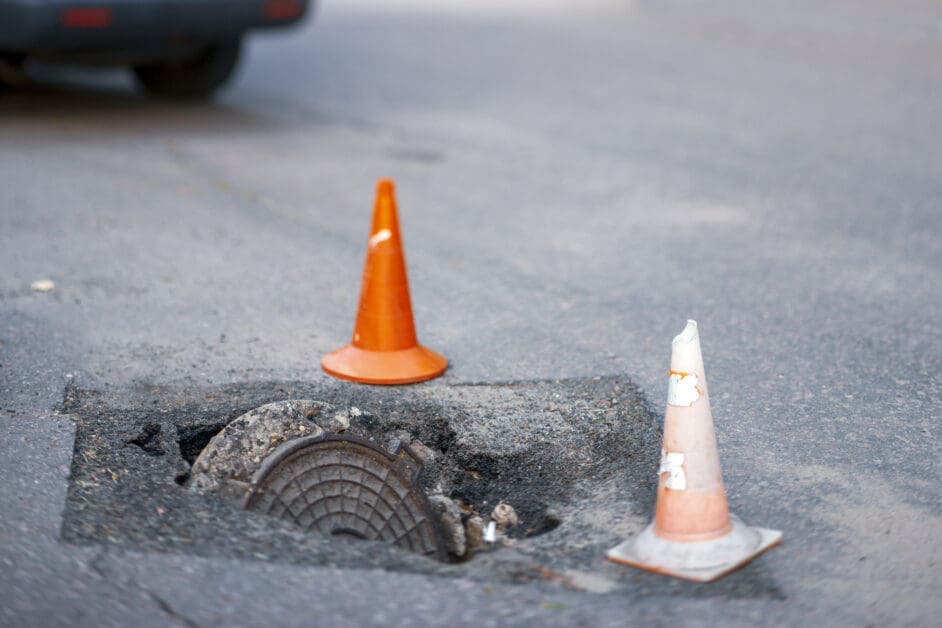
- Open manholes or poorly secured utility covers
- Unmarked utility trenches or active maintenance zones
- Broken steps, curbs, or handrails in public areas
- Pooled water, ice, or debris on walkways
- Poor lighting that conceals a known defect
Recent legal disputes underscore these dangers. A lawsuit in Bellingham over a hole in a sidewalk shows how visibility and overgrowth factor into the analysis of negligence. Ongoing complaints about utility sidewalk repairs that rely on temporary patches highlight how incomplete fixes create lasting safety concerns rather than solving them.
Large maintenance backlogs confirm that deteriorating pedestrian infrastructure isn’t an isolated problem. A recent sidewalk repair program in San Diego and reports of broken pathways affecting elderly residents in South LA illustrate just how widespread these hazards have become.
Who Can Be Liable for an Injury in a Public Space?
Liability usually turns on three things: who exercises control over the area, who has a maintenance duty, and whether that party had notice of the hazard. A city might control the general sidewalk surface, a utility company might control a specific manhole cover within that sidewalk, and a private contractor might control a temporary excavation zone right next to it. Sound confusing? It often is, even for the lawyers involved.
| Entity | Typical Area of Responsibility | Common Liability Question |
| Municipality | Sidewalks, parks, streets, public walkways | Did the city have notice and enough time to fix it? |
| Utility company | Manholes, underground access points, marked work areas | Did the utility create or fail to secure the hazard? |
| Contractor | Construction or repair zones | Were warnings, barriers, and site checks adequate? |
| Adjacent owner | Sidewalks, overgrowth, or walkways abutting their property | Did local ordinances shift liability to the owner, and did they fail to maintain a safe walkway? |
What Duty of Care Do Municipalities and Utility Companies Owe?
Public entities and utility companies generally must exercise reasonable care to maintain their properties and the public areas they control. In practice, that means taking concrete steps to inspect, maintain, repair, or, at a minimum, warn about dangers they know about or should reasonably discover through routine checks.
Common hazard-control measures include setting up barriers, placing warning cones, using heavy cover plates over open utility access points, and conducting routine inspections on a set schedule. Think of it this way: an open manhole on a busy sidewalk is about as foreseeable a risk as you can get, which means the utility company responsible for it has a strong duty to secure the area before a pedestrian falls in.
How Do Courts Decide Whether a Public Hazard Was Foreseeable?
Foreseeability boils down to one question: should a reasonable entity have expected that this condition could injure someone? Courts evaluate the location, pedestrian traffic volume, visibility of the defect, and whether the hazard was concealed or out in the open.
They also dig into prior complaints and how long the condition existed before the incident. A recent pothole lawsuit in Portland alleged city crews were working near a defect and should have discovered it, putting constructive notice squarely at the center of the case. Reports of broken sidewalks blocking wheelchair access further reinforce that these hazards predictably cause serious injuries, not just minor inconvenience.
Why Is Notice So Critical in Public-Space Injury Cases?
You can’t hold a city or utility company liable for a hazard they didn’t know about, and that’s exactly why notice is the make-or-break element in most of these cases. Actual notice means the entity explicitly knew about the hazard, typically through direct reports, 311 complaints, or internal work orders documenting the problem.
Constructive notice is a different animal. It means the defect existed long enough, or was obvious enough, that a routine inspection should have uncovered it. Many cases succeed or fail based on evidence such as maintenance logs, complaint records, and surveillance footage showing that the hazard was visible for weeks or months before someone was hurt.
In many jurisdictions, however, cities protect themselves using Prior Written Notice statutes. In these areas, a municipality cannot be held liable for a sidewalk or roadway defect—no matter how obvious or long-standing it is—unless a citizen had filed a formal, written complaint about that specific hazard before the accident occurred. This creates an incredibly high hurdle for injured pedestrians, making tools like 311 public logs and municipal databases the literal backbone of a legal claim.
The financial stakes of known hazards are enormous. For context, New York City paid $1.94 billion in tort claims in 2024, with personal injury and property damage claims accounting for nearly 54% of that total. That number alone tells you how much exposure municipalities face when maintenance lapses pile up.
What Happens After Liability Is Established?
Proving liability is only half the battle. Financial recovery usually depends on the severity of the injury, medical treatment costs, lost income, and whether the injury results in permanent impairment. Someone who sprains an ankle on a raised sidewalk slab is looking at a very different outcome than someone who fractures a hip and needs surgery.
Courts also look at comparative fault, which can reduce compensation if the injured person is found partly responsible for the accident. Maybe you were looking at your phone, or maybe you stepped around a clearly marked barrier. Those details matter. For a closer look at how injury severity, notice, comparative fault, and filing deadlines affect compensation in New York City, this overview of the average slip and fall settlement provides helpful context.
As a rough benchmark, minor injuries may resolve in the $10,000 to $50,000 range. Cases involving severe injuries requiring surgery or resulting in permanent disability can reach $250,000 to well over $2 million, depending on the facts.
Are Claims Against a City Different From Claims Against a Private Property Owner?
Yes, and the differences can trip you up if you aren’t prepared. Claims against government entities typically involve shorter and stricter procedural deadlines than those against private parties. In New York City, for instance, a public-space fall claim generally requires filing a Notice of Claim within 90 days of the incident. Not 90 business days; 90 calendar days.
A formal lawsuit against a municipal entity must often be filed within one year and 90 days. Miss those windows, and the claim can be barred entirely, regardless of how strong the evidence is or how severe the injuries were. If you’re considering this kind of claim, checking those deadlines is the very first thing you should do.
What Broader Issues Do These Cases Raise?
Public-space premises liability disputes involve more than individual falls; they shed light on systemic problems with aging infrastructure, temporary repair practices, and blurred lines of responsibility between public agencies and private operators. Recurring sidewalk and utility-related disputes are a reminder that proper maintenance protocols aren’t just about avoiding lawsuits. They’re about basic pedestrian safety.
As seen in a recent utility mapping failure case involving Liberty Utilities, private entities operating in public areas must strictly adhere to safety duties to prevent catastrophic accidents. Maintaining public spaces requires continuous oversight, not just reactive patching after someone gets hurt.
Disclaimer: The insights shared in this piece are for general information only and do not establish an attorney-client relationship or constitute legal counsel. Because local ordinances and state regulations vary widely, anyone injured in a public space should speak with an experienced attorney regarding the specific filing timelines and statutes governing their case.