
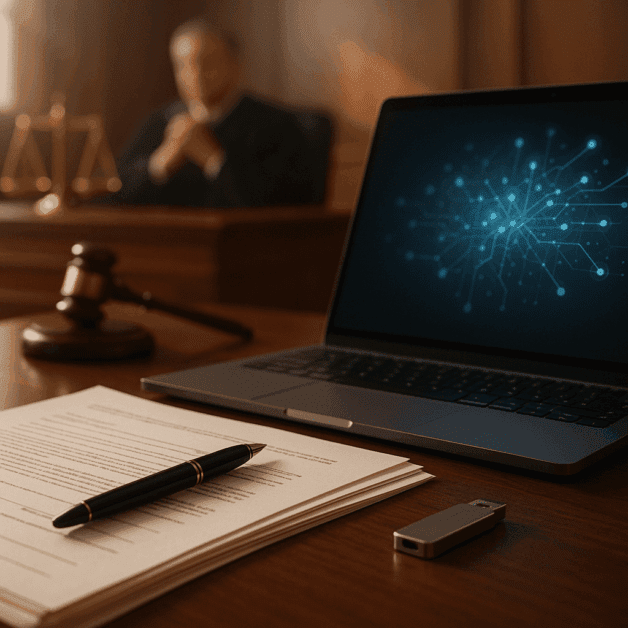
AI Wrote My Will. Here’s What the Probate Judge Said.
An AI-drafted will can be rejected or partially invalidated in probate if it isn’t properly executed or its terms are unclear. Probate judges focus on statutory signing/witness rules and evidence of testamentary capacity and intent—not who typed the document. This article explains what the judge scrutinized, the most common AI-will pitfalls, and practical steps to make your estate plan court-ready.
When Technology Meets Your Final Wishes
It started as a simple curiosity. Like millions of people who have been experimenting with artificial intelligence tools, I decided to test just how capable these systems really are. Instead of asking it to write a poem or plan a vacation, I asked an AI chatbot to write my will. What happened next surprised me — and the feedback I eventually got from a probate judge surprised me even more.
Estate planning is one of those things most people put off for years. It feels complicated, expensive, and honestly a little uncomfortable to think about. So when AI tools promised to make difficult tasks easier, it seemed worth exploring whether they could simplify this process too. Here is exactly what happened when I put that idea to the test.
What I Asked the AI to Do
I gave the AI chatbot a detailed prompt. I included my name, the names of my beneficiaries, a description of my major assets, and my wishes for how those assets should be distributed. I also asked it to include a guardian designation for my minor children and an executor appointment. Within about two minutes, the AI produced a multi-page document that looked, at first glance, like a real legal will.
The document used formal language. It had numbered sections. It even included standard legal phrases like “I hereby revoke all prior wills and codicils.” On the surface, it was genuinely impressive. But looking impressive and being legally valid are two very different things.
The Red Flags I Noticed Right Away
Even before I consulted a legal professional, a few things stood out as potentially problematic:
- No state-specific formatting: Will requirements vary significantly from state to state. The AI produced a generic document without tailoring it to the laws of my specific state.
- Missing witness and notary instructions: The document mentioned signature lines but gave no clear guidance on the exact number of witnesses required or whether notarization was needed.
- Vague asset descriptions: The AI used general language to describe property that really needed specific legal descriptions, especially for real estate.
- No residuary clause: A proper will typically includes a clause that handles any assets not specifically mentioned. The AI-generated version left this out entirely.
- No self-proving affidavit: Many states allow a self-proving affidavit that can speed up the probate process. This was completely absent.
What the Probate Judge Had to Say
Through a mutual connection, I was able to sit down informally with a retired probate judge who now works as a legal consultant. I want to be clear that this was not official legal advice, but the conversation was eye-opening.
Her first reaction when she read the document was a familiar one — she had started seeing AI-generated wills come across her desk with increasing frequency. Her overall assessment was direct: “This document has the skeleton of a will, but it has too many gaps to be reliable.”
She pointed out several specific concerns:
1. Witness Requirements Were Unclear
In most states, a valid will requires two witnesses who are present at the same time when the testator signs. Some states have additional rules about who can serve as a witness. The AI document mentioned witnesses but did not specify these requirements at all, which could lead to the will being challenged or rejected during probate.
2. Holographic Will Confusion
Some states recognize what are called holographic wills, which are handwritten and signed by the person making the will, without witnesses. An AI-generated will is neither handwritten nor typed by the person making it, which means it does not qualify as holographic — yet it might not be properly executed as a formal will either, depending on how it was signed.
3. Ambiguous Language Could Cause Family Disputes
The judge noted that certain phrases in the AI document were too vague. For example, referring to “my jewelry collection” without listing specific items can lead to family disagreements that end up in court. Good estate planning uses precise language to avoid exactly this kind of conflict.
4. No Legal Accountability
When an estate attorney drafts a will, they carry professional liability. If they make an error, there are legal and ethical remedies available. When an AI makes an error, there is no one to hold accountable — and by the time the mistake is discovered, the person who made the will is usually no longer alive to correct it.
Is an AI-Generated Will Ever Legally Valid?
This is the question most people want answered. The honest answer is: it depends, and that uncertainty is itself a serious problem.
A will’s validity is not determined at the time it is written. It is determined when it is submitted to probate court after the person dies. At that point, if the document does not meet your state’s legal requirements, it could be partially or entirely thrown out. That means your assets might be distributed according to your state’s default inheritance laws, not according to your wishes.
The AI-generated will I created might have been valid if I had properly signed it in front of the required number of witnesses. But even then, the vague language and missing sections could have caused significant problems. And if I had made any errors in the signing process — which is easy to do without clear guidance — the document could have been invalid from the start.
What the Law Currently Says About AI and Estate Planning
As of now, there are no specific laws in the United States that either prohibit or validate AI-generated wills as a category. Courts look at whether a will meets the established legal requirements for that state, not at how it was created. However, legal experts are watching this space closely.
The American Bar Association and various state bar associations have begun issuing guidance on AI use in legal practice, but consumer-facing AI tools are largely unregulated when it comes to legal document generation. This means the responsibility for ensuring a document meets legal standards falls entirely on the person using the tool — which is a significant burden for someone without legal training.
The Real Cost of Getting This Wrong
People often turn to AI or online will-writing tools because they want to save money. Attorney fees for estate planning can range from a few hundred dollars to several thousand, depending on the complexity of your situation. It is understandable that people look for more affordable options.
But consider what happens if the will fails. Your family could face:
- A lengthy and expensive probate process
- Legal disputes between family members over your intentions
- Assets going to people you did not intend to receive them
- Court-appointed guardians for your children rather than the person you would have chosen
- Significant tax consequences that proper planning could have avoided
The cost of fixing a bad will — or dealing with no valid will at all — almost always far exceeds the cost of doing it right in the first place.
Where AI Can Actually Help With Estate Planning
This experience did not leave me thinking AI has no place in estate planning. It just helped me understand where its role should and should not be.
AI tools can be genuinely useful for:
- Getting educated: Understanding basic concepts like what a will does, what a trust is, or what probate involves
- Organizing your thoughts: Making a list of your assets, your beneficiaries, and your wishes before meeting with an attorney
- Asking preliminary questions: Getting a sense of what topics to discuss with a legal professional
- Understanding documents: Having complex legal language explained in plain terms
What AI should not do is serve as the final word on a document that will govern what happens to everything you have worked for and, more importantly, who will care for the people you love.
What Experts Recommend Instead
The guidance from legal professionals is consistent on this point. For simple estates, working with an estate planning attorney is still the gold standard. Many attorneys offer flat-fee packages for basic wills, powers of attorney, and healthcare directives that are more affordable than people expect.
For those who genuinely cannot afford an attorney, some nonprofit organizations and legal aid societies offer free or low-cost estate planning services. Some states also have simplified will forms that meet basic legal requirements for people with straightforward situations.
If you do use an online tool or AI system, have the resulting document reviewed by a licensed attorney in your state before you sign it. The review itself may cost far less than a full drafting service, and it could save your family enormous trouble down the road.
The Bottom Line on AI-Generated Wills
AI is getting better every year, and it is already changing many industries in meaningful ways. But legal validity is not something that improves with software updates. It is determined by courts, shaped by state laws, and enforced in ways that have real consequences for real families.
The probate judge I spoke with put it simply: “I have no doubt that AI will eventually play a much bigger role in legal work. But right now, using it to write your own will is like using a recipe from a stranger on the internet to perform your own surgery. The information might be mostly right. But mostly right is not good enough when the stakes are this high.”
My experiment with an AI-generated will taught me something valuable. It taught me that the discomfort of dealing with estate planning is worth pushing through — not because the process has to be complicated, but because the alternative of leaving things to chance is far worse. Talk to an attorney. Get it done properly. Your family will thank you for it, even if they never know all the reasons why.














