

How Personal Injury Settlements Are Really Calculated in Florida
In Florida, personal injury settlements are calculated by totaling economic damages (medical bills, lost wages, property damage) and adding non-economic damages, then reducing for fault and insurance limits like the $10,000 PIP minimum. The final amount depends on injury severity, proof, policy limits, and whether the case is a car crash or another injury claim. This article explains the factors, formulas, and Florida-specific rules that drive real settlement numbers.
A friend got a six-figure check after a fender bender. Someone on Facebook swears their cousin walked away with a million. Then your own claim comes back at a fraction of that, and it stings. You start to wonder whether your lawyer dropped the ball or the insurance company is cheating you. The gap between the number people expect and the amount they actually receive is one of the most common sources of frustration after an accident, and it usually comes down to a few factors that are easy to overlook.
Usually it’s neither. The numbers people throw around almost never match the amount that actually reaches your bank account. Once you walk through where the money really goes, the smaller figure usually makes sense. It is rarely one big problem, and more often several small ones stacked on top of each other. Understanding how personal injury settlements are actually calculated, and what happens to the number between the first offer and the final check, is what keeps those small things from catching you off guard.
The most significant factor is your own share of fault. In many states, being even partly at fault reduces what you can recover, and beyond a certain point it eliminates the claim entirely. Before settling on an expected figure, it helps to see how much this one factor affects the total. If your accident happened in Florida, a free Florida personal injury settlement calculator can help you estimate a realistic range by applying the state’s comparative fault rules instead of relying on a national average.
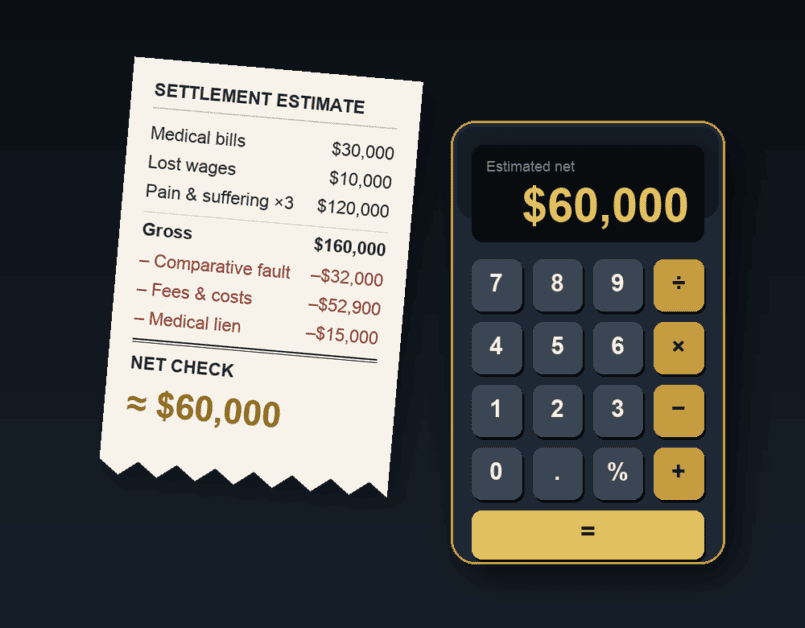
The number you hear is the gross, not your check
Most people are surprised to learn that the figure they hear quoted is the gross settlement, not the amount anyone actually takes home. Two ceilings and a set of deductions sit between that headline number and the final deposit.
The first ceiling is the available insurance. A settlement cannot exceed the at-fault driver’s policy limits plus any coverage you carry yourself. If the other driver has a $25,000 policy and no assets, a $200,000 case can still be limited to $25,000, unless your own uninsured or underinsured motorist coverage makes up the difference. This is why checking your own UM limits matters. It is one of the most overlooked lines on a Florida auto policy, and it often determines the outcome of a case.
Then the deductions come out. This is where people find the answer to how much personal injury lawyers take from a settlement, along with a few other costs:
- Attorney fee (contingency): usually 33% to 40%. You pay it only if you win, and it often goes up if the case has to be filed in court.
- Case costs: roughly 5% to 10%, covering filing fees, expert witnesses, medical records, and depositions.
- Medical liens: the hospitals and health insurers that treated you are repaid from your share, though these are often negotiable.
The gap becomes clear with real figures. Suppose the gross settlement is $160,000. A 20% fault share reduces it to $128,000. After a one-third attorney fee, roughly 8% in case costs, and a $15,000 medical lien, about $60,000 remains. The $160,000 and the $60,000 describe the same case. Most injured people keep between 60% and 70% of the gross, a fact that is rarely explained at the outset. And a personal injury settlement is generally not taxable at the federal level when it pays for a physical injury, though any portion tied to lost wages or interest can be. Even cases involving similar injuries can settle for very different amounts, because the available insurance, medical documentation, and liability are rarely identical.

Florida’s 51% rule can quietly gut a claim
Florida changed its fault rule in 2023 through House Bill 837. Your recovery now drops by whatever percentage of the accident is found to be your fault, and if you are 51% or more at fault, you recover nothing at all.
The effect is easy to see with real figures. On a $100,000 claim, a 20% fault share leaves you with $80,000. At 51% fault, the same claim pays nothing. While the law provides the framework, every claim depends on its own facts. That is why attorneys at Kremenchuker Law Group recommend understanding the legal process before making decisions about a settlement.
Thin medical records shrink everything
Now, a big piece of what you’re owed has nothing to do with medical bills. It’s the stuff you can’t put on a spreadsheet. The pain. The nights you don’t sleep. The hobby you dropped, the way you can’t pick up your kid like you used to. None of that comes with a receipt, so the industry leans on a shortcut called the multiplier: take your hard costs and multiply them by something in the 1.5 to 5 range. That’s the rough value of the human side. How high it goes depends on how bad the injury is and how long you’re stuck with it.
The multiplier is applied to your documented losses, so your records largely determine the final number. Consider two clients with the same neck injury. One has a $30,000 medical file, which at a 3.0 multiplier supports about $90,000 for pain and suffering. The other pursued only $15,000 in treatment, and their figure is roughly half. The difference usually comes down to who maintained care and who did not, and medical records generally cannot be reconstructed later. Missed appointments and long gaps in treatment lower a claim’s value, often without the client noticing.
There is also a Florida deadline that catches many people. PIP, the no-fault coverage every driver carries, only applies if you see a doctor within 14 days of the accident. Miss that window and up to $10,000 in medical coverage can be lost. Many people feel fine immediately after a crash and do not seek medical care until weeks later, after the deadline has already passed. Even if you believe you are uninjured, it is worth being examined early, both for your health and for your claim.
The first offer is supposed to be low
A first offer is rarely a fair opening. Adjusters use the same method you would, but they set every assumption in the insurer’s favor: a lower multiplier, a higher estimate of your fault, doubts about future treatment, and questions about any delay before your first medical visit. What changes the number is documentation rather than a phone conversation. A written demand supported by organized records, a clear treatment timeline, and a defensible multiplier is much harder to dismiss, and it carries the most weight when sent after you have reached maximum medical improvement, once the full extent of the injury is known.
How to avoid the shock of a low number
The best way to avoid an unpleasant surprise is to estimate the potential value of your claim before the first offer arrives. It takes only a few steps:
1. Add up your economic damages, and don’t forget the treatment your doctor says is still coming.
2. Pick a multiplier that matches how bad the injury really is, not the version you’re hoping for.
3. Knock off a fair guess at your own share of fault under your state’s law.
4. Then take out the attorney fee, the case costs, and any liens hanging over the file.
Running those four numbers through a personal injury settlement calculator built for Florida turns them into a realistic range.
Frequently asked questions
How are personal injury settlements calculated?
Most start with the multiplier method: total your economic damages, such as medical bills, lost wages, and future care, then multiply that figure by a number, usually between 1.5 and 5, to estimate pain and suffering. A more severe and better-documented injury supports a higher multiplier. That combined total is the gross figure. Your actual recovery is then reduced by your share of fault and by attorney fees, case costs, and any medical liens, which is why the final check is almost always smaller than the gross.
How much of my settlement do I actually keep?
Most injured people take home somewhere between 60% and 70% of the gross settlement, and less when medical liens are large. The gross figure is reduced by comparative fault, a contingency fee of roughly 33% to 40%, case costs of about 5% to 10%, and any liens repaid to hospitals or health insurers. Understanding these deductions in advance is the best way to keep the headline number from creating false expectations.
How much do personal injury lawyers take from a settlement?
Most personal injury lawyers work on contingency, meaning they are paid only if you recover. The fee is commonly around 33% of the settlement before a lawsuit is filed and closer to 40% once the case moves into litigation. Case costs, such as expert witnesses, medical records, and filing fees, are usually separate and also come out of your share. The trade-off is that you pay nothing upfront and owe no fee at all if the claim does not succeed.
Is a personal injury settlement taxable?
Compensation for a physical injury is generally not taxable at the federal level. Some portions can be, however, including amounts for lost wages, interest that builds up on the settlement, and any punitive damages. Because how a settlement is divided affects how much of it is taxable, it is worth confirming the details with a tax professional or your attorney before filing.
Does Florida’s 51% rule affect how much I receive?
Yes. Under Florida’s modified comparative negligence law (House Bill 837, 2023), your recovery drops by your percentage of fault, and if you are found 51% or more at fault, you recover nothing at all. On a $100,000 claim, being 20% at fault leaves you with $80,000, while being 51% at fault leaves nothing. That single threshold makes how fault is assigned one of the most important parts of a Florida claim.
Making sense of a lower settlement
By the time an offer reaches you, the number has already been shaped by fault, the available coverage, your documentation, and the deductions taken before payment. That is why a settlement that looks “low” on paper is often not a mistake or an attempt to undervalue your case, but the result of legal limits and case-specific facts that are easy to miss without experience handling these claims.
No two personal injury claims are worth exactly the same amount. The final settlement depends on how fault is shared, the available insurance coverage, the quality of your medical documentation, and the deductions that apply to your case. Understanding these factors early helps you set realistic expectations and evaluate any offer with greater confidence.














