How to Beat an Arson Charge in Harris County, Texas When Fire Investigators Claim Accelerant Use
In Harris County arson cases, an “accelerant” finding is often the state’s linchpin—but it can be beaten by attacking the lab results, the origin-and-cause methodology, and the proof of intent beyond a reasonable doubt. Houston-area fire investigations frequently rely on scene indicators, canine alerts, and debris testing that can be misinterpreted or contaminated. This article explains the most effective defense strategies, local court dynamics, and evidence challenges when investigators claim accelerant use.
When “accelerant use” becomes the prosecution’s entire story
In Harris County, an arson allegation tied to “accelerant use” often comes down to one narrative: investigators say the fire was intentionally set because they believe a flammable liquid was used to start or spread it. Prosecutors then argue that an accelerant equals intent, intent equals arson, and the defendant is the person who did it.
But accelerant claims are not the same as proof. Even when a fire investigator is confident, the law still requires the state to prove (1) the fire was caused intentionally (not accidentally), (2) the defendant was the actor (identity), and (3) the required mental state (usually intent) beyond a reasonable doubt. The best defenses in accelerant-based arson cases focus on breaking one or more of those links using science, procedure, and Texas evidentiary rules.
What Texas law requires the state to prove in an arson case
Most arson prosecutions in Texas are brought under Texas Penal Code § 28.02. Arson generally involves starting a fire or causing an explosion with intent to destroy or damage certain property, or with knowledge it will endanger people or property. Penalties vary dramatically depending on what burned (habitation vs. building), whether anyone was injured, and other aggravating factors.
In “accelerant” cases, the state typically tries to prove intent by offering:
- Origin-and-cause testimony from a fire investigator (e.g., “incendiary fire” or “flammable liquid used”)
- Fire debris lab results (GC-MS testing identifying ignitable liquid residues, or “ILR”)
- Canine alerts indicating possible ignitable liquids
- Motive evidence (insurance, relationship conflict, eviction, business failure)
- Opportunity (access, keys, proximity, timeline)
To beat the charge, the defense does not need to “prove innocence.” It needs to raise reasonable doubt—often by showing the fire’s cause is undetermined, the accelerant evidence is unreliable, the investigation was flawed, or the state cannot reliably connect the defendant to the alleged act.
How accelerant evidence is supposed to be collected—and where cases go wrong
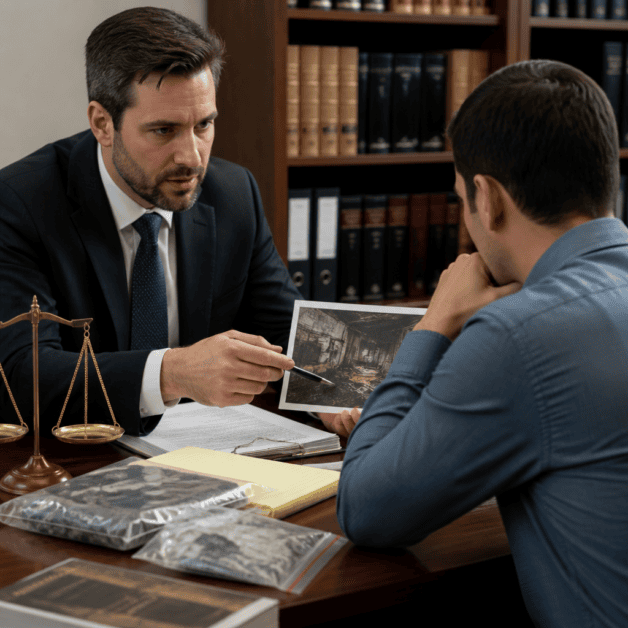
In Harris County arson prosecutions, accelerant allegations commonly rest on fire debris sampling and lab analysis. In an ideal investigation, fire debris is collected from appropriate locations (near the area of origin or suspected pour patterns), placed in clean, airtight containers, properly sealed, and documented with an unbroken chain of custody. The lab then uses validated methods (often gas chromatography-mass spectrometry) to determine whether ignitable liquid residue is present and what class it most closely matches.
In the real world, accelerant evidence can be undermined by:
1) Contamination at the scene
Fire scenes are chaotic. Water runoff, firefighting foam, fuel from tools or equipment, melted plastics, household chemicals, and cross-contact from gloves or tools can introduce or mimic patterns that look like accelerant use.
2) Wrong container or improper sealing
Volatile compounds evaporate. If debris is collected in unsealed bags or containers that are not appropriate, residues can dissipate or become contaminated by external vapors. Evidence handling failures can support suppression arguments, reliability challenges, or strong cross-examination.
3) Sampling bias (only collecting “supportive” samples)
Some investigations overemphasize debris from areas that “look suspicious,” while failing to take comparison samples from nearby areas. Without comparison samples, the defense can argue that the alleged residue could be background contamination or pyrolysis products from ordinary household materials.
4) Misinterpretation of lab reports
A lab report that identifies an “ignitable liquid residue” does not automatically mean the liquid was used as an accelerant to start the fire. Residues can come from stored products (gasoline in a garage, solvents in a workshop), transferred contamination, or post-fire conditions. A good defense attorney works with an independent expert to interpret the chromatograms and classification language, not just the summary line.
Fire investigation methodology: challenging the “incendiary” conclusion
Modern fire investigation is heavily influenced by NFPA 921 (the National Fire Protection Association’s guide for fire and explosion investigations), which emphasizes the scientific method and warns against relying on “myths” and outdated indicators.
A key defense theme in accelerant cases is that an investigator may label a fire “incendiary” based on visual cues (like low burning, irregular patterns, or “pour patterns”) that can be produced by flashover, ventilation effects, melted synthetics, or suppression activities. If the investigator did not systematically rule out accidental causes—or if the fire’s cause should properly be “undetermined”—the state’s intent theory weakens.
Common investigative gaps that create reasonable doubt
- Electrical causes not adequately examined: Breakers, wiring, appliances, and arc mapping can be overlooked.
- Alternate fuel sources ignored: Cleaning supplies, aerosols, alcohol-based products, or stored fuels can explain residues.
- Failure to document the scene thoroughly: Missing photos, incomplete diagrams, or late scene access can undermine conclusions.
- Overreliance on canine alerts: Dogs are screening tools, not definitive proof, and alerts should be confirmed by lab results.
Winning strategies: how a Harris County defense can beat “accelerant” arson charges
Every case differs, but successful arson defenses in Harris County often combine technical challenges with legal and factual defenses.
1) Force the state to prove “beyond a reasonable doubt” on intent—separate from accelerant
Even if an ignitable liquid residue is present, the state must still prove the defendant intentionally started the fire (or caused the explosion) with the required mental state. A defense can emphasize that:
- The defendant had no exclusive access to the scene.
- There is no reliable timeline placing the defendant there when the fire started.
- The state’s motive theory is speculative or contradicted by records (payments, communications, alibis).
2) Challenge admissibility and reliability of expert opinions (Texas “Kelly/Daubert” issues)
Texas courts can exclude or limit expert testimony that is not reliably grounded. In arson cases, this can matter when an investigator’s conclusion is based on outdated indicators or an incomplete application of NFPA 921 principles. A defense attorney may file motions to:
- Require a reliability hearing on the methodology used to classify the fire as incendiary.
- Limit opinions that are not supported by testing, documentation, or proper elimination of accidental causes.
- Scrutinize canine evidence, handler records, training, certification, and field performance.
Even when testimony is admitted, reliability challenges can be powerful with juries—particularly in Harris County, where jurors may expect scientific rigor when the state claims “accelerant.”
3) Attack chain of custody and evidence handling
Arson cases frequently involve multiple agencies: fire marshal investigators, law enforcement, and outside labs. Each handoff creates risk. Effective defenses look for:
- Unclear evidence seals, missing initials/dates, or inconsistent packaging descriptions
- Storage issues (heat exposure, unsealed containers, evidence room logs)
- Gaps between collection and submission that could allow evaporation or contamination
Weak chain of custody may not always suppress evidence, but it can diminish weight and credibility—especially if the “accelerant” claim is central.
4) Retain independent experts early (origin-and-cause + fire debris chemist)
One of the biggest differences between a defensible case and a loss is how quickly the defense brings in qualified independent experts. Ideally, the defense team will retain:
- An origin-and-cause expert to review scene photos, investigator notes, suppression records, and NFPA 921 compliance.
- A fire debris chemist to review lab methodology, chromatograms, and alternative explanations for residues.
Experts can also help identify missing evidence (e.g., lack of comparison samples, incomplete elimination of accidental sources) and provide a basis for targeted motions and cross-examination.
5) Use digital, financial, and timeline evidence to refute identity
Many arson cases are circumstantial. In Harris County, prosecutors often try to fill identity gaps with motive. Defense counsel can counter with hard data:
- Cell phone location information (and its limits) to show the defendant’s movements
- Door access logs, security cameras, toll records, and ride-share receipts
- Bank and insurance records that undermine “financial distress” narratives
If the state cannot place the defendant at the scene, the accelerant debate may become irrelevant.
Specific examples of “accelerant” claims that can be defensible
Example A: Garage fire with gasoline residue
Investigators find gasoline-range residues in debris near the garage entry and conclude an accelerant was poured. But the property stored lawn equipment, gas cans, and solvents. A defense expert points out that stored fuels and post-fire spread can produce residues, and that the scene lacked reliable pour pattern documentation. Result: the cause becomes “undetermined,” undercutting intent.