
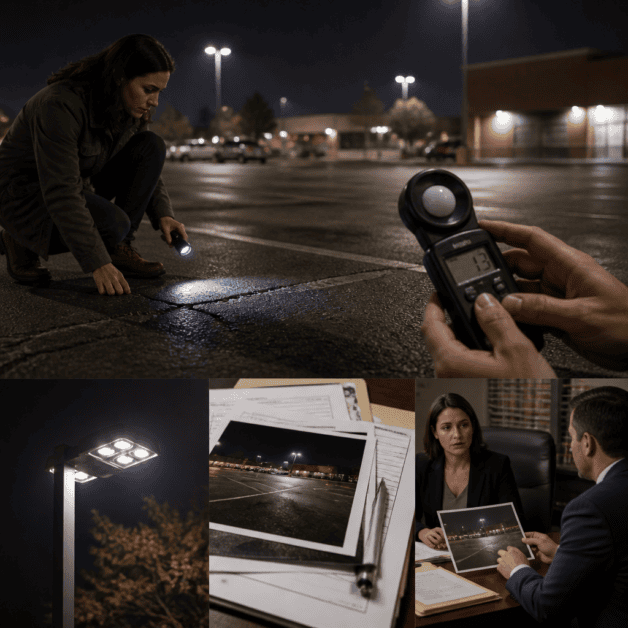
How to Prove Inadequate Lighting Caused a Parking Lot Slip-and-Fall in Phoenix, Arizona
Poor lighting is a common factor in night-time parking lot slip-and-falls, and in Phoenix it can be proven with a combination of measurements, records, and witness evidence. Arizona premises liability law requires property owners to take reasonable steps to make areas like parking lots safe when hazards are foreseeable. This article explains the exact evidence, local sources, and legal elements attorneys use to prove inadequate lighting caused a parking lot fall in Phoenix.
Parking lots are supposed to be “transitional” spaces—safe enough to walk from your car to a store, apartment, or venue without needing special precautions. But in Phoenix, where many errands happen after dark due to heat and late business hours, inadequate lighting can turn common hazards (oil slicks, uneven pavement, wheel stops, speed bumps, and curbs) into invisible traps. If you fell in a dimly lit parking lot, the key legal question is not just whether the surface was dangerous, but whether the lack of lighting made that danger unreasonably difficult to see and avoid.
Proving inadequate lighting caused a slip-and-fall requires more than saying “it was dark.” Strong cases are built with objective light-level evidence, scene documentation, and records showing the property owner knew (or should have known) lighting was inadequate or broken. Below is a practical roadmap for building that proof in Phoenix, Arizona.
1) The Legal Theory in Phoenix: Premises Liability and “Unreasonable Risk”
Most parking lot falls are handled as premises liability claims. The property owner—or the business/entity controlling the lot—generally has a duty to take reasonable steps to keep common areas safe for lawful visitors. In a lighting-based case, the focus is usually on whether the owner:
(1) Created an unreasonable risk by failing to provide adequate illumination,
(2) Knew or should have known the lighting was out, poorly designed, obstructed, or insufficient, and
(3) Failed to fix it or warn within a reasonable time.
In Arizona, defendants commonly argue that the hazard was “open and obvious” or that the person “should have watched where they were going.” Poor lighting can directly rebut that defense: a hazard cannot be “obvious” if it is not reasonably visible due to inadequate illumination.
Who Can Be Responsible for Parking Lot Lighting?
Liability often involves more than one party. Potential defendants can include:
- Property owners (commercial centers, apartment complexes, HOA-controlled property)
- Tenants/business operators who control the area by lease or practice
- Property management companies responsible for maintenance
- Lighting maintenance contractors hired to inspect/repair fixtures
- Security contractors if lighting is part of the contracted safety scope
A Phoenix attorney will typically request leases, management agreements, and maintenance contracts early to identify who had control of lighting decisions and repairs.
2) Causation: The Core Argument You Must Prove
To win, you must connect the lighting deficiency to the fall. In practice, that means proving:
- The lighting was inadequate at the time and place of the incident, and
- The inadequate lighting prevented reasonable detection of the hazard (or prevented safe navigation), and
- That visibility failure caused the misstep leading to the fall.
Examples of hazards made more dangerous by poor lighting include:
- Unpainted or worn wheel stops blending into asphalt
- Uneven pavement, potholes, or broken curbs hidden in shadow
- Oil or coolant slicks that are hard to see at night
- Speed bumps without reflective markings
- Stair/sidewalk transitions at the edge of a lot
3) Evidence That Proves Inadequate Lighting in a Phoenix Parking Lot
The strongest lighting cases are evidence-heavy. Here is what typically makes the difference.
A. Lux (Illuminance) Measurements Taken Quickly
Lighting adequacy can be documented using illuminance measurements (commonly recorded in lux or foot-candles). These readings help convert “it was dark” into quantifiable proof. Attorneys often use:
- Handheld light meters (lux meters)
- Forensic engineers or lighting experts for methodology and reporting
- Multiple readings across a “grid” around the fall location
Timing matters. Parking lots change—bulbs get replaced, fixtures repaired, or temporary lights installed after an incident. Early documentation helps prevent a defendant from arguing the lighting “must have been fine” because it was brighter later.
B. Nighttime Photographs and Video (With Proper Technique)
Photos are persuasive, but only if they accurately reflect what a person would see. A common problem is that phone cameras automatically brighten low-light scenes. To strengthen nighttime documentation:
- Take photos from the pedestrian’s viewpoint (standing height)
- Use a reference object for scale (cone, ruler, shoe, or measuring tape)
- Capture multiple angles: approach path, hazard close-up, and the nearest light fixtures
- If possible, preserve original files/metadata (time, date, exposure data)
When available, surveillance video from businesses, parking garage cameras, or adjacent properties can show the lighting conditions, shadowing, and whether fixtures were functioning.
C. 911 Calls, Incident Reports, and Same-Day Complaints
If police, fire, or EMS responded, those records can corroborate the time, location, and immediate observations (including darkness or non-functioning lights). Additionally:
- Store/apartment incident reports sometimes note “lighting out” or “area dark.”
- Customer complaints or tenant maintenance requests can establish notice.
Even a quick written complaint sent the same night (“the light by space D12 is out and the curb isn’t visible”) can be valuable evidence of a known condition.
D. Maintenance Logs, Work Orders, and Bulb Replacement Histories
Lighting cases frequently turn on what the owner knew. Attorneys typically demand:
- Lighting inspection schedules
- Work orders for fixture or ballast repairs
- Invoices from electricians
- Records of recurring outages in the same area
Patterns matter. If records show the same pole light repeatedly failing, that supports an argument that the owner should have implemented a more permanent fix rather than sporadic bulb changes.
E. Code and Industry Standards (How Lawyers Establish “Unreasonable” Lighting)
Phoenix properties may be subject to building and electrical requirements and, depending on the facility, design criteria used by engineers and contractors. In litigation, lawyers and experts often reference:
- Municipal and adopted building/electrical codes (as applicable to the property and time of construction/renovation)
- Industry standards for parking area illumination (often discussed through engineering testimony)
- Internal property standards (policies requiring lights to be functioning, inspections, or minimum illumination targets)
Importantly, code compliance is not always a complete defense. A property can be “code compliant” yet still unreasonably dangerous due to poor maintenance, burned-out fixtures, blocked light distribution (tree overgrowth), or dark zones created by design changes.
F. Weather and Sunlight Timing Evidence (Phoenix-Specific Context)
Phoenix has predictable sunset times, but lighting adequacy depends on more than whether it was “night.” Lawyers may use:
- Sunset and twilight data for the incident date
- Weather records (e.g., monsoon conditions, dust, cloud cover) affecting visibility
- Parking lot layout showing where shadows pool (overhangs, walls, landscaping)
This helps explain why a hazard was not reasonably visible even if some fixtures were on.
4) Proving Notice: Showing the Owner Knew (or Should Have Known)
Even when lighting is objectively poor, the defense may argue they had no reason to know. Notice can be shown in two primary ways:
Actual Notice
Evidence the owner was directly aware, such as:
- Prior complaints about lights being out
- Emails/texts to management
- Work orders opened but not completed
- Employee statements (“that pole light has been out for weeks”)
Constructive Notice
Evidence the condition existed long enough that reasonable inspections would have discovered it. Examples include:
- A fixture visibly burned out for an extended period
- Multiple lights out in the same row
- Routine inspection policies that were not followed
In Phoenix slip-and-fall claims, constructive notice arguments often rely on maintenance practices—how often the property checks lighting and how quickly outages are addressed.
5) Linking the Lighting to the Specific Hazard: A Practical Example
Consider a common scenario: a shopper exits a grocery store at 9:15 p.m. and walks toward their vehicle. A wheel stop in the parking stall is unpainted and sits partially outside the stall line. The nearest light pole is out, creating a shadowed zone. The shopper trips, falls forward, and fractures a wrist.
To prove inadequate lighting caused the fall, the case may be built with:
- Scene photos showing the wheel stop blending into the asphalt
- <














