How to Prove Negligent Security in a New Orleans Parking Garage Assault Claim Explained
New Orleans parking garage owners can be held liable for an assault when inadequate security foreseeably allows criminal attacks. These claims often turn on prior incidents, poor lighting, broken gates or cameras, and lack of patrols in high-traffic areas like the CBD and French Quarter. This article explains how to prove negligent security under Louisiana law, what evidence matters most, and what defenses to expect.
Negligent security in New Orleans parking garages: what it is (and what it isn’t)
A parking garage assault is traumatic and sudden—but a successful negligent security claim is rarely “sudden.” These cases are built by showing the attack was foreseeable and preventable if the property owner (or operator) had taken reasonable security measures for that location and risk level.
Negligent security is a type of premises liability claim. The core allegation is not that the garage owner “caused” the attacker’s criminal conduct, but that the owner’s inadequate safety measures created an unreasonable risk of harm that made the attack more likely or more dangerous.
It is also important to understand what negligent security is not. The law does not require parking garages to guarantee safety or act as insurers against crime. Your claim must show specific, provable security failures tied to the risk profile of the garage and the circumstances of the assault.
Louisiana legal framework: duty, breach, and foreseeable third-party crime
In Louisiana, negligent security claims generally arise under the state’s fault principles (including Louisiana Civil Code art. 2315) and premises liability concepts. In practice, courts examine whether the garage owner/operator owed a duty to take reasonable steps to protect patrons from foreseeable criminal acts of third parties, whether that duty was breached, and whether the breach was a legal cause of the plaintiff’s injuries.
The analysis often centers on foreseeability. A garage in a high-traffic nightlife corridor with a history of thefts, robberies, or assaults may require more robust measures than a low-traffic facility with no prior incidents. Foreseeability is not limited to identical past crimes; patterns of criminal activity in or near the garage can matter.
The elements you must prove
Although phrasing can vary by case, negligent security claims typically require evidence supporting these points:
1) The defendant controlled the premises. The garage owner, management company, or operator had custody/control of the property and its safety features (gates, lighting, cameras, staffing, policies).
2) A duty of reasonable care applied. The facility owed patrons (and sometimes invitees/tenants) reasonable care under the circumstances, including reasonable security precautions when crime risk is foreseeable.
3) Breach: security measures were unreasonable. Examples include broken access controls, inadequate lighting, nonfunctioning cameras, lack of patrols, or failure to address known risks.
4) Causation. The inadequate security meaningfully contributed to the assault—e.g., darkness enabled concealment, a broken gate allowed unauthorized entry, or a known “blind spot” lacked cameras and patrols.
5) Damages. Physical injuries, medical bills, lost income, pain and suffering, and often significant psychological harm (PTSD, anxiety) supported by treatment records.
Common negligent security failures in parking garage assault cases
Parking garages have recurring risk factors: enclosed spaces, multiple levels, stairwells, elevators, blind corners, and intermittent foot traffic. In New Orleans, garages serving entertainment areas, hotels, hospitals, and event venues can face predictable crime risks depending on time of day and neighborhood conditions.
Security problems that frequently support liability
Poor lighting. Burned-out bulbs, dim stairwells, and dark elevator lobbies can create concealment opportunities and reduce witness visibility.
Broken or absent access controls. Malfunctioning gates, propped doors, missing keycard controls, or open pedestrian access points can allow unauthorized entry.
Nonfunctioning or poorly placed cameras. Cameras that don’t record, have obstructed views, lack coverage in stairwells, or have no retention policy can be evidence of unreasonable safety management—especially if the facility advertises surveillance.
No security presence during known high-risk hours. Lack of patrols, attendants, or monitoring during late-night hours or event exit surges can be critical where incidents are foreseeable.
Ignored prior incidents or warnings. Repeat thefts, robberies, or reports of suspicious activity without corrective action can strengthen foreseeability.
Inadequate staffing policies or training. Poor procedures for escort requests, emergency call boxes, response times, or monitoring security feeds can be relevant.
How attorneys prove foreseeability in New Orleans parking garage claims
Foreseeability is often the battleground issue. To prove it, attorneys build a record showing the garage operator knew or should have known the risk of violent crime was significant enough to require stronger precautions.
Evidence used to establish foreseeability
Prior crime on the premises. Police calls, incident reports, internal security logs, trespass reports, and 911 records tied to the garage are powerful.
Crime in the immediate area. Violent crime in nearby blocks can be relevant, especially if patrons routinely walk between the garage and nightlife, hotels, or venues.
Tenant/employee complaints. Emails, work orders, and prior complaints about lighting outages, broken doors, or suspicious persons can show notice.
Security assessments and vendor proposals. If the owner previously received recommendations (more lighting, access control upgrades, patrol services) but delayed implementation, that can show knowledge of risk.
“Representations of security.” Signs stating “24-hour surveillance,” staffed booths, or advertised security features can create expectations and highlight gaps if reality did not match.
Proving breach: the “reasonable security measures” standard
Once foreseeability is supported, the next question becomes: what would a reasonable parking garage operator have done under similar circumstances in New Orleans?
There is no universal checklist, but breach is often proven through a combination of objective conditions and expert testimony.
Key ways breach is proven
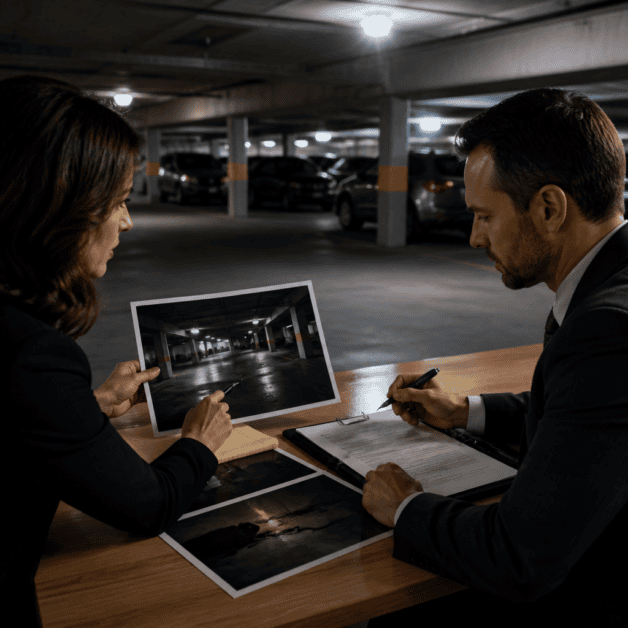
Photos and video of conditions. Lighting levels, broken fixtures, unsecured doors, blind corners, and lack of signage can be documented soon after the assault.
Maintenance and repair records. Work orders showing repeated lighting failures or deferred repairs can be crucial.
Camera system records. Footage (or the absence of footage), camera placement diagrams, retention policies, and proof of nonfunction can show the system was inadequate or not maintained.
Staffing schedules and patrol logs. Who was on duty? Was anyone monitoring cameras? Were patrols actually performed or only “on paper”?
Security expert analysis. In contested cases, experts evaluate CPTED principles (Crime Prevention Through Environmental Design), lighting, sightlines, access control, and industry practices for similar facilities.
Causation: connecting the security failure to the assault
Defendants commonly argue: “A criminal did this; we didn’t.” To win, the plaintiff must show the security lapse was not merely unfortunate, but a meaningful factor that enabled or failed to deter the attack.
Examples of causation arguments that often resonate
Lighting failure enabled concealment. An attacker waited in a dark stairwell or behind a column; adequate lighting would have increased detection and deterrence.
Broken access gate allowed entry. The assailant entered because a vehicle gate was stuck open or a pedestrian door latch failed.
No monitoring delayed response. Cameras existed but were not monitored, or emergency call boxes were nonfunctional, increasing the severity of injuries due to delayed aid.
Known “hot spot” lacked patrols. Prior incidents occurred on a particular level/stairwell, but security routines never changed.
Who can be liable: it’s often more than one entity
Parking garages in New Orleans are frequently owned by one entity, managed by another, and staffed or secured by vendors. A thorough claim identifies every party with control over safety decisions.
Potential defendants
Property owner. The entity that owns the structure and is responsible for capital improvements and major maintenance.
Garage operator/management company. Often controls day-to-day operations, staffing, maintenance requests, and signage.
Security contractor. If guards were hired but negligently trained/supervised, or patrol protocols were not followed.
Event or tenant entities (limited situations). If a tenant controlled a portion of the premises or created dangerous conditions, liability may be investigated.
Damages in a parking garage assault case
Assault injuries can include broken bones, head injuries, lacerations, and long-term impairment. In negligent security claims, damages also frequently reflect psychological harm and safety-related life disruption.
Common categories of compensation
Medical expenses. ER treatment, surgery, rehabilitation, medications, follow-up care.
Mental health treatment. Therapy, psychiatric care, PTSD treatment, sleep disorders, anxiety management.
Lost wages and diminished earning capacity. Time off work, job limitations, career impact.
Pain and suffering. Physical pain and emotional distress.
Scarring/disfigurement and disability. Particularly relevant in violent assaults.
Out-of-pocket costs. Transportation, home modifications, replacement of damaged property (depending on claim structure).
Defenses you should expect (and how claims are strengthened)
Garage owners and insurers typically fight these cases hard. Understanding their defenses helps you preserve evidence early and avoid missteps.
Common defense strategies
“The crime wasn’t foreseeable.” They may argue there were no similar incidents or the area’s crime data is too general.
“We had reasonable security.” Expect them to highlight any cameras, signage, or occasional