
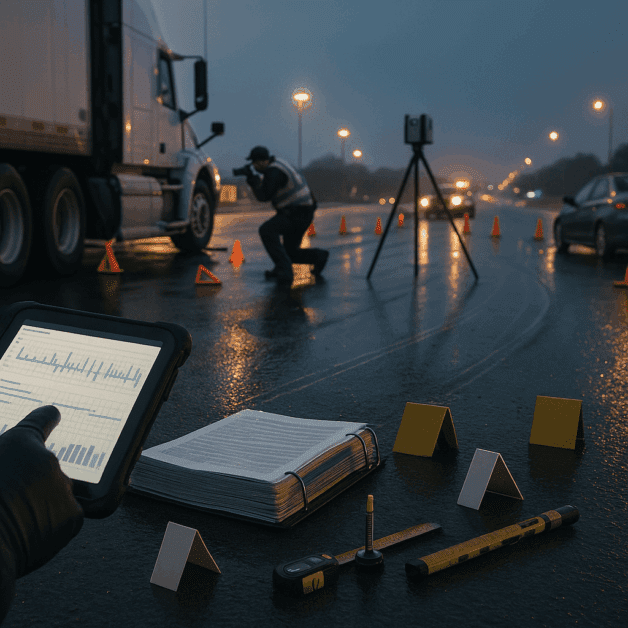
Truck Accidents – Why Federal Rules Can Turn a $50K Case Into a $2M Case
Federal trucking rules (FMCSA) can increase a truck accident case from about $50,000 to $2 million by proving regulatory violations and expanding liability. Driver logs, maintenance records, and carrier safety policies often create stronger negligence evidence and higher insurance coverage. This article explains why trucking crashes differ from car wrecks and how federal rules raise case value.
When a Truck Accident Is More Than Just a Car Crash
Most people assume that a truck accident works the same way as a regular car accident. You file a claim, insurance companies negotiate, and eventually someone gets a check. But that’s not how it works. Truck accidents operate under an entirely different set of rules — federal rules — and those rules can completely change what your case is worth.
A crash that might settle for $50,000 in a typical car accident scenario can grow into a $2 million case when a commercial truck is involved. That’s not an exaggeration. It happens regularly, and understanding why can make all the difference if you or someone you love has been hurt in a trucking accident.
The Federal Regulations That Change Everything
Commercial trucks don’t just follow state traffic laws. They’re governed by a set of strict federal regulations created by the Federal Motor Carrier Safety Administration, also known as the FMCSA. These rules cover almost every part of how a trucking company and its drivers must operate.
When those rules are broken — even partially — it can open the door to serious legal liability. Here are some of the key federal regulations that come into play in trucking cases:
- Hours of Service Rules: Federal law limits how many hours a truck driver can be behind the wheel without rest. Drivers are generally limited to 11 hours of driving after 10 consecutive hours off duty. Violations of these limits are a leading cause of truck accidents due to driver fatigue.
- Electronic Logging Device (ELD) Requirements: Trucking companies must use electronic devices to track driver hours. These devices create a digital paper trail that can be used as evidence in a lawsuit.
- Drug and Alcohol Testing: Commercial drivers must undergo regular drug and alcohol testing. A positive test before or after an accident can dramatically increase a company’s legal exposure.
- Vehicle Inspection and Maintenance Requirements: Trucks must be regularly inspected, and records must be kept. Skipped inspections or ignored maintenance issues can point directly to negligence.
- Cargo Securement Rules: Loads must be properly secured according to federal standards. Improperly loaded cargo is a common cause of accidents and can involve both the trucking company and the shipper.
- Driver Qualification Standards: Companies must verify that their drivers have the proper licenses, training, and clean enough driving records to legally operate a commercial vehicle.
When any of these rules are violated, it doesn’t just show that someone made a mistake. It shows that a company or driver broke a specific federal standard designed to keep people safe. That’s a very powerful thing to be able to prove in court.
Why Federal Violations Make Cases Worth So Much More
There are a few key reasons why federal violations can turn a modest settlement into a major verdict or payout.
1. They Prove Negligence More Easily
In a personal injury case, you typically have to prove that someone was negligent — that they failed to act with reasonable care. When a trucking company violates a specific federal regulation, that violation can be used to establish negligence almost automatically. Instead of arguing about what a “reasonable” truck driver would do, your attorney can point to a specific rule that was broken.
2. They Can Lead to Punitive Damages
This is where cases can really grow. Punitive damages are not meant to compensate you for your injuries. They’re meant to punish the wrongdoer and send a message. Courts award them when a defendant’s behavior is especially reckless or irresponsible.
If a trucking company knew about a driver’s history of hours violations and did nothing, or if they regularly skipped required vehicle inspections to save money, a jury might decide that a simple damages award isn’t enough. Punitive damages in trucking cases can be enormous — sometimes far exceeding the base compensation amount.
3. They Expand Who Can Be Held Responsible
In a car accident, you’re usually dealing with one driver and one insurance policy. Truck accidents are different. Depending on which federal regulations were violated and how, multiple parties can share responsibility:
- The truck driver
- The trucking company
- The company that owns the truck (if different from the carrier)
- The company that loaded the cargo
- Third-party maintenance contractors
- The truck or parts manufacturer (if a defect was involved)
More responsible parties mean more insurance policies and more potential sources of compensation. This is one of the most significant ways trucking cases grow in value.
4. Commercial Insurance Policies Are Much Larger
Federal law requires commercial trucking companies to carry significantly higher insurance minimums than regular drivers. For a standard interstate freight carrier, the minimum required liability coverage is $750,000. Many policies are much larger — often $1 million or more — and some companies carry umbrella policies that go far beyond that.
Compare that to the minimum liability coverage in most states for regular drivers, which is often as low as $25,000 to $50,000. The simple fact that larger insurance policies exist means there’s more money on the table from the very beginning.
The Importance of Acting Fast After a Truck Accident
One of the most critical things to understand about trucking cases is that evidence can disappear quickly. Trucking companies have legal teams and insurance adjusters who respond to serious accidents almost immediately. Their goal is to protect the company — not to help you.
Key evidence in a trucking case includes:
- Electronic logging device data showing driver hours
- GPS and tracking data from the truck
- Dashcam or onboard camera footage
- Driver inspection reports and maintenance logs
- Driver qualification files
- Drug and alcohol test results
- Communications between the driver and dispatch
Trucking companies are required to keep some of this information for a set period, but not all of it and not forever. An experienced trucking attorney can send what’s called a spoliation letter — a formal legal notice demanding that all relevant evidence be preserved. Without this step, important documentation can be erased or destroyed before you ever get a chance to see it.
What Makes Trucking Law Different From General Personal Injury Law
Not every personal injury attorney is equipped to handle a trucking case. These cases require a working knowledge of FMCSA regulations, an understanding of how the trucking industry operates, and the ability to work with expert witnesses like accident reconstruction specialists and trucking industry consultants.
A lawyer who handles mostly slip-and-fall cases or minor car accidents may not know what questions to ask or what records to demand. They might settle your case quickly and cheaply without ever realizing the full scope of what you could have received.
That’s a real risk. Trucking companies know the regulations better than most people do, and they count on accident victims not knowing their rights under federal law. Having an attorney who specializes in commercial vehicle accidents levels the playing field.
Real-World Examples of How Value Grows
To make this concrete, consider a few realistic scenarios:
Scenario 1: Fatigued Driving
A truck driver falls asleep at the wheel and rear-ends your vehicle. You suffer a herniated disc requiring surgery. On its own, your medical bills, lost wages, and pain and suffering might value the case around $100,000. But when your attorney pulls the driver’s ELD data and discovers he had been driving for 14 hours straight — well over the federal limit — the case changes. Now there’s clear evidence of a federal violation, possible punitive damages, and the trucking company is exposed for allowing it to happen. The case could easily reach $500,000 or more.
Scenario 2: Failed Brakes
A truck runs a red light because the brakes fail. Investigation reveals the company had skipped multiple required brake inspections. The maintenance records, which the company tried to destroy, were recovered through a spoliation demand. The driver had also filed a complaint about the brakes two weeks earlier that was ignored. Now you have evidence of both negligence and recklessness. Multiple parties are liable. Punitive damages are on the table. A case that might have settled for $75,000 is now heading toward seven figures.
Scenario 3: Improperly Loaded Cargo
A flatbed truck loses part of its load on the highway, striking your car. Your injuries are moderate, but the cause is significant — the cargo wasn’t secured according to federal requirements. The company that loaded the truck, the trucking company, and the driver all share responsibility. Three parties. Three insurance policies. Suddenly your case has multiple layers of liability and compensation sources it wouldn’t have had otherwise.
How to Protect Yourself After a Trucking Accident
If you’ve been in an accident involving a commercial truck, here are the most important steps to take:
- Get medical attention immediately, even if you feel okay. Some injuries don’t show up right away, and medical documentation is critical to your case.
- Don’t give a recorded statement to any insurance company — including your own — before speaking to an attorney.
- Gather information at the scene if you’re able to: the truck’s license plate, the carrier name and DOT number on the side of the truck, and contact information for any witnesses.
- Contact a trucking accident attorney as soon as possible. Time is a factor with evidence preservation, and the sooner your attorney gets involved, the better your chances of building a strong case.
- Don’t accept a quick settlement offer. Insurance companies sometimes move fast to offer a settlement before you know the full extent of your injuries or before an attorney has reviewed your case. A quick offer is often a low offer.
The Bottom Line
Truck accidents are not the same as car accidents. The federal rules that govern the trucking industry create a legal landscape where violations can dramatically increase the value of a personal injury claim — sometimes by tens or hundreds of thousands of dollars, and in serious cases, by millions.
Understanding trucking law, knowing what evidence to look for, and moving quickly to preserve that evidence are what separate a fair outcome from a life-changing one. If you’ve been hurt in a trucking accident, the single most important thing you can do is work with an attorney who understands commercial vehicle cases and federal regulations inside and out.
Your case may be worth far more than you think — but only if you know how to pursue it.














