
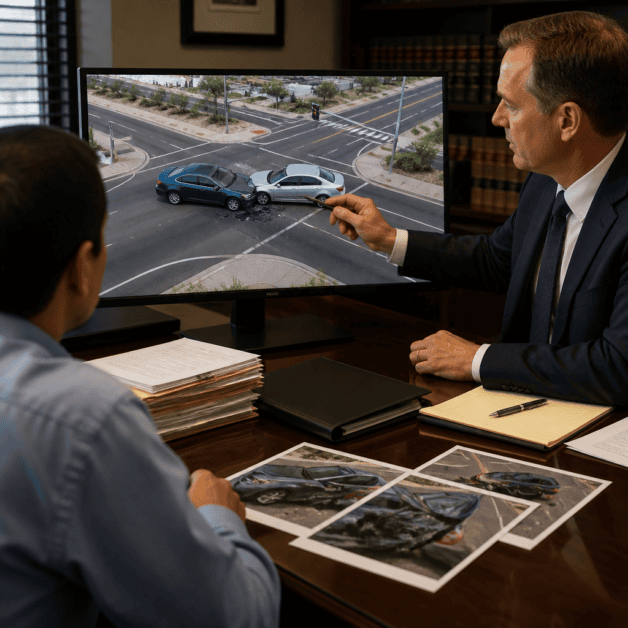
How to Prove Fault After a Left-Turn Car Accident in Phoenix, Arizona
In Arizona, the left-turning driver is at fault in many Phoenix crashes because they must yield to oncoming traffic under A.R.S. § 28-772. Left-turn collisions are common at busy Valley intersections where visibility, speed, and signal timing become disputed. This article explains how fault is proven after a left-turn car accident in Phoenix, what evidence matters most, and how Arizona’s comparative fault rules affect your claim.
Why left-turn accidents are so hard to “prove” in Phoenix
Left-turn crashes often happen in a split second, and the drivers usually tell competing stories: one says they had a protected green arrow, the other says they had a green light and the left-turner “cut them off.” In Phoenix, that dispute matters because fault drives insurance decisions, settlement value, and whether an injured person can recover damages at all.
To prove fault, you’re not trying to reach “certainty.” In most injury claims, the question is whether the evidence shows it is more likely than not that the other driver’s negligence caused the collision and your injuries. The key is building a clear timeline supported by objective evidence—signals, right-of-way rules, physical damage patterns, video, and third-party witnesses.
Arizona right-of-way law for left turns (the foundation of most claims)
In Phoenix intersection cases, the starting point is the right-of-way rule for left turns. Under A.R.S. § 28-772, a driver intending to turn left within an intersection (or into an alley, private road, or driveway) must yield the right-of-way to oncoming traffic that is within the intersection or close enough to pose an immediate hazard.
Practically, that means:
- Unprotected left turn (solid green light): the left-turning driver typically must wait and yield to oncoming vehicles traveling straight.
- Protected left turn (green arrow): the left-turning driver generally has the right-of-way—but only if the arrow was actually green at the time and they completed the turn safely.
- Permissive left turn after arrow ends: once the protected phase ends, the left-turn driver often reverts to yielding duties while oncoming traffic has a green.
Fault usually follows the yield rule. But real cases are rarely that simple because of common “defenses” raised by the turning driver or their insurer—such as speeding, red-light running, or distracted driving by the oncoming driver.
What you must prove to establish negligence after a left-turn collision
Most left-turn claims in Phoenix revolve around negligence. To prove negligence, you generally must show:
- Duty: the other driver had a legal duty to act with reasonable care and follow traffic laws (including yielding when required).
- Breach: they violated that duty (turned left when unsafe, failed to yield, misjudged distance, ran a red arrow, etc.).
- Causation: the breach caused the crash and your injuries.
- Damages: you suffered losses (medical bills, lost wages, pain and suffering, property damage).
Evidence is used to fill in each of these elements—especially breach and causation.
Key evidence that proves fault in a Phoenix left-turn crash
1) Traffic-signal sequencing and intersection design
Signal timing is often the make-or-break issue. The question is not just “who had green,” but whether the left-turn phase was protected (green arrow) or permissive (solid green), and whether it changed as vehicles entered the intersection.
Helpful documentation can include:
- Photos/video showing lane markings and posted signal heads (left-turn arrow vs circular green).
- City or ADOT signal timing plans (in some cases obtainable through records requests).
- Crash reconstruction analysis tied to the light cycle and vehicle speeds.
Phoenix-specific reality: many major intersections (e.g., along Camelback, Bell, Thomas, Indian School, and Central) have complex phasing and dedicated left-turn lanes. Confusion about “stale green” lights and changing arrows is common—so documenting the exact intersection layout matters.
2) Police crash report (useful, but not the final word)
A police report can help establish where the collision occurred, the vehicles involved, witness names, and whether any driver received a citation. If an officer writes that a driver “failed to yield while turning left,” insurers often treat that as strong evidence.
However, police reports have limits:
- Officers usually arrive after the crash and may not see the signal phase.
- Reports can contain errors (wrong lane, wrong direction of travel).
- A lack of citation does not mean lack of fault.
An attorney will typically use the report as a roadmap for evidence—not as the only proof.
3) Video: dash cams, business cameras, and intersection footage
Video is often the clearest way to prove a left-turn fault case, especially when the other driver claims you ran a red light or were speeding.
Common sources in Phoenix include:
- Dash cams (your vehicle, rideshare vehicles, nearby cars).
- Ring doorbells and residential security systems near the intersection.
- Business surveillance (gas stations, convenience stores, banks, strip malls).
Time-sensitive tip: many systems overwrite footage within days. Preserving it quickly—often through a written preservation request—is critical.
4) Independent witnesses (and why “independent” matters)
In left-turn crashes, a neutral witness can break a deadlock. Insurers tend to discount statements from passengers or family members as biased. A witness who stopped and gave contact information, or who is listed in the police report, can help confirm:
- which driver had the green arrow or green light,
- whether the oncoming driver was speeding,
- whether the left-turning driver hesitated then darted across,
- whether a driver was on a phone.
When possible, get a short recorded or written statement quickly while memories are fresh.
5) Vehicle damage patterns and the point of impact
Physical evidence often tells the story when the stories conflict. Examples:
- T-bone to the passenger side of the turning vehicle often indicates the turning driver entered the oncoming lane when it wasn’t clear.
- Front-end damage to both vehicles can suggest both entered simultaneously or one tried to “beat” the other through the turn.
- Damage location (front quarter panel vs rear door) can indicate whether the turning driver was almost through the turn (potentially supporting a “late entry” by the other driver) or cut across early.
Scene photos, tow yard photos, and repair estimates can become important exhibits. In serious-injury cases, accident reconstruction experts may use crush damage, final rest positions, and skid marks to estimate speed and timing.
6) Skid marks, debris field, and roadway evidence
Debris fields, gouge marks, and skid marks help establish:
- the lane of travel,
- whether a driver braked (or never reacted),
- the likely point of impact,
- possible speed issues.
Because Phoenix roadways are heavily traveled and quickly cleared, early documentation is essential. If you can safely do so, take wide-angle and close-up photos from multiple directions.
7) Cell phone and vehicle data (when distraction is suspected)
If there are signs the other driver was distracted—delayed braking, drifting, or inconsistent statements—phone records and in-vehicle data can matter. Modern vehicles may store “event data recorder” (EDR) information such as speed and braking inputs just before impact.
These forms of evidence typically require quick action to preserve and, in some cases, formal legal steps.
Common scenarios and how fault is analyzed
Scenario A: Unprotected left turn vs oncoming traffic going straight
This is the classic case. The left-turning driver must yield under A.R.S. § 28-772. Fault is often straightforward unless the turning driver can show the oncoming vehicle created an “immediate hazard” by speeding excessively or running a red light.
Best evidence: witness statements, dash cam, damage location, and reconstruction if speed is disputed.
Scenario B: Protected green arrow disputed
If the left-turning driver claims they had a green arrow, the central question becomes whether that arrow was actually green at the moment they entered and continued the turn. The oncoming driver may argue the arrow had ended, or that they had a green light and the left-turner turned on a permissive phase.
Best evidence: video, signal timing data, and witness statements from cars stopped at the intersection.
Scenario C: Left turn across multiple lanes (including a center or “suicide” lane)
Turning left across several lanes increases exposure time and often increases the chance of misjudging speed. Insurers may argue the turning driver failed to yield and failed to ensure the turn could be completed safely.
Best evidence: point of impact mapping, lane analysis, and intersection photos.
Scenario D: Oncoming driver was speeding
Speeding can change fault, but it must be proven—not assumed. If the oncoming driver was traveling significantly above the limit, that may support a comparative fault allocation (more on that below) or, in some cases, shift primary blame.














