
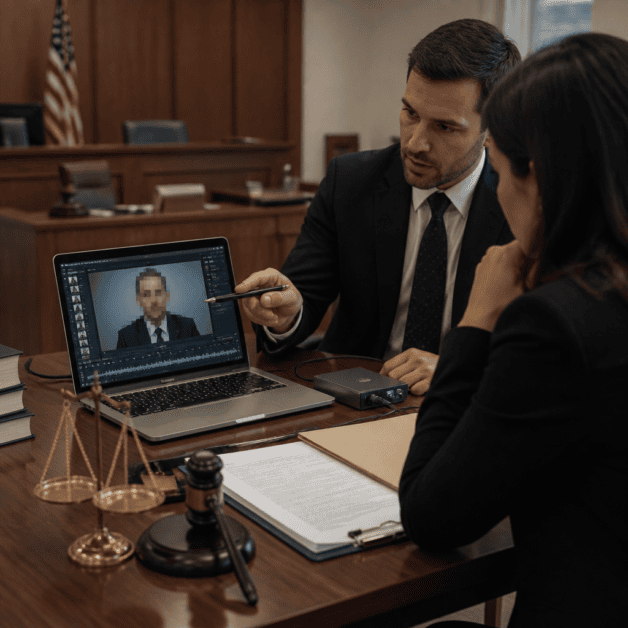
How to Respond to an AI-Generated Deepfake Video Used as Evidence in a California Civil Lawsuit
A suspected deepfake video can be excluded or sharply limited in a California civil case by timely evidentiary objections, targeted discovery, and expert authentication challenges under the Evidence Code. Deepfakes raise unique risks of fabrication, altered metadata, and misleading “reality cues” that can sway juries if not addressed early. This article explains a step-by-step California playbook—from preservation and forensic review to motions in limine and jury instructions—when AI-generated video is offered as evidence.
Why deepfake video evidence is uniquely dangerous in California civil litigation
Video has historically been persuasive because it appears to “speak for itself.” AI-generated and AI-altered videos (deepfakes) undermine that assumption: a clip can look authentic while depicting words, gestures, or events that never occurred. In a California civil lawsuit—employment, business disputes, harassment claims, defamation, personal injury, or probate contests—a deepfake can be offered to prove intent, admissions, threats, misconduct, or notice.
California courts already require authentication, relevance, and a balancing of prejudice versus probative value. Deepfakes don’t create brand-new rules so much as they intensify the need to use existing Evidence Code tools aggressively: authentication challenges, expert testimony, focused discovery, and pretrial motions to keep unreliable or misleading media away from the jury.
Step 1: Lock down preservation and demand the “native” source files immediately
If your client believes the opposing side is using a deepfake, treat it as a high-risk electronic evidence issue and act fast. The earlier you demand preservation and obtain the native materials, the more likely you can (a) prove manipulation, (b) identify the creation pipeline, or (c) show spoliation.
Send a preservation letter tailored to deepfake issues
In addition to standard ESI language, request preservation of:
1) Native video files (original container formats, not screen recordings), including all versions and exports.
2) Source inputs used to generate the video (original photos/videos/audio of the purported speaker, training datasets, reference images, prompt logs, project files).
3) Metadata and chain-of-custody data: file system timestamps, EXIF/XMP where applicable, cloud upload logs, device IDs.
4) Device and platform records: phone/computer used to create or store the file, social media upload data, messaging app transmission logs.
5) AI tool records: any account data for generation tools (e.g., subscription dashboards, watermarking indicators, model/version information, API logs).
Use early discovery to prevent “evidence laundering”
Deepfake proponents often offer a circulated copy (downloaded from a platform or forwarded through messaging) rather than the true original. That creates forensic blind spots. Consider early requests aimed at:
• The first instance of the file in their possession (when/how obtained, from whom, and in what format).
• All intermediaries who transmitted it (third-party subpoenas may be needed).
• The editing history (software names, export settings, filters, enhancement tools).
Step 2: Identify the purpose—what exactly is the video being offered to prove?
Before making objections, pin down the proponent’s theory. Is the video offered as:
• An admission by a party (e.g., “the CEO said it on camera”)?
• Proof of conduct (harassment, threats, intoxication, assault)?
• Impeachment of a witness (“you said this earlier”)?
• Notice/knowledge (e.g., showing a safety issue was visible)?
• Context (background visuals to set the scene)?
This matters because your best exclusion path may be narrower than “the whole video is fake.” For example, you may stipulate to limited background facts while excluding the audio as unreliable, or you may allow a still frame while excluding a manipulated sequence.
Step 3: Attack admissibility under California Evidence Code—start with authentication
Authentication is typically the first pressure point. Under California law, the proponent must produce evidence “sufficient to sustain a finding” that the item is what it claims to be. With deepfakes, the “what it claims to be” issue is often the entire case.
Key authentication angles for deepfakes
1) Chain of custody gaps: Who created it? Who possessed it? How was it stored and transmitted? Each unknown handoff is a chance for alteration.
2) Missing original: If only a compressed repost or screen-recording is produced, argue that it is not a reliable representation of any original and cannot be authenticated as depicting what it purports to depict.
3) Internal inconsistencies: Lip-sync artifacts, lighting mismatch, unnatural blinking, facial boundary warping, audio-visual desynchronization, inconsistent reflections, or “temporal jitter.” These are not definitive alone, but they support the need for forensic scrutiny and undermine “it’s obviously real.”
4) Metadata anomalies: Creation dates inconsistent with the alleged event, editing software fingerprints, missing camera identifiers, or re-encoding history.
Practical courtroom framing
Rather than arguing “deepfakes exist,” present the court with a concrete authentication failure: “Opposing counsel cannot identify the device, the original file, the creator, the edit history, or a witness with personal knowledge that this recording accurately depicts the event.” That shifts the debate from AI hype to foundational proof.
Step 4: Use Evidence Code 352 to exclude misleading deepfake content—even if minimally authenticated
Even if the proponent clears a basic authentication threshold, California Evidence Code section 352 allows exclusion when probative value is substantially outweighed by the probability of undue prejudice, confusing the issues, misleading the jury, or undue consumption of time.
Deepfakes are tailor-made for 352 arguments because:
• “Seeing is believing” creates outsized persuasive impact.
• The risk of juror confusion is high if the jury must evaluate complex AI/forensics without adequate foundation.
• Mini-trials about provenance, model tools, and editing history can consume time—especially when the proponent lacks originals.
Use 352 strategically: the judge may be more comfortable excluding or limiting the evidence under 352 than making a broader “it’s a deepfake” finding at an early stage.
Step 5: Don’t forget hearsay and “implied assertions” in deepfake audio/video
If the video includes spoken words and is offered for the truth of what is said (“I did it,” “I fired her for reporting harassment,” “we agreed to the deal”), hearsay issues arise. Party admissions may be argued, but with deepfakes the threshold question is whether it is truly the party speaking. If authentication is shaky, hearsay objections become more powerful because the proponent cannot establish the declarant’s identity.
Also consider whether the video is being used to smuggle in implied assertions (e.g., showing your client “at the scene” to imply involvement). If the image is synthetic or manipulated, that implication may be more prejudicial than probative.
Step 6: Bring in the right expert—digital forensics first, AI specialist second
Courts tend to respond best to concrete forensic methods: file hashing, metadata extraction, compression analysis, error level analysis, photogrammetry consistency checks, and comparison to known camera profiles. A digital forensics expert can often testify about:
• Whether the file is an original camera output or an edited export.
• Whether timestamps and metadata are consistent with the claimed origin.
• Whether there are signs of multiple encoding passes, splices, or compositing.
• Whether the audio track shows artifacts consistent with synthesis or stitching.
An AI/deepfake specialist can add value when the dispute centers on model-based generation artifacts and probability of synthesis. The most effective pairing is often: (1) forensics expert establishes provenance defects; (2) AI expert explains why those defects align with synthetic generation or manipulation.
Step 7: Discovery requests that matter in deepfake disputes
In California civil discovery, tailor your demands to the creation story. Consider:
Requests for Production for all versions, project files, source media, prompts, and tool logs.
Special Interrogatories asking the proponent to identify the creator, the tools used, dates of creation, and each person who handled the file.
Requests for Admission to lock in positions: that they cannot identify the recording device, cannot produce the native file, or that the file has been edited/exported.
Depositions of the custodian and any “first uploader.” Ask about device settings, storage, transfers, and any enhancement apps.
Third-party subpoenas to platforms or cloud providers for upload logs, original upload filenames, and account identifiers (subject to privacy and statutory limits).
Step 8: Motions that win—motion in limine, protective order, and (when warranted) sanctions
Motion in limine to exclude or limit deepfake video
A pretrial motion in limine is often the best vehicle to keep a deepfake away from the jury. Seek exclusion based on:
• Lack of authentication foundation
• Evidence Code 352 prejudice/misleading jury
• Hearsay (if offered for truth and identity is not established)
• Lack of personal knowledge if a witness is attempting to “authenticate” beyond what they truly know
If full exclusion is unlikely, request limitations: no audio; no references to “confession














