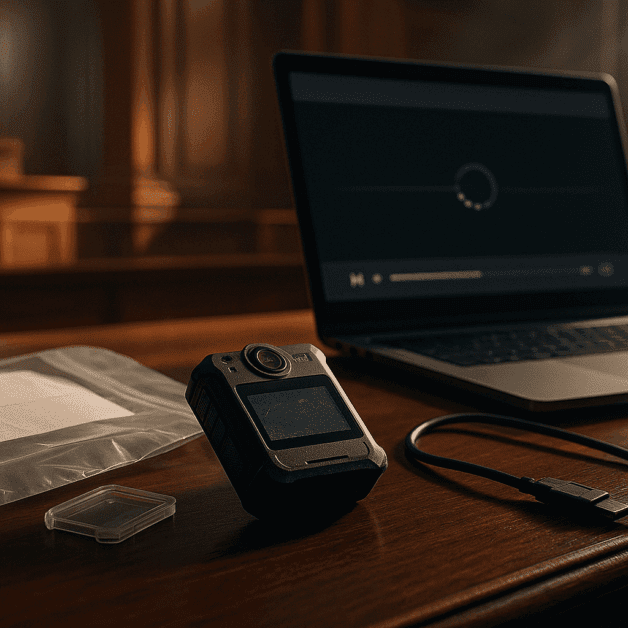
chain of custody

Understanding the chain of custody is crucial in legal proceedings, as it refers to the process of maintaining and documenting the handling of evidence. Visitors to this section will find informative articles, video interviews with legal professionals, and glossary definitions that clarify how the chain of custody impacts the admissibility of evidence in court. Explore resources that delve into best practices and legal standards related to preserving evidence integrity throughout the legal process.

Lawyer filing motion for missing bodycam footage

Bodycam Footage Disappeared? Here’s the Motion Your Lawyer Should File.

Your lawyer should file a motion to preserve and compel production of bodycam footage (and related metadata) and request spoliation sanctions if it was destroyed. Courts can order recovery efforts, adverse-inference instructions, or other remedies when evidence is lost after a duty to preserve. This article explains why footage disappears, what to request, and how […]

Bodycam Footage Disappeared? Here’s the Motion Your Lawyer Should File. Read More »

Evidence handling documentation and tracking process

What is chain of custody?

Chain of custody is a continuous, documented record of evidence control from collection through courtroom presentation, showing no tampering or contamination. It logs each transfer’s who, what, when, where, and how to support admissibility. This article explains the steps, required documentation, and common breaks that can undermine a case. Chain of custody is a critical

What is chain of custody? Read More »

Judge's gavel with evidence files in court

Evidence Handling: Essential Legal Standards Guide

Evidence handling forms the backbone of legal proceedings. From digital evidence handling procedures to vehicle collision evidence analysis, proper protocols ensure admissibility. Key principles include chain of custody, preservation, documentation, and authentication for all evidence types.

Evidence Handling: Essential Legal Standards Guide Read More »

Indiana Personal Injury? Master 3 Key Evidence Preservation Principles to Win Your Case

3 Principles to Evidence Preservation in Indiana Personal Injury Cases

In Indiana personal injury cases, the 3 core evidence preservation principles are document immediately, preserve physical/digital proof, and send preservation (spoliation) letters promptly. Quick action helps prevent lost data, repairs, overwrites, or destroyed items that can weaken liability and damages proof. This article explains practical steps to secure and protect key evidence under Indiana law.

3 Principles to Evidence Preservation in Indiana Personal Injury Cases Read More »

How Tech Impacts Due Process Standards Worldwide Perspectives

How Technology is Changing Due Process Requirements

The fundamental transformation of due process requirements through technological advancement represents one of the most significant shifts in American jurisprudence in recent memory. As courts grapple with novel questions posed by digital evidence, artificial intelligence, and automated decision-making systems, the constitutional guarantees that have long protected individuals from arbitrary government action face unprecedented challenges. These

How Technology is Changing Due Process Requirements Read More »

DNA Proof Issues Trust in Legal Cases Analysis Guide Now

DNA Evidence Challenges: Reliability in Criminal Cases

The promise of DNA evidence in criminal cases has long been heralded as a breakthrough in forensic science, offering the potential for both exonerating the innocent and convicting the guilty with scientific precision. Yet, beneath the surface of this powerful tool lies a complex web of challenges that can undermine its reliability and, in some

DNA Evidence Challenges: Reliability in Criminal Cases Read More »

Essential Proof for Winning Cybercrime Defense Cases

What Evidence is Crucial in Cybercrime Defense Cases?

In the rapidly evolving landscape of criminal law, digital evidence has become the cornerstone of both prosecution and defense strategies in cybercrime cases. As we navigate through 2025, the complexity of these cases continues to increase, with technological advancements creating both new opportunities and challenges for legal practitioners. The critical nature of properly collected, preserved,

What Evidence is Crucial in Cybercrime Defense Cases? Read More »

Maintaining Evidence Chain in Criminal Justice

Chain of Custody: Ensuring Evidence Integrity in Criminal Trials

The chain of custody is a critical concept in the criminal justice system, playing a pivotal role in ensuring the integrity of evidence from the moment it is collected until its presentation in court. This meticulous documentation process serves as a safeguard against tampering, contamination, or mishandling of evidence, thereby upholding the fundamental principles of

Chain of Custody: Ensuring Evidence Integrity in Criminal Trials Read More »

Challenges of Using DNA in Criminal Justice

DNA Evidence in Criminal Cases: Reliability and Challenges

The use of DNA evidence in criminal cases has revolutionized forensic science and the criminal justice system. Since its introduction in the 1980s, DNA analysis has become a powerful tool for both prosecutors and defense attorneys, offering unprecedented accuracy in identifying or exonerating suspects. However, while DNA evidence is often portrayed as infallible, it comes

DNA Evidence in Criminal Cases: Reliability and Challenges Read More »

Scroll to Top