
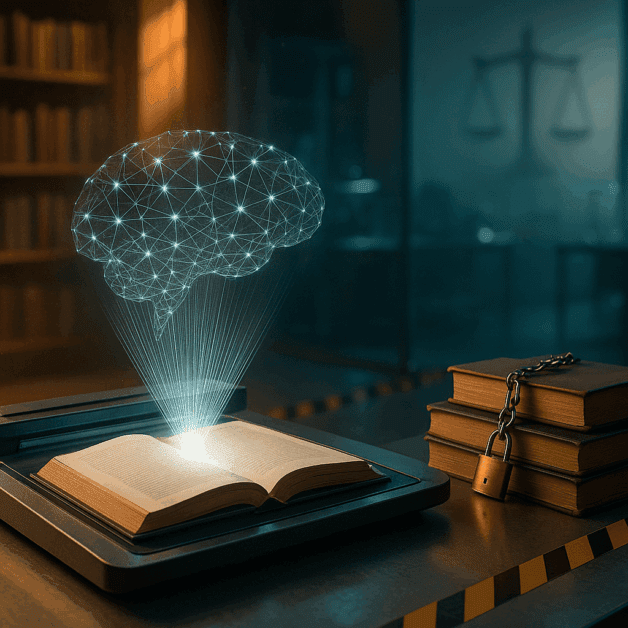
Training an AI on Copyrighted Books Is Fair Use — Until It Isn’t
AI training on copyrighted books can qualify as fair use under the 4-factor test when the use is transformative and doesn’t substitute for the original. It becomes infringement when copying is substantial, used commercially to compete, or outputs reproduce protected expression. This article explains where courts draw the line, key factors, and practical risk for AI developers and authors.
When Does AI Training Cross the Line?
Artificial intelligence has changed the way we think about creativity, writing, and knowledge. But behind every large language model is a massive dataset — and a growing legal question: Can AI companies train their systems on copyrighted books without permission? The short answer is: sometimes yes, sometimes no. And the line between the two is getting harder to draw.
The debate touches on some of the most important concepts in intellectual property law, including the fair use doctrine. Understanding where that line falls matters — not just for tech companies, but for authors, publishers, and anyone who creates original work.
What Is Fair Use, and Why Does It Matter Here?
Fair use is a legal principle in United States copyright law that allows people to use copyrighted material without permission under certain conditions. It was designed to balance the rights of creators with the public’s interest in free expression, education, and innovation.
Courts typically look at four factors when deciding whether something qualifies as fair use:
- The purpose and character of the use — Is it commercial or educational? Does it transform the original work in some meaningful way?
- The nature of the copyrighted work — Is the original work creative or factual?
- The amount used — How much of the original work was taken?
- The effect on the market — Does the new use hurt the original creator’s ability to earn money from their work?
AI companies often argue that training a model on books is “transformative” — meaning the AI isn’t copying the books to reproduce them, but rather to learn patterns, grammar, and ideas. That argument has some legal merit, but it is far from settled.
The Arguments in Favor of Fair Use for AI Training
There is a reasonable case that using books to train AI models falls under fair use. Here is why some legal experts and tech companies believe that:
Transformation Is Key
One of the strongest arguments for fair use is transformation. When a human reads a book and learns from it, they absorb ideas and develop their own style. Supporters of AI training argue that machines do something similar — they analyze text to understand language structure, not to copy the content word for word.
Courts have previously ruled in favor of transformation in high-profile cases. Google’s book scanning project, for example, was ruled to be fair use in part because the company created a searchable index rather than reproducing entire books for readers to consume.
The Output Doesn’t Always Reproduce the Input
AI language models generally do not spit out exact passages from the books they were trained on. They generate new text. If a model reads a million books and produces original sentences, the argument goes that no direct copying has occurred in any meaningful sense.
Broad Access Enables Innovation
Tech companies also argue that restricting AI training data would slow down scientific progress and limit access to useful tools. From this perspective, allowing AI to learn from a wide range of human knowledge — including copyrighted work — benefits society as a whole.
Where the Fair Use Argument Starts to Break Down
Despite these arguments, fair use for AI training is not a guaranteed shield. There are several situations where the doctrine simply does not hold up.
When the AI Reproduces Copyrighted Content
If an AI model can reproduce lengthy, near-identical passages from a copyrighted book when prompted, that is a serious problem. It suggests the model did not just “learn” from the material — it memorized it. This kind of reproduction clearly threatens the market for the original work and is difficult to defend as fair use.
Researchers have already demonstrated that some AI models can reproduce exact text from books they were trained on. This undermines the transformation argument significantly.
When AI-Generated Content Competes Directly With the Original
One of the four fair use factors asks whether the new use hurts the original creator’s market. If an AI is trained on romance novels and then used to generate romance novels that compete directly with those authors, courts may find that the training caused real economic harm.
This is especially relevant for authors who sell their work in digital formats, since AI companies often collected exactly those formats to build their training datasets.
When Entire Books Are Used Without Transformation
Using a small excerpt for commentary or education is different from ingesting an entire novel. The more of a copyrighted work that is used, and the less transformative the use, the harder it becomes to claim fair use. Some AI datasets reportedly include entire books — cover to cover — which makes the fair use defense harder to sustain.
Real Lawsuits Are Already Happening
This is not just a theoretical debate. Authors and publishers have already filed lawsuits against some of the biggest AI companies in the world.
Several well-known authors, including Pulitzer Prize-winning novelists, have joined class action lawsuits against companies like OpenAI and Meta. They claim their books were used to train AI models without consent or compensation. Publishers have also taken legal action, arguing that their catalogs were scraped and used without licensing agreements.
These cases are working their way through the courts, and their outcomes will shape copyright law for years to come. Judges will need to apply old legal frameworks to brand-new technology — and that is never a simple task.
What About Books Sourced From Shadow Libraries?
One of the most controversial aspects of AI training data is where it actually comes from. Investigations have found that some AI companies used datasets that included books sourced from piracy websites — sometimes called “shadow libraries.” These are websites that distribute copyrighted books illegally.
If a company trained its AI on pirated books, even a strong fair use argument becomes much weaker. Using illegally obtained material undermines the entire defense and adds potential liability for copyright infringement on top of any training-related questions.
How Other Countries See This Differently
It is worth noting that fair use is largely an American legal concept. Other countries handle copyright exceptions differently.
- The European Union has specific rules about text and data mining for research purposes, but commercial AI training falls into a grayer area.
- Japan has relatively permissive rules that allow data mining even for commercial purposes, which is one reason some AI development has shifted there.
- The United Kingdom is currently reviewing its approach, with ongoing debates about whether to expand exceptions for AI training or protect creators more strongly.
These differences mean that AI companies operating globally face a patchwork of rules — and what is legal in one country may be infringement in another.
What Authors and Creators Want
Many authors are not necessarily opposed to AI. What they want is a seat at the table. A few key demands have emerged from creator communities:
- Transparency — Authors want to know whether their work was used to train AI models.
- Consent — Many believe their work should not be used without permission, regardless of legal technicalities.
- Compensation — If AI companies profit from tools built on human creativity, some creators argue they deserve a share of that value.
- Opt-out rights — At a minimum, many ask for a clear and easy way to remove their work from future AI training datasets.
Some AI companies have started to respond. A few have announced licensing deals with publishers or created opt-out tools for creators. Whether these efforts are enough remains an open question.
The Bigger Picture for Intellectual Property Law
Copyright law was written in an era when copying meant physically reproducing something — printing a book, making a recording, or distributing a film. The internet already challenged those assumptions. AI has pushed them even further.
The core tension is this: copyright law protects the expression of ideas, not the ideas themselves. AI companies argue they are learning ideas and patterns, not stealing expression. Authors argue that their unique voice and style — the very thing that makes their work valuable — is exactly what AI is capturing and replicating.
Neither side is entirely wrong, and that is what makes this such a difficult legal problem. The courts will have to decide where human creativity ends and machine learning begins.
What Happens Next?
The legal battles over AI and copyright are just getting started. Over the next few years, courts in the United States and around the world will issue rulings that define the boundaries of fair use in the age of artificial intelligence.
Some outcomes to watch for include:
- Rulings on whether AI training counts as transformative use under existing copyright law
- Legislative changes that create specific rules for AI and data mining
- Industry-wide licensing frameworks that set fair compensation for creators
- International agreements that bring some consistency to how different countries handle AI and intellectual property
The stakes are high for everyone involved. For AI companies, restrictive rulings could limit their ability to build and improve their models. For authors and publishers, weak protections could devalue their work and reduce the incentive to create. And for society, getting this balance wrong could either slow innovation or hollow out the creative industries that produce culture, stories, and ideas.
Final Thoughts
Training an AI on copyrighted books can look like fair use — right up until it doesn’t. The difference often comes down to how the training data was sourced, how the AI uses that material, and whether the output competes with the original creators. These are not simple questions, and the law is still catching up with the technology.
What is clear is that the old rules were not written with AI in mind. New frameworks — whether through court decisions, legislation, or voluntary agreements — are needed to protect both innovation and the rights of the people who create the content that makes AI possible in the first place.
Until those frameworks exist, every AI company that trains on copyrighted material is making a legal bet. And some of those bets are going to lose.














