
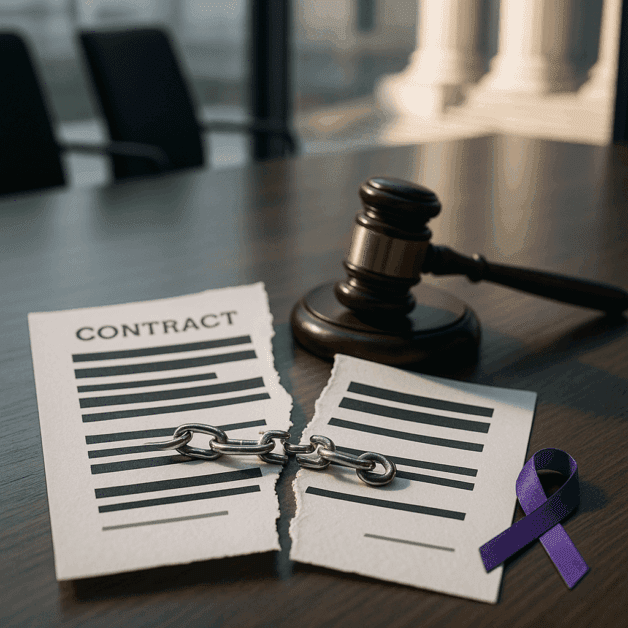
Why Your Arbitration Clause May Not Cover Sexual Assault Claims Anymore
Since March 3, 2022, the Ending Forced Arbitration of Sexual Assault and Sexual Harassment Act lets victims choose court over mandatory arbitration. Employers can’t force arbitration or class-action waivers for covered claims, even if a contract says otherwise. This article explains what arbitration clauses are, what claims are covered, and what to do next.
What Is an Arbitration Clause?
If you have ever signed an employment contract, a service agreement, or even a terms-of-service document, there is a good chance you agreed to an arbitration clause without fully realizing it. These clauses require people to resolve legal disputes through a private process called arbitration rather than going to court. In most cases, this means giving up your right to a jury trial and keeping the outcome confidential.
For decades, arbitration clauses have been a standard part of employment contracts across the United States. Employers often favor them because they tend to be faster, cheaper, and less public than traditional court cases. However, recent changes in arbitration law have started to shift the balance, especially when it comes to claims involving sexual assault and sexual harassment.
The Law That Changed Everything
In March 2022, the United States government passed a significant piece of legislation called the Ending Forced Arbitration of Sexual Assault and Sexual Harassment Act. This law made a major change to how arbitration agreements work in the context of sexual misconduct claims.
Before this law was passed, if you signed an employment contract with an arbitration clause, your employer could generally force you to take any sexual harassment or assault claim to private arbitration. You had very little say in the matter. The new law changed that. Now, if someone has a claim involving sexual assault or sexual harassment, they have the right to choose whether they want to go to court instead of arbitration, regardless of what their contract says.
This applies even if the arbitration clause in the contract is broad and covers all workplace disputes. The law essentially makes those clauses unenforceable for this specific category of claims.
Who Does This Law Protect?
The law covers a wide range of people and situations. Here is a breakdown of who it applies to:
- Employees who have experienced sexual harassment or assault in the workplace
- Independent contractors who work under agreements that include arbitration clauses
- Anyone with a pre-dispute arbitration agreement, meaning an agreement they signed before any incident took place
- Class action participants, since the law also invalidates clauses that prevent people from joining class or collective actions related to these claims
It is worth noting that the person making the claim gets to decide whether to use arbitration or go to court. The employer cannot make that decision for them. This puts the power squarely in the hands of the person who experienced the harm.
Why This Matters for Employment Contracts
Employment contracts are legal documents that set the terms of the working relationship between an employer and an employee. They often include arbitration clauses because employers want to avoid costly and public lawsuits. While arbitration can sometimes be a fair and efficient way to resolve disputes, it has long been criticized for favoring businesses over individuals.
One of the biggest concerns with mandatory arbitration in sexual harassment cases is confidentiality. When cases are settled through arbitration, the results are typically kept private. This means that if a company has a pattern of protecting bad actors, the public may never find out. The #MeToo movement brought this problem into sharp focus, revealing how confidential settlements had allowed serial harassers to continue their behavior for years.
By limiting the legal enforceability of arbitration clauses in sexual misconduct cases, the new law makes it easier for victims to speak publicly about what happened to them and to pursue justice in a more transparent setting.
Does This Law Apply to Old Contracts?
One of the most important questions people ask is whether this law affects contracts they already signed before March 2022. The answer is yes, with some important details.
The law applies to any dispute or claim that arises on or after the date it was enacted, even if the arbitration agreement was signed years earlier. So if you signed an employment contract in 2015 with an arbitration clause, and you experience sexual harassment in 2024, you still have the right to take that claim to court rather than arbitration.
However, if a dispute arose before the law was enacted and arbitration proceedings had already begun, the situation may be more complicated. In those cases, courts may look at the specific facts to determine how the law applies.
What About Other Types of Harassment?
It is important to understand that this law specifically covers sexual assault and sexual harassment claims. It does not automatically invalidate arbitration clauses for other types of workplace disputes, such as wage theft, racial discrimination, or age discrimination.
That said, there is growing momentum in Congress and among advocacy groups to expand these protections. Some lawmakers have proposed similar legislation that would cover other forms of discrimination. Until such laws are passed, arbitration clauses remain largely enforceable for most other types of employment disputes.
If you are dealing with a workplace issue that does not involve sexual misconduct, it is still a good idea to speak with an employment attorney to understand your rights and options.
How Courts Are Handling These Cases
Since the law was passed, courts have had to interpret and apply it in real cases. So far, the general trend has been to follow the law closely and allow plaintiffs to pursue sexual misconduct claims in court even when they signed broad arbitration agreements.
Some employers have tried to argue that certain claims should still go to arbitration, either because the conduct does not meet the legal definition of sexual harassment or because the arbitration clause was part of a different type of agreement. Courts have generally not been receptive to these arguments when the core claim clearly involves sexual assault or harassment.
The law also says that any question about whether the law applies to a particular claim should be decided by a court, not an arbitrator. This is a significant detail because it prevents employers from using arbitration to avoid the question of whether arbitration is even allowed in the first place.
What Should Employees Know Before Signing a Contract?
Even with these new protections in place, it is still important to understand what you are agreeing to when you sign an employment contract. Here are a few practical tips:
- Read the arbitration clause carefully. Understand what types of disputes it covers and what rights you may be giving up.
- Ask questions before signing. If something is unclear, ask for clarification or consult with an attorney.
- Know your rights. Even if a contract includes an arbitration clause, some claims may not be subject to it under current law.
- Keep copies of all agreements. Having a record of what you signed can be important if a dispute arises later.
- Stay informed. Arbitration law continues to evolve, and your rights today may be different from what they were a few years ago.
What Employers Need to Understand
Employers also need to take this law seriously. Including a broad arbitration clause in an employment contract does not mean that clause will hold up in court for every type of dispute. When it comes to sexual assault and sexual harassment claims, that clause is now essentially unenforceable.
Businesses that rely on arbitration agreements to manage legal risk should work with their legal teams to review and update their contracts. More importantly, they should focus on creating safe and respectful workplaces where harassment and assault do not occur in the first place. A strong arbitration clause is not a substitute for good workplace policies and a culture of accountability.
The Bigger Picture
The Ending Forced Arbitration of Sexual Assault and Sexual Harassment Act represents a real shift in how the law treats victims of workplace misconduct. For years, mandatory arbitration kept many stories hidden and many victims without a meaningful path to justice. This law opens a new door.
While it does not solve every problem in employment law, it sends a clear message that some rights are too important to be signed away in a contract. The legal enforceability of arbitration clauses has limits, and those limits are now being defined more clearly by lawmakers and courts alike.
If you believe you have a claim involving sexual harassment or assault at work, speaking with a qualified employment attorney is one of the best steps you can take. The law may be on your side in ways you did not expect, and understanding your rights is the first step toward protecting them.














