How to Challenge AI-Generated Evidence in Los Angeles Superior Court Under California Evidence Code §§ 801–802
In Los Angeles Superior Court, you can challenge AI-generated evidence by forcing the proponent to prove reliability under California Evidence Code §§ 801–802 and by obtaining disclosure of the model’s inputs, methodology, and error rates. As AI summaries, facial comparisons, “risk scores,” and synthetic media increasingly appear in criminal and civil cases, courts are scrutinizing whether the underlying process is trustworthy and explainable. This article explains practical motions, foundational objections, and examination strategies attorneys can use in Los Angeles to exclude or limit AI evidence.
Why California Evidence Code §§ 801–802 are the pressure point for AI evidence in Los Angeles
When an opponent offers AI-generated output—an automated “risk score,” a facial recognition match, an LLM-generated summary, a gunshot detection “confidence” report, or a deepfake “verification” tool—the shortest path to exclusion in Los Angeles Superior Court usually runs through expert admissibility. California Evidence Code §§ 801 and 802 govern opinion testimony by experts and, critically, what an expert may rely on and how they may be examined about that basis.
Section 801 requires that expert opinion be (1) related to a subject sufficiently beyond common experience and (2) based on matter “of a type that reasonably may be relied upon” by experts in the field. Section 802 permits the court to inquire into (and permits opposing counsel to cross-examine on) the reasons for an expert’s opinion and the matter upon which it is based. In practice, §§ 801–802 let you force the proponent to answer: What exactly did the AI do, what data did it see, how accurate is it, and why should this court trust it in this case?
Identify what kind of “AI evidence” is really being offered
Before drafting motions, pin down the evidentiary theory. AI often enters LA Superior Court in one of four ways, each with different objections:
1) AI as an expert’s tool (human expert adopts AI output)
Example: A retained “digital forensic expert” testifies that an LLM analysis shows a defendant’s text messages indicate intent, or that an AI video enhancer clarifies a face. Here, §§ 801–802 apply directly to the expert’s methodology and basis.
2) AI output offered as a business record or official record
Example: A vendor-generated “fraud score” or “shotspotter-style” report is offered as a routine record. Even if hearsay objections are litigated under the business records exception, §§ 801–802 still matter if the proponent uses an expert to interpret or “validate” the system.
3) AI-generated media or analytics offered as demonstrative evidence
Example: An AI-generated animation reconstructing an accident, or an AI “enhanced” surveillance clip. Authentication and potential prejudice are central, but §§ 801–802 can exclude the expert foundation if the generation method is not reliable.
4) AI used in investigations (leads) that later drive human testimony
Example: A detective testifies they identified a suspect after an AI face match “hit.” Even if the AI output itself is not admitted, it can contaminate identification procedures and become discoverable for impeachment and due process arguments.
The core attack under § 801: show the AI method is not “reasonably relied upon” or not reliably applied
Most AI fights are won by reframing them as reliability fights. Under § 801(b), you are not required to prove the AI is “wrong”; you can exclude or limit it by showing the underlying matter is not the kind that experts reasonably rely upon—or that the expert cannot establish why reliance is reasonable in the first place.
In Los Angeles Superior Court, build your § 801 record around concrete reliability factors that judges can evaluate:
Validation and testing
Ask: Has the tool been tested on data similar to the case conditions (lighting, camera angle, language variety, population demographics, noise levels)? A facial recognition system validated on high-resolution booking photos may perform poorly on grainy convenience-store video.
Error rates and confidence metrics
Many AI vendors advertise “accuracy” without disclosing false positive rates (Type I errors) and false negative rates (Type II errors). Push for numbers tied to this use: e.g., “1-in-10,000 false match” claims often do not translate to open-set identification in uncontrolled environments.
Training data provenance and representativeness
Bias and domain shift are reliability issues, not just policy debates. If training data is undisclosed, outdated, or non-representative, the proponent may be unable to establish reasonable reliance.
Explainability and reproducibility
If the system cannot reproduce the result (e.g., model updated, prompt changes, nondeterministic generation), argue it is not a dependable basis for an expert opinion. If the expert cannot explain what features drove the decision, § 801 challenges sharpen: courts are wary of “black box” opinions that cannot be meaningfully tested by cross-examination.
Use § 802 to force disclosure: “show your work” or lose admissibility
Section 802 is your procedural engine. Even where an expert claims they relied on proprietary AI, § 802 allows inquiry into the “reasons” for the opinion and the “matter” relied upon. In practical terms, that means you should seek:
- Model identity and version (vendor, product name, build, update logs).
- Configuration details (thresholds, prompts, parameters, filters, face database size, watchlist composition).
- Input data (the exact files, metadata, compression history, chain-of-custody details, and any pre-processing).
- Output artifacts (scores, heatmaps, embeddings, audit logs, “reason codes,” and intermediate steps).
- Validation materials (benchmarks, test reports, known limitations, bias assessments, vendor white papers).
- Human-in-the-loop steps (who reviewed results, what instructions they followed, whether confirmation bias controls exist).
If the expert cannot provide this information, your theme is simple: the opinion is not testable, not transparent, and therefore not a proper basis for expert testimony under §§ 801–802.
Pretrial playbook in Los Angeles Superior Court: motions that work
1) Motion in limine to exclude or limit AI opinions under §§ 801–802
Bring the issue to the judge before the jury ever hears “the AI matched him.” Seek an order excluding the AI output entirely or restricting testimony to non-AI observations (e.g., “I compared these two images visually” rather than “the system returned a match”).
Request a foundational hearing (often styled as an Evidence Code hearing) requiring the proponent to establish: the tool’s purpose, scientific or technical basis, validation, error rates, and how it was used in this case.
2) Demand a § 402 hearing for foundational facts
Even when the opponent claims the AI output is “just a report,” you can request an Evidence Code § 402 hearing to examine foundational facts outside the presence of the jury—particularly where you anticipate prejudice or confusion.
3) Protective order proposals that still preserve § 802 rights
In LA practice, vendors frequently raise trade secret or confidentiality objections. Consider offering a protective order that permits attorney/expert review, limits dissemination, and allows in camera review—while still insisting on enough disclosure to test reliability. The strategic point: confidentiality is not a substitute for foundation.
4) Discovery motions targeting AI artifacts
In civil cases, seek targeted production: logs, model/version, training and validation documentation, and the precise workflow used. In criminal matters, frame requests around what is necessary to confront and cross-examine the basis for opinion testimony, and to investigate potential misidentification or investigative contamination.
Authentication and “AI-enhanced” media: pairing §§ 801–802 with foundation objections
AI evidence rarely stands alone. It usually rides in on a video, image, or audio file. In Los Angeles Superior Court, you can often combine:
- Authentication challenges (is the exhibit what it purports to be?)
- § 801–802 expert challenges (is the enhancement/analysis reliable?)
- Relevance and prejudice limits (risk of misleading the jury if the “enhanced” clip looks more certain than it is)
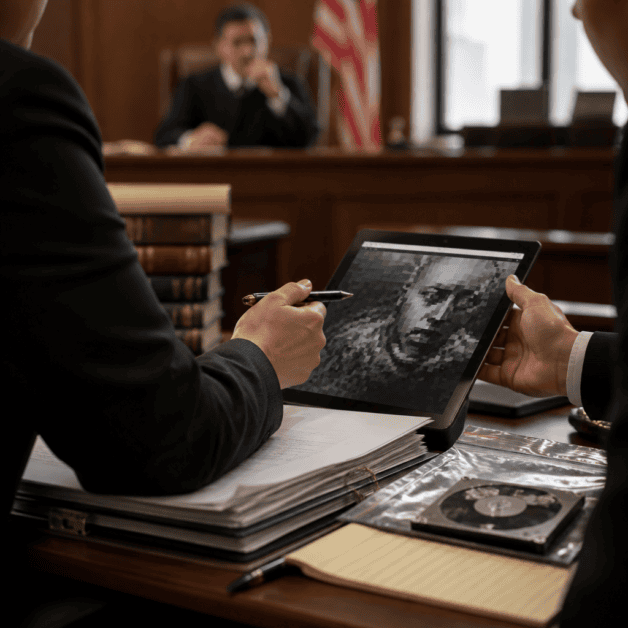
Example: The proponent offers an “AI sharpened” surveillance video to support identity. Your cross should separate the original from the generated pixels. If the enhancement algorithm hallucinates detail or increases apparent clarity without preserving fidelity, argue the exhibit is misleading and the expert’s reliance is not reasonable under § 801.
Cross-examination outline: questions that expose black-box opinions under § 802
Use tight, technical-but-jury-comprehensible questions. The goal is to show the expert cannot explain or validate the system and therefore is asking the court to accept an untestable conclusion.
Foundational competence
“You didn’t design this model, correct? You don’t have access to its training dataset? You cannot describe the feature extraction method in a way that another lab could replicate?”
Versioning and reproducibility
“What version ran this analysis? If we rerun the same input today, will we get the same output? Do you have audit logs showing the exact settings used?”
Error and context
“What is the false positive rate under conditions similar to this video’s resolution and lighting? What is the known performance for people of the defendant’s demographic group? Are you aware of peer-reviewed studies on this system?”
Human decisions and confirmation bias
“Who selected the input image? Who chose the threshold? Did anyone know the suspect’s identity before running the tool? What safeguards prevent the tool from being used to confirm an already-formed conclusion?”
Alternative explanations
“Is it possible the score increases