
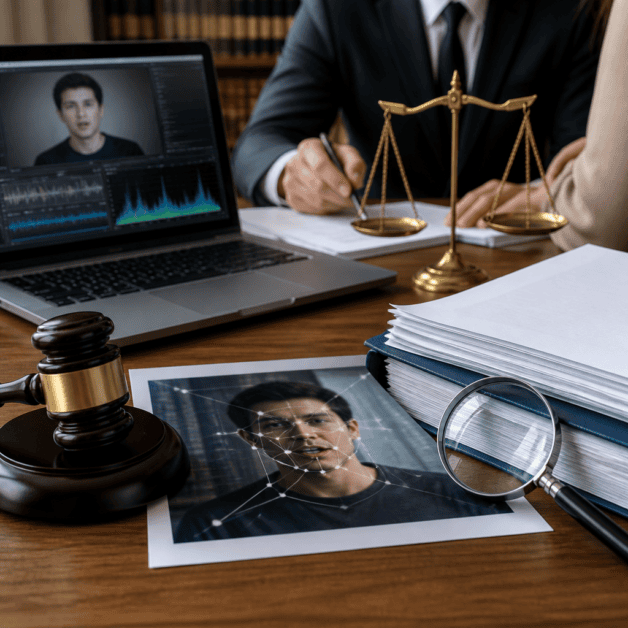
How to Prove Causation and Damages in a Florida AI Deepfake Defamation Lawsuit
Florida deepfake-defamation cases often turn on two proof pillars—(1) causation (the fake caused the harm) and (2) damages (the harm is measurable), and defendants commonly attack both. AI manipulation complicates identity, publication, and “actual malice” evidence, especially when content spreads across platforms. This article explains how Florida lawyers can prove causation and damages in an AI deepfake defamation lawsuit, with practical evidence tactics and claim-specific considerations.
AI deepfakes—synthetic audio, video, or images that convincingly depict a person saying or doing something they never did—create an evidentiary puzzle in defamation litigation. In Florida, the legal standards for defamation are familiar, but deepfakes alter how plaintiffs prove two elements that frequently decide outcomes: (1) causation (the deepfake caused the complained-of harm) and (2) damages (the harm can be proven and valued). Defense strategy often focuses on severing the causal chain (“it wasn’t us,” “it didn’t reach anyone,” “no one believed it,” “your losses came from something else”) and minimizing damages (“no economic loss,” “speculative,” “preexisting reputation issues”).
This guide focuses on how to build a Florida deepfake-defamation case that survives early motions, supports injunctive and monetary relief, and persuades a jury—by constructing a clean timeline, preserving platform evidence, using the right experts, and tying the fake to concrete reputational and economic outcomes.
1) Start with the Florida defamation framework—and map deepfake issues onto each element
In Florida, a defamation plaintiff generally must prove: (1) publication to a third party; (2) falsity; (3) the statement is “of and concerning” the plaintiff; (4) fault (at least negligence for private plaintiffs; “actual malice” for public figures/officials); and (5) damages. Deepfakes impact each element, but causation and damages are where synthetic media creates the most room for dispute.
Deepfake-specific pressure points
Identity attribution: Defendants may claim they didn’t create or upload the deepfake, or that a third-party “source” did. A causation narrative must connect creation, distribution, and amplification to the defendant (or to an actionable actor) with admissible proof.
Audience belief and impact: Because deepfakes can be both highly convincing and quickly debunked, defendants often argue that “no one believed it,” reducing both causation and damages. Plaintiffs should be ready to prove the opposite with engagement metrics, witness testimony, and business records showing real-world consequences.
Platform dynamics: Content can be reposted, remixed, and mirrored. Plaintiffs need a strategy for tracking the spread and linking the harm to the original posting and foreseeable republications.
2) Proving causation: build a time-stamped chain from creation → publication → perception → harm
Causation in defamation is not just “the statement existed.” You must show that the publication caused the plaintiff’s reputational, emotional, or economic injuries. Deepfakes invite alternative explanations (a prior scandal, market downturn, termination for unrelated reasons), so the best approach is to build a chronological “causation storyboard” supported by hard evidence.
A. Lock down the publication record (who published what, where, and when)
Preservation letters: Immediately send litigation hold/preservation demands to suspected creators, posters, employers, and relevant third parties. In parallel, send preservation requests to platforms (even if they resist) and be prepared to subpoena records.
Forensic captures: Use tools and protocols that reliably capture URLs, timestamps, post IDs, and metadata (screenshots alone are often attacked). Consider third-party forensic capture services and store hash values to show integrity.
Subpoenas and records: Target records that establish the chain of publication:
- Account registration and login IP logs (where obtainable)
- Upload timestamps and device/browser identifiers
- Direct messages coordinating posting
- Monetization records (ad revenue, sponsorships, affiliate links)
- Moderation/flagging logs that show the platform recognized the content as synthetic or harmful
B. Prove “of and concerning” despite synthetic media ambiguity
Deepfakes often blur faces, alter voices, or add disclaimers. To establish that the content was about the plaintiff, collect:
- Comparative imagery: side-by-side facial feature analysis, voice comparisons, distinctive mannerisms
- Context cues: captions, hashtags, names, workplace references, location tags
- Audience reaction evidence: comments tagging the plaintiff, messages asking “Is this you?”, or threats referencing the content
Lay witnesses can help: colleagues, clients, or family who recognized the plaintiff and can testify that viewers associated the deepfake with the plaintiff.
C. Establish foreseeability of republication and the “spread” narrative
In online defamation, harm often occurs through reposts. To strengthen causation, show that republication was a foreseeable consequence of the initial posting—especially where the defendant used viral formats, targeted hashtags, paid promotion, or sent the content to journalists, employers, or business partners.
Practical proof includes:
- Analytics: views, shares, repost counts, engagement spikes
- Referral data: links showing the deepfake originated from or traced back to the defendant’s account or website
- Paid amplification: receipts for ads/boosts, influencer outreach, or coordinated posting
D. Show audience belief and reputational impact (the “it fooled people” evidence)
Defendants will argue the deepfake was “obvious satire,” “clearly AI,” or quickly debunked. Plaintiffs should compile evidence that real people believed it or treated it as true:
- Witness testimony from people who initially believed the deepfake
- Customer/client communications referencing the allegation as fact
- Internal employer communications showing concern or reliance
- Media inquiries, interview cancellations, rescinded offers
Example: A Florida physician is deepfaked admitting to insurance fraud. The doctor can prove causation with (1) patient portal messages canceling appointments “because of the video,” (2) insurer emails requesting audits, (3) staff testimony about daily call volume changes after the post, and (4) engagement analytics showing the video spiked locally after being shared in community groups.
E. Address alternative causes head-on with “but for” documentation
Expect defenses like: “Your business dropped due to seasonality,” “You were already being investigated,” or “You were terminated for performance.” Counter by:
- Pre/post comparisons using business records (revenue, leads, cancellations)
- Customer surveys or declarations identifying the deepfake as the reason for withdrawal
- HR timelines and performance reviews showing no preexisting termination plan
- Market data to isolate broader economic trends
3) Proving damages in Florida: choose the correct damages model for the claim
Damages in Florida defamation can include reputational harm, emotional distress, and economic losses. The proof approach depends on whether the case is treated as defamation per se, whether the plaintiff is a private person or public figure, and whether the defendant’s conduct supports punitive damages.
A. General damages: reputational harm that is real, concrete, and provable
Even when reputational harm is not easily reduced to a spreadsheet, plaintiffs should treat it as provable. Strong proof includes:
- Testimony from community members, clients, colleagues, and industry peers
- Evidence of changed treatment: exclusion from events, loss of referrals, damaged professional relationships
- Online sentiment shifts: before/after sentiment analysis (with methodology disclosed)
- Volume and nature of harassment: threats, doxxing incidents, reputational attacks referencing the deepfake
In deepfake cases, the “vividness” of video/audio can intensify reputational damage. Consider retaining a reputational harm expert to explain how synthetic media increases believability and accelerates social spread.
B. Special damages: quantify economic loss with business records, not estimates
Special damages typically require specificity. Build a damages file anchored in contemporaneous records:
- Lost income: pay stubs, contracts, 1099s, tax returns, client invoices
- Lost deals/opportunities: term sheets, emails, cancellation notices, CRM logs
- Increased costs: PR crisis management invoices, security expenses, platform monitoring services
- Future loss capacity: vocational expert and economist projections when career harm is lasting
Example: A Miami real estate broker is deepfaked using racist slurs. Damages proof can include (1) broker’s transaction pipeline records showing deals that collapsed after the deepfake circulated, (2) client emails stating they will not work with the broker because of the “video,” and (3) expert testimony projecting lost commissions based on historical conversion rates.
C. Emotional distress and consequential harms
Deepfake defamation commonly triggers severe emotional distress due to humiliation, fear, and harassment. Plaintiffs should document:
- Medical and therapy records (when applicable)
- Sleep disruption, anxiety, safety planning, relocation
- Family impact and daily-function limitations (corroborated by witnesses)
Even where privacy concerns exist, counsel can seek protective orders to limit disclosure while preserving admissibility.
D. Punitive damages: preserve evidence of intent, knowledge, and concealment
In Florida, punitive damages require a heightened showing tied to intentional misconduct or gross negligence, and procedural steps often apply. Deepfake cases may support punitive damages where evidence shows deliberate fabrication, targeted distribution, or coordinated harassment—especially when the defendant knew it was false and acted to maximize harm.
Evidence that can support punitive theories includes:
- Prompt














