
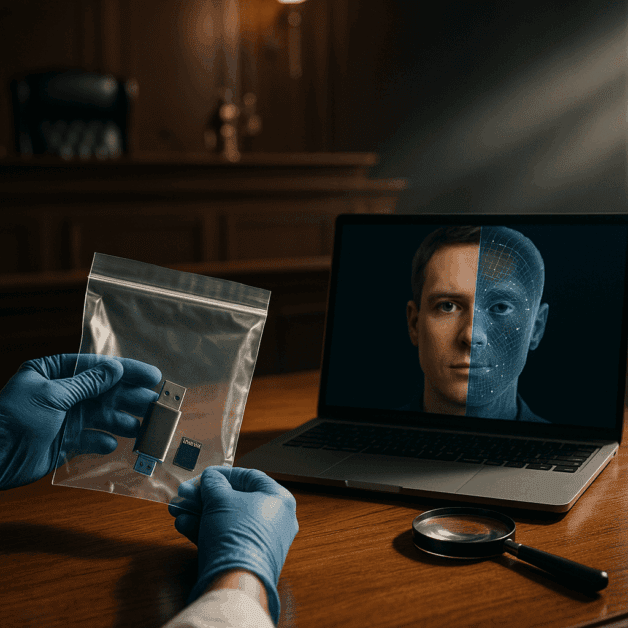
How to Challenge an Opponent’s AI-Generated Evidence in California State Court (2026 Guide)
Challenging AI-generated evidence in California state court typically requires 5 moves: early preservation demands, targeted discovery, authentication objections, expert-driven reliability attacks, and tailored motions in limine. California’s Evidence Code and Civil Discovery Act already provide strong tools to expose how a model produced (or fabricated) an output. This guide explains practical objections, discovery requests, expert angles, and motion practice attorneys can use in 2026.
Why AI-Generated Evidence Is Different (and Why California Courts Still Have the Tools)
AI is now showing up in California state cases as screenshots of chatbot answers, “AI-written” summaries of medical records, synthetic audio/video (deepfakes), automated translation, and vendor-produced “risk scores” or analytics. The opposing side may frame these materials as neutral “technology,” but in evidentiary terms they are usually one (or more) of the following: (1) a writing of uncertain authorship, (2) a computer-generated output dependent on undisclosed inputs, (3) an out-of-court statement offered for its truth, or (4) a demonstrative with a misleading aura of precision.
The good news for litigators is that California doesn’t need a brand-new “AI evidence code” for you to challenge these exhibits effectively. The Evidence Code’s authentication rules, hearsay framework, expert testimony provisions, and the Civil Discovery Act’s ESI tools are already designed to force a proponent to show what something is, who created it, how it was generated, and why it’s reliable.
Step 1: Identify the Category of AI Evidence (Your Objection Strategy Depends on It)
Before you draft objections or discovery, classify what the opponent is actually offering. Different AI artifacts trigger different foundational burdens.
Common AI evidence buckets
1) Generative text outputs (chatbot responses, AI “investigations,” AI-written emails or memos). These often raise authentication, hearsay, relevance, and unfair prejudice concerns.
2) Synthetic media (deepfake video, voice cloning, altered images). These are primarily authentication and integrity disputes, often requiring expert analysis.
3) Automated summaries and “smart” document review outputs (AI-created timelines, privilege logs produced by AI, clustering results). Often challenged as demonstratives, hearsay, best-evidence issues, and improper expert opinion if a non-expert tries to sponsor them.
4) Algorithmic scores (fraud risk scores, propensity or “likelihood” analytics). These commonly implicate expert testimony, foundational reliability, and potential bias/opacity arguments.
Once you know which bucket you’re in, you can tailor (a) the foundation you demand, (b) what discovery you pursue, and (c) whether you attack admissibility, limit use, or both.
Step 2: Force the Proponent to Authenticate the AI Output Under California Evidence Code
In California state court, authentication is often the fastest way to shrink or exclude AI-generated exhibits. As a baseline, evidence must be authenticated before it is received. For writings, California Evidence Code section 1401 generally requires authentication by evidence sufficient to sustain a finding that it is what the proponent claims.
Authentication pressure points for generative AI text
If an opponent offers a screenshot of a chatbot answer (e.g., “ChatGPT said the industry standard is X”), demand clarity on:
Who prompted the model (identity, access credentials, device), when it happened, and what prompt text was used (including system prompts or “custom instructions,” if any).
Whether the output is complete (full conversation thread versus selective excerpt) and whether it was edited before capture.
Which model/version was used, whether the model had browsing enabled, and whether it referenced external sources.
Chain of custody for the screenshot and the underlying conversation logs.
Authentication is not just “it looks like a chatbot.” You are entitled to test whether the exhibit is a faithful capture of a particular interaction, and whether that interaction is attributable to a person with knowledge (or is being offered as machine “truth”).
Authentication pressure points for deepfakes and altered media
With video/audio/images, press the proponent to establish integrity: original file format, hash values, metadata, device provenance, transfer history, and whether any AI-based enhancement, denoising, face-swapping, or voice conversion occurred. If the opponent cannot produce the native file (and only has a social-media rip or screen recording), argue the foundation is deficient and the risk of manipulation is high.
Step 3: Use Hearsay (and “Machine Statement” Confusion) to Your Advantage
Opponents frequently try to smuggle AI outputs in as “not hearsay” because “a machine said it.” But the hearsay analysis often turns on whether a human assertion is embedded in the output (prompt content, training data reflected as factual claims, or the proponent’s selection/curation), and whether the output is being offered for its truth.
Common hearsay scenarios
Chatbot answer offered as factual proof. Example: In a trade-secret case, the plaintiff offers an AI response stating “Company A’s process is patented and publicly known.” If offered to prove the process is public, you have a hearsay problem (and a foundation problem), plus potential improper expert opinion if used as technical authority.
AI summary offered as a substitute for underlying records. Example: Defense offers an “AI-generated medical chronology” to prove treatment dates. If offered for truth, it’s hearsay unless a valid exception applies; it also invites best-evidence objections when the source records are available.
AI-translated messages. Treat the translation as a “statement” whose accuracy must be established—often through a qualified translator or an expert familiar with translation tools and error rates for the language pair and context.
Even if a court is inclined to treat some “computer-generated” data as non-hearsay, you still attack reliability, authentication, and Evidence Code section 352 unfair prejudice/misleading effect.
Step 4: Demand ESI Discovery Tailored to AI Creation, Not Just the Final Exhibit
AI evidence is typically the end product of a pipeline: prompts, data sources, settings, plugins, model version, and post-processing. Your discovery plan should target the pipeline.
High-yield discovery targets
Requests for Production (RFPs): seek the full prompt/response transcript; account logs; export files; audit logs; settings; “custom instructions”; plugin/browsing history; and any post-generation edits (including copy/paste into Word, redlining, or rewriting).
Interrogatories: demand identification of the tool, vendor, version, who operated it, and each data source used (uploaded PDFs, links, databases, prior documents).
Requests for Admission (RFAs): pin down concessions such as “You cannot reproduce the output using the same prompt today,” “You do not possess the native file,” “The exhibit was edited,” or “No validation was performed for accuracy.”
Depositions: depose the operator (the person who typed the prompt), the custodian, and any vendor representative if the opponent intends to rely on the vendor’s process or score.
Ask for reproducibility
A critical AI weakness is non-reproducibility. Many systems change over time (model updates, randomness/temperature settings, retrieval sources). Discovery should require the proponent to disclose whether the output can be reproduced, and under what conditions. If it cannot, argue heightened scrutiny: the opponent is offering a one-off artifact that cannot be meaningfully tested.
Preservation letters and spoliation angles
Send a preservation demand early that specifically calls out AI-related sources: chat logs, prompt histories, vendor portals, cloud accounts, exported conversation IDs, and native media files. If the opponent deletes a chat history or fails to preserve native files while planning to use AI outputs at trial, you may have spoliation arguments and leverage for sanctions or evidentiary preclusion, depending on the facts and the court’s inherent authority and discovery enforcement powers.
Step 5: Use Expert Testimony to Turn “Black Box” Mystique into Admissibility Problems
Many AI exhibits are presented with an implicit claim of technical authority. A qualified expert can help the court understand why the output is not a measurement but a probabilistic text generator; why synthetic media can be difficult to authenticate; and why “AI summaries” can silently drop exceptions, dates, or negations.
Where experts matter most
Deepfake detection and media forensics: an expert can analyze metadata inconsistencies, compression artifacts, frame interpolation, voice conversion artifacts, and chain-of-custody gaps.
LLM reliability and hallucination risk: an expert can explain that generative models may produce plausible but false statements, especially when prompted with leading questions or incomplete data.
Algorithmic scoring systems: if a party wants to use a risk score as proof of misconduct, an expert can challenge validation, bias, error rates, and whether the system was designed for the context at issue.
Even when the opponent does not disclose their vendor’s internal model, an expert can still critique methodology and testing. The key is to translate AI skepticism into admissibility: missing foundation, untested assumptions, and a high risk of misleading the trier of fact.
Step 6: File Motions in Limine That Target Specific Evidentiary Defects (Not “AI Is Bad”)
Judges are more receptive to focused motions than broad attacks on AI. Your motion in limine should map each defect to a concrete ruling: exclude, limit purpose, require foundation outside the jury’s presence, or require production of underlying materials.
Useful motion themes
1) Lack of authentication and incomplete chain of custody. Ask the court to require the proponent to establish: prompt, operator, model/version, full transcript, and integrity of capture.
2) Hearsay and improper expert opinion. If the proponent wants to use AI text as authoritative factual proof, argue it is an out














