
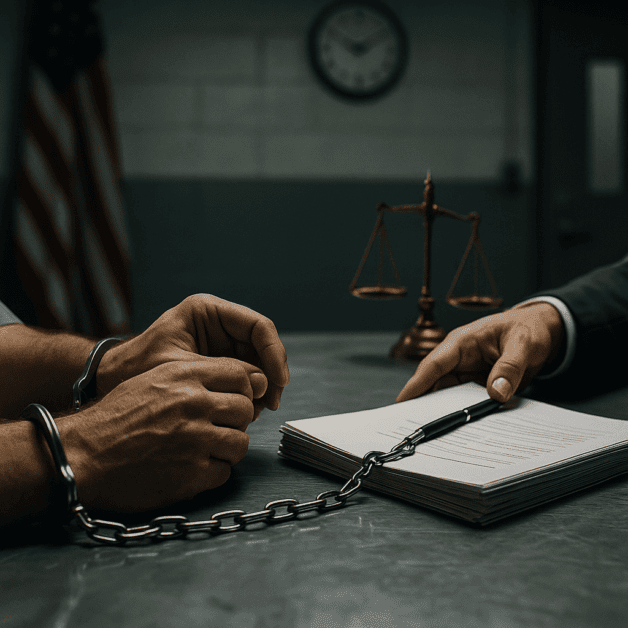
The Plea Bargain Trap – Why 95% of Defendants Take a Deal
About 95% of criminal cases end in a plea bargain rather than a trial. Defendants often take deals to avoid harsher sentences, stacked charges, and the uncertainty of trial. This article explains how plea bargaining works, why the pressure is so strong, and what to consider before accepting a plea.
What Is a Plea Bargain?
If you’ve ever watched a courtroom drama on TV, you’ve probably heard the term “plea bargain” thrown around. But what does it actually mean in real life? A plea bargain is an agreement between a defendant and a prosecutor. The defendant agrees to plead guilty to a charge — sometimes a lesser one — in exchange for a lighter sentence or the dropping of other charges. It sounds straightforward, but the reality is far more complicated.
The American criminal justice system is built on the idea of a fair trial by jury. Yet the overwhelming majority of criminal cases — roughly 95% — never make it to trial. They end with a plea deal. That number should make you stop and think. Why are so many people choosing to skip the very process designed to protect them?
The Numbers Behind the Plea Deal System
Let’s talk about the scale of this. According to data from the U.S. Department of Justice, more than 90% of all federal convictions come from guilty pleas. In state courts, that number climbs even higher, reaching around 95% or more in many jurisdictions. This means that for every 100 people charged with a crime, fewer than 5 will actually stand before a jury.
This isn’t just a modern trend. Over the past several decades, the rate of plea bargaining has steadily increased as courtrooms have grown more crowded and the legal system has become more complex. The trial has become the exception, not the rule. And that shift has enormous consequences for defendants, victims, and the justice system as a whole.
Why Do So Many Defendants Take a Deal?
To understand why so many people accept plea deals, you have to understand what they’re up against. The decision to take a plea or go to trial is rarely a free or simple choice. It’s shaped by fear, pressure, limited resources, and a legal system that can feel impossible to navigate without expert help.
The Risk of Going to Trial
Going to trial is a gamble. Even if you believe you are innocent, a jury might not see it that way. Prosecutors carefully build their cases, and the evidence presented in court can be overwhelming — even if some of it is circumstantial. If a defendant is convicted at trial, they often face a much harsher sentence than what was offered in the plea deal. This is sometimes called the “trial penalty,” and it is very real.
For example, a prosecutor might offer a defendant two years in prison through a plea deal. But if that same defendant goes to trial and loses, they could face ten years or more. That gap is terrifying. For many people, taking the sure thing — even if they didn’t commit the crime — seems like the safer option.
The Pressure of Pretrial Detention
Not everyone can afford bail. Many defendants sit in jail for weeks, months, or even years while waiting for their trial date. During that time, they may lose their jobs, their housing, and their connection to their families. A plea deal that results in time served or probation can mean walking out of jail the same day. For someone already behind bars, that offer can be almost impossible to refuse — even if they are innocent.
The Cost of Legal Defense
Hiring a private defense attorney is expensive. A serious criminal case can cost tens of thousands of dollars to defend properly. Most defendants can’t afford that. Those who qualify for a public defender get legal representation, but public defenders are often stretched incredibly thin, handling dozens or even hundreds of cases at a time. They simply don’t have the hours needed to fully investigate every case and prepare for trial. In many situations, accepting a plea deal is the most practical path forward — not because it’s the right outcome, but because the resources for a proper defense just aren’t there.
How the Negotiation Strategy Works
Plea bargaining is, at its core, a negotiation. And like any negotiation, the side with more power tends to win. In most cases, that side is the prosecution.
Prosecutors hold something called “charging discretion.” That means they get to decide what charges to file, and they can often pile on multiple charges at once — a practice sometimes called “charge stacking.” The more charges a defendant faces, the higher the potential sentence if convicted at trial. This gives prosecutors enormous leverage when offering a plea deal.
Here’s how the process typically unfolds:
- Charges are filed: The prosecutor files charges, sometimes multiple counts, to maximize the potential sentence.
- An offer is made: The prosecutor offers to reduce the charges or recommend a lighter sentence in exchange for a guilty plea.
- The clock ticks: Defendants are often given a limited time to accept the offer before it’s withdrawn or reduced to something less favorable.
- A decision is made: The defendant, usually in consultation with their attorney, decides whether to accept or reject the deal.
The negotiation strategy used by prosecutors is designed to make the plea deal look like the smart choice. And in many cases, it is. But that doesn’t mean the system is always fair.
The Legal Consequences of Pleading Guilty
When someone accepts a plea deal, they are pleading guilty to a crime. That comes with consequences that go far beyond whatever sentence is handed down in court. Many people don’t fully understand these long-term effects until after they’ve already signed on the dotted line.
A Permanent Criminal Record
A guilty plea creates a criminal record. Depending on the crime, that record can show up in background checks for jobs, housing applications, and professional licenses. Even a misdemeanor conviction can close doors that a person didn’t even know existed. For non-citizens, a guilty plea can trigger immigration consequences, including deportation.
Loss of Civil Rights
In many states, a felony conviction — including one resulting from a plea deal — means losing the right to vote, the right to own a firearm, and in some cases, the right to serve on a jury. These aren’t small things. They affect a person’s ability to participate fully in society for years, sometimes for life.
The Collateral Damage
Beyond the legal penalties, a conviction can damage relationships, limit educational opportunities, and affect a person’s mental health. The stigma of having a criminal record follows people long after they’ve served their time. Many defendants don’t fully grasp this when they’re sitting across from a prosecutor, trying to decide whether to take a deal.
Innocent People and Plea Deals
Perhaps the most troubling aspect of the plea bargain system is this: innocent people take plea deals too. Studies and exoneration records have confirmed this repeatedly. The Innocence Project, which works to overturn wrongful convictions through DNA evidence, has documented numerous cases where innocent defendants pleaded guilty simply because the risks of going to trial were too high.
Think about that for a moment. Someone who did nothing wrong chooses to say they did — because the system makes that the safer option. This is one of the most serious flaws in modern criminal procedure, and it raises important questions about whether the current system is truly delivering justice.
Is the System Broken?
Critics of the plea bargain system argue that it has essentially replaced the trial system with a backroom negotiation process. Defense attorneys, prosecutors, and judges all know how the game works. Defendants — especially those without legal experience or resources — often don’t.
Supporters of the system say plea deals are a necessary part of keeping the courts functioning. If every case went to trial, the system would collapse. There simply aren’t enough judges, courtrooms, or public defenders to handle that volume. Plea deals allow cases to be resolved quickly, which keeps the system moving.
Both sides have a point. The real problem isn’t that plea deals exist — it’s the conditions under which they happen. When defendants are pressured, under-resourced, and facing the threat of a crushing sentence at trial, the “choice” to take a deal isn’t really a free choice at all.
What Can Defendants Do?
If you or someone you know is facing criminal charges, understanding how the plea bargain process works is the first step. Here are some practical things to keep in mind:
- Don’t rush: Prosecutors often create a sense of urgency to pressure defendants into accepting deals quickly. Take the time to fully understand what you’re agreeing to.
- Know the full consequences: Ask your attorney to explain not just the sentence, but all the long-term legal consequences of pleading guilty, including effects on immigration status, employment, and civil rights.
- Get legal help: Even if you can’t afford a private attorney, make sure you have access to a public defender and that they have enough time to properly review your case.
- Explore all options: Sometimes charges can be challenged, evidence can be suppressed, or deals can be negotiated more favorably. Don’t assume the first offer is the best or only option.
- Understand your rights: You have the right to a trial. That right doesn’t disappear just because a plea deal is on the table.
Final Thoughts
The plea bargain system is a powerful and deeply embedded part of criminal procedure in the United States. It resolves the vast majority of criminal cases, keeps courts from being completely overwhelmed, and in many situations, results in fair outcomes for defendants. But it also carries serious risks — especially for those who are poor, uninformed, or innocent.
When 95% of defendants take a deal, it’s worth asking whether that reflects a system working as intended or a system that has made the alternative too frightening to consider. The answer probably lies somewhere in between. But for anyone caught up in the criminal justice system, understanding how plea deals work — and what they really cost — is not just useful. It could be one of the most important things you ever learn.














